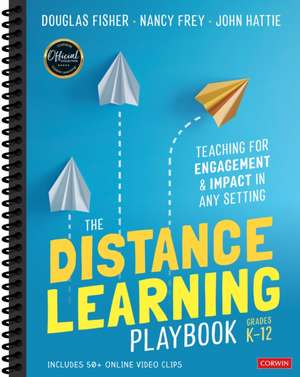
The Distance Learning Playbook, Grades K-12
Autor Douglas Fisher, John Hattie, Nancy Freyen Limba Engleză Paperback – 17 aug 2020
În literatura pedagogică recentă, a existat o lacună majoră între metodele de predare de urgență, impuse de criza sanitară din 2020, și fundamentele riguroase ale învățării la distanță sustenabile. The Distance Learning Playbook, Grades K-12 vine să umple acest gol, oferind cadrelor didactice instrumentele necesare pentru a trece de la improvizație la o proiectare instrucțională bazată pe dovezi. Reținem că acest volum nu este un simplu manual tehnic, ci o adaptare a celebrului cadru Visible Learning al lui John Hattie pentru mediul virtual, punând accent pe impactul real asupra elevului. Structura cărții este organizată riguros în module care ghidează cititorul de la auto-îngrijirea profesorului și stabilirea normelor în primele zile de școală, până la designul site-ului clasei și gestionarea relațiilor profesor-elev la distanță. Găsim în acest ghid o progresie logică: fiecare modul începe cu obiective clare („Learning Intentions”) și se încheie cu criterii de succes, oferind un model de bune practici pe care profesorii îl pot replica la clasă. Față de On-Your-Feet Guide: Distance Learning by Design, Grades 3-12, care oferă strategii rapide de intervenție, acest titlu reprezintă o alternativă mai profundă pentru cursurile de formare continuă, având avantajul integrării resurselor video și a spațiilor dedicate reflecției și planificării. Autorii Douglas Fisher și Nancy Frey continuă aici temele explorate în Engagement by Design sau Teaching Literacy in the Visible Learning Classroom, Grades K-5, dar le recalibrează pentru mediul online. Merită menționat că volumul nu ignoră dificultățile practice, dedicând secțiuni speciale pentru educația timpurie și menținerea echității în accesul la educație.
Preț: 231.75 lei
Carte disponibilă
Livrare economică 26 octombrie-09 noiembrie
Livrare express 09-15 octombrie pentru 39.66 lei
Specificații
ISBN-10: 1071828924
Pagini: 208
Dimensiuni: 231 x 276 x 20 mm
Greutate: 0.58 kg
Ediția:1
Editura: Sage Publications, Inc
Locul publicării:Thousand Oaks, United States
V-ar putea interesa
-
 Using Comic Art to Improve Speaking, Reading and WritingSteve Bowkett-18%Preț: 1005.60 lei1226.35 lei
 -
 Text Messaging and Literacy - The EvidenceClare Wood-18%Preț: 1108.55 lei1351.88 lei
 -
 Time and Space in Literacy ResearchCatherine Compton-LillyPreț: 338.62 lei
 -
 Preț: 387.07 lei
 -
 Best Practices in Literacy Instruction, Fifth EditionTimothy ShanahanPreț: 268.34 lei
 -
 -23%Preț: 283.37 lei369.90 lei
 -
 -25%Preț: 218.06 lei291.42 lei
 -
 -23%Preț: 281.24 lei363.94 lei
 -
 -32%Preț: 682.19 lei1007.62 lei
 -
 Preț: 399.38 lei
 -
 Improving Writing and Thinking Through AssessmentTeresa L. FlatebyPreț: 407.99 lei
 -
 Improving Writing and Thinking Through Assessment (Hc)Teresa L. Flateby-19%Preț: 651.45 lei804.25 lei
 -
 From Trainee to TeacherThomas S. C. Farrell-19%Preț: 535.31 lei660.87 lei
De ce să citești această carte
Recomandăm această carte educatorilor și profesorilor din învățământul preuniversitar care doresc să transforme predarea online într-o experiență structurată și eficientă. Cititorul câștigă acces la strategii validate de cercetarea Visible Learning, adaptate pentru mediul virtual. Este un instrument esențial pentru a construi credibilitate și claritate pedagogică, oferind soluții concrete pentru menținerea angajamentului elevilor, indiferent de barierele fizice.
Despre autor
Douglas Fisher este un profesor și cercetător renumit, colaborator de lungă durată al lui Nancy Frey. Expertiza sa se concentrează pe dezvoltarea vocabularului, alfabetizare și impactul instrucțional, teme pe care le-a explorat în lucrări precum „Background Knowledge”. Alături de John Hattie, Fisher a integrat principiile cercetării bazate pe dovezi în diverse discipline, de la științe sociale la managementul clasei. Activitatea sa la Universitatea de Stat din San Diego și implicarea directă în școli îi permit să ofere soluții care îmbină rigoarea academică cu aplicabilitatea practică în sala de clasă.
Descriere scurtă
The pandemic teaching of mid-2020 was not really distance learning, but rather crisis teaching. But starting now, teachers have the opportunity to prepare for distance learning with purpose and intent—using what works best to accelerate students’ learning all the while maintaining an indelible focus on equity.
Harnessing the insights and experience of renowned educators Douglas Fisher, Nancy Frey, and John Hattie, The Distance Learning Playbook applies the wisdom and evidence of VISIBLE LEARNING® research to understand what works best with distance learning. Spanning topics from teacher-student relationships, teacher credibility and clarity, instructional design, assessments, and grading, this comprehensive playbook details the research- and evidence-based strategies teachers can mobilize to deliver high- impact learning in an online, virtual, and distributed environment.
This powerful guide includes:
· Learning Intentions and Success Criteria for each module to track your own learning and model evidence-based teacher practices for meaningful learning
· A diversity of instructional approaches, including direct instruction, peer learning, and independent work that foster student self-regulation and move learning to deep and transfer levels
· Discussion of equity challenges associated with distance learning, along with examples of how teachers can work to ensure that equity gains that have been realized are not lost.
· Special guidance for teachers of young children who are learning from a distance
· Videos of the authors and teachers discussing a wide variety of distance learning topics
· Space to write and reflect on current practices and plan future instruction
The Distance Learning Playbook is the essential hands-on guide to preparing and delivering distance learning experiences that are truly effective and impactful.
Recenzii
As we charter the unfamiliar territory of a blended learning platform, we turn to the experts who have gone before us. Douglas Fisher, Nancy Frey, and John Hattie remind us that the focus is not technology, learning management systems, or devices, but the focus remains student learning. This book serves as a safe haven, as it reminds us what effective teaching and learning entail, and it rewraps it around a digital learning framework. Whether districts are familiar with distance learning, or if they are starting from ground zero, The Distance Learning Playbook is the place to start.
Echoing through the pages of this timely book is the message: Effective teaching is effective teaching, no matter where it occurs. Teacher voices and classroom examples animate core principles of research-based teaching and learning, enabling the reader to visualize practices in both face-to-face and online learning environments. Multiple self-assessments and templates for reflection support reader interaction with the content. The authors connect Visible Learning and informed teacher decision-making to all facets of effective lesson design and delivery, and address the important issues of equity and inclusiveness; learner self-regulation and driving of their own learning; and use of formative evaluation and feedback to move learning forward. A must-read book!
We are in a place in history where we desperately need answers to questions that will determine the future of our nation's most precious possession -- our children. The Distance Learning Playbook is an incredible resource with a wealth of practical support for teachers and administrators, and it will fill a huge information gap that many schools are experiencing in educating students in a virtual setting. Very practical, easy-to-use samples about how to start and end a class, the social-emotional support needed, and setting up norms to develop a safe culture for students to learn at high levels. This is a must-have for educators at all levels -- district leaders, principals, coaches and teachers in the 21st century and beyond. This resource is ideal for schools that are looking for answers to a whole-child approach to virtual education.
The year 2020 will be forever etched as the Era of Distance Learning. The COVID-19 pandemic has caused cascading changes that have shifted our educational institutions. This concerted seismic move has elevated the need for robust internet connections and meaningful virtual interactions. The Distance Learning Playbook is an invaluable resource to prepare our teachers to provide a powerful learning environment through technology, while promoting the most powerful tool available to educators -- a caring and challenging relationship with students.
Never has there been another time in history where the majority of educators around the world jumped into action to reinvent how schools and classrooms function. Using current research of what constitutes ‘best practice,’ The Distance Learning Playbook helps guide us all through ‘pandemic teaching.’ This book is filled with ideas and insight from real educators as they reflect on what they themselves need and what students will need to learn within a new teaching and learning environment. Douglas Fisher, Nancy Frey, and John Hattie continue to develop relational pedagogies that support cultural responsiveness and social emotional development in order to have a positive effect on student achievement, but this time, in a new setting. They help us understand new research-based approaches to engage every student, and in doing so, help us select the appropriate digital tools. I can’t wait to use this book in our professional learning.
Cuprins
Acknowledgments
Introduction
A Visible Learning Primer
Visible Learning and Distance Learning
A Question of Equity
Module 1: Take Care of Yourself
Learning Intentions
A View From the Early Years
Conclusion
Success Criteria
Module 2: The First Days of School
Learning Intentions
Develop a Classroom Management Plan for Distance Learning
Establish Norms
Link Norms to Class Agreements
Identify Expectations for Synchronous Distance Learning
Develop and Teach Organizational and Procedural Routines
A View From the Early Years
Design a Considerate Website
Your First Distance Classes
Learn Students’ Interests
Conclusion
Success Criteria
Module 3: Teacher—Student Relationships From a Distance
Learning Intentions
Characteristics of Teacher–Student Relationships
Judgment and Will, Not Just Knowledge and Ability
Peer-to-Peer Relationships Are Influenced, Too
A “Chilly” Classroom
A View From the Early Years
Reaching the Hard to Teach
Increase Your Touchpoints With All Students
Conclusion
Success Criteria
Module 4: Teacher Credibility at a Distance
Learning Intentions
Teacher Credibility Defined
A View From the Early Years
Conclusion
Success Criteria
Module 5: Teacher Clarity at a Distance
Learning Intentions
Start With the Standards
Create a Flow of Lessons: Unit Planning
Create Learning Intentions
Identify Success Criteria
A View From the Early Years
Find the Relevance
Conclusion
Success Criteria
Module 6: Engaging Tasks
Learning Intentions
Think Functions of Engagement, Not Just Tools
Set the Conditions for Engagement and Learning
Select the Tools That Meet These Functions and Conditions
Design Tasks With Engagement in Mind
A View From the Early Years
Design a Considerate Schedule to Promote Engagement
Conclusion
Success Criteria
Module 7: Planning Instructional Units for Distance Learning
Learning Intentions
Demonstrating
Collaborating
A View From the Early Years
Coaching and Facilitating
Practicing
Conclusion
Success Criteria
Module 8: Feedback, Assessment, and Grading
Learning Intentions
Feedback to Students
The Socioemotional Links to Feedback
A View From the Early Years
Feedback at a Distance
Formative Evaluation
Summative Evaluations
Competency-Based Grading
Conclusion
Success Criteria
Module 9: Learning, Distance or Otherwise
Learning Intentions
Learning From Other Crises
Use Crisis Learning to Make Schools Better
Make Learning Better for Students
Make Learning Better for Teachers
Conclusion
Success Criteria
Appendix
References
Index