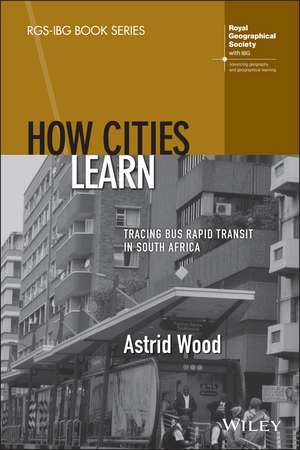
How Cities Learn
Autor Astrid Wooden Limba Engleză Paperback – 18 apr 2022
Descoperim în paginile acestui volum o perspectivă care nu era accesibilă anterior: modul în care infrastructura de transport nu este doar un sistem tehnic, ci un proces viu de învățare și adaptare politică. În How Cities Learn, observăm cum modelul Bus Rapid Transit (BRT) a migrat și s-a localizat în Africa de Sud, devenind un instrument de reconfigurare a spațiului urban marcat istoric de segregare. Subliniem calitatea analizei senzoriale a spațiului; nu citim doar despre trasee și stații, ci experimentăm tensiunea dintre moștenirea socială a apartheidului și eforturile moderne de integrare prin mobilitate. Apreciem rigoarea cu care Astrid Wood urmărește circulația cunoștințelor între planificatori, politicieni și cetățeni. Ca și Assembling Bus Rapid Transit in the Global South, lucrarea pune în valoare mobilitatea politicilor urbane, dar cu un accent pe modul specific în care orașele învață să navigheze între modelele globale și realitățile locale dure. Această abordare completează temele explorate în Why Transportation Fails, unde autoarea oferea o critică a eșecurilor sistemice; aici, accentul se mută pe mecanismele de învățare și pe potențialul de transformare al infrastructurii. Credem că structura narativă a cărții reușește să transforme un subiect aparent tehnic într-o explorare sociopolitică fascinantă. Este o lectură care ne invită să privim dincolo de asfalt și beton, către fluxurile de idei care dau formă orașelor contemporane din Sudul Global. Tonul este unul echilibrat, evitând soluțiile simpliste în favoarea unei înțelegeri profunde a modului în care politicile publice prind viață în teritorii complexe.
Preț: 230.80 lei
Carte disponibilă
Livrare economică 07-21 noiembrie
Livrare express 24-30 octombrie pentru 26.52 lei
Specificații
ISBN-10: 1119794285
Pagini: 208
Dimensiuni: 155 x 228 x 12 mm
Greutate: 0.34 kg
Editura: Wiley
Locul publicării:Chichester, United Kingdom
V-ar putea interesa
-
 Human Geography: A Very Short IntroductionPatricia Daley-20%Preț: 57.15 lei71.12 lei
 -
 Preț: 370.66 lei
 -
 The Image of the CityKevin LynchPreț: 277.67 lei
 -
 Preț: 383.89 leiRecomandat
 -
 Planning White Supremacy: Civil Rights and City Planning in Montgomery, Alabama, 1920–1970Rebecca Coleen RetzlaffPreț: 267.25 lei
 -
 Peripheral Centralities: The Lost and Past Urbanity of the SuburbsNicholas A. Phelps-14%Preț: 1065.56 lei1239.02 leiRecomandat
 -
 Nature-Based Solutions in Cities of the Global SouthMasoumeh MirsafaPreț: 346.20 lei
 -
 Preț: 380.83 lei
 -
 -18%Preț: 1109.25 lei1352.73 lei
 -
 Comparative Urbanism - Tactics for Global Urban StudiesJennifer RobinsonPreț: 178.51 lei
 -
 -17%Preț: 180.69 lei217.78 lei
 -
 Confronting SuburbanizationKiril StanilovPreț: 174.76 lei
 -
 Learning the CityColin McfarlanePreț: 288.50 lei
 -
 The Expressway WorldRichard J. WilliamsPreț: 170.64 lei
 -
 Preț: 176.67 lei
 -
 The Homegrown CityMatias EchanovePreț: 152.61 lei
 -
 Keep LeftPauline BryanPreț: 85.65 lei
 -
 -24%Preț: 772.89 lei1016.97 lei
 -
 African Perspectives: Dsd Series Vol. 7Gerhard BruynsPreț: 338.83 lei
 -
 New Geographies of Music 2Séverin GuillardPreț: 336.23 lei
De ce să citești această carte
Recomandăm această carte urbaniștilor și cercetătorilor care doresc să înțeleagă dincolo de hărți și statistici. Cititorul câștigă o viziune clară asupra modului în care transportul public poate deveni un motor al dreptății sociale. Este un instrument esențial pentru oricine vrea să vadă cum se traduc modelele teoretice globale în soluții practice pentru orașe care se luptă cu inegalități istorice profunde.
Despre autor
Astrid Wood este o voce academică recunoscută în domeniul geografiei și planificării urbane, cu un interes special pentru infrastructura din Africa de Sud. Opera sa explorează frecvent intersecția dintre politică, spațiu și mobilitate, investigând de ce sistemele de transport reușesc sau eșuează în contexte post-apartheid. Prin lucrări precum Why Transportation Fails, Wood s-a impus ca un critic fin al politicilor de mobilitate, aducând în prim-plan complexitatea Sudului Global. Contribuțiile sale sunt esențiale pentru înțelegerea modului în care cunoștințele tehnice sunt modelate de realitățile sociale și politice locale.
Notă biografică
Descriere
How Cities Learn traces the circulation of bus rapid transit (BRT) to understand how and why it was widely adopted in South Africa.
- Investigates the global proliferation and localization of BRT
- Examines the production and distribution of transportation knowledge in the global south
- Addresses the spatial and social legacy of apartheid in South African cities
- Reveals a new way of understanding the intersections between policy, people and place
- Essential reading for scholars of geography, politics, sociology and transportation, as well as urban planners and practitioners