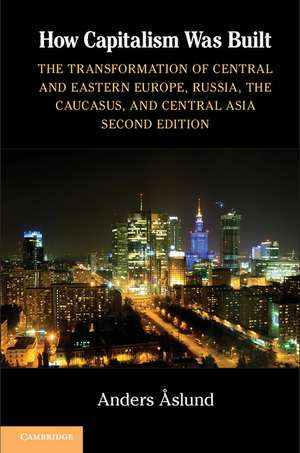
How Capitalism Was Built: The Transformation of Central and Eastern Europe, Russia, the Caucasus, and Central Asia
Autor Anders Aslunden Limba Engleză Paperback – 11 noi 2012
Problema fundamentală pe care o rezolvă How Capitalism Was Built este lipsa de claritate asupra motivelor pentru care unele state postcomuniste au prosperat, în timp ce altele au stagnat în autoritarism și corupție. Putem afirma că lucrarea lui Anders Aslund nu este doar o cronică istorică, ci un instrument analitic riguros care explică mecanismele economice din spatele prăbușirii sistemului sovietic și ascensiunea oligarhiei. Apreciem modul în care autorul demontează miturile despre succesul reformelor graduale, oferind răspunsuri concrete despre necesitatea terapiei de șoc în contrast cu modelul chinez.
Abordarea diferă de Constructing Capitalism de Kazimierz Z. Poznanski prin pragmatismul său economic — este mai puțin concentrată pe aspecte sociologice abstracte și mult mai aplicabilă prin analiza politicilor de liberalizare și privatizare. În contextul operei sale, această a doua ediție reprezintă o evoluție naturală de la Building Capitalism, integrând acum impactul Uniunii Europene și al crizei financiare din 2007-2012. Față de Russia's Crony Capitalism, unde se axează strict pe plutocrația lui Putin, aici Anders Aslund oferă o perspectivă comparativă vastă asupra a 21 de economii în tranziție.
Structura cărții este una progresivă și logică: începe cu analiza decesului comunismului, trece prin bătălia dintre reformele radicale și gradualism (capitolul 2), și culminează cu provocările moderne ale statului de drept. Cele 45 de ilustrații și 7 tabele oferă o bază empirică solidă pentru argumentele autorului referitoare la hiperinflație și drepturile de proprietate privată, transformând volumul într-o resursă esențială pentru înțelegerea peisajului geopolitic actual.
Preț: 360.07 lei
Carte tipărită la comandă
Livrare economică 15-29 iulie
Specificații
ISBN-10: 1107628180
Pagini: 440
Ilustrații: 45 b/w illus. 7 tables
Dimensiuni: 152 x 229 x 30 mm
Greutate: 0.57 kg
Ediția:Secondtion
Editura: Cambridge University Press
Colecția Cambridge University Press
Locul publicării:New York, United States
V-ar putea interesa
-
 The Third PillarRaghuram RajanPreț: 102.97 lei
 -
 The Great Global TransformationBranko MilanovicPreț: 188.67 lei
 -
 Sale Of The Century: The Inside Story of the Second Russian RevolutionChrystia Freeland-28%Preț: 76.21 lei105.89 lei
 -
 The Commanding Heights: The Battle for the World EconomyDaniel YerginPreț: 127.01 lei
 -
 Europe since 1989Philipp TherPreț: 158.70 lei
 -
 Capitalist Diversity on Europe`s PeripheryDorothee BohlePreț: 301.72 lei
 -
 Uncivil SocietyStephen KotkinPreț: 88.27 lei
 -
 East Central Europe since 1989: Politics, Culture, and SocietySabrina P. RametPreț: 343.25 lei
 -
 In the Storms of TransformationUlf BrunnbauerPreț: 240.24 lei
 -
 The Collapse of Global LiberalismPhilip PilkingtonPreț: 113.21 lei
 -
 The Soviet Union and Its Successors 1970-2020Jeremy SmithPreț: 76.07 lei
 -
 KaputWolfgang MunchauPreț: 77.80 lei
 -
 What Went Wrong With CapitalismRuchir SharmaPreț: 92.32 lei
 -
 The Communist ManifestoFriedrich EngelsPreț: 52.82 lei
 -
 False DawnJohn GrayPreț: 78.67 lei
 -
 Zero SumCharles Hecker-22%Preț: 167.88 lei215.55 lei
 -
 -24%Preț: 177.52 lei232.97 lei
 -
 Preț: 186.79 lei
De ce să citești această carte
Această carte se adresează economiștilor, studenților la relații internaționale și profesioniștilor care doresc să înțeleagă dinamica puterii în spațiul ex-sovietic. Cititorul câștigă o perspectivă autoritară asupra modului în care politicile economice modelează regimurile politice. Este o resursă indispensabilă pentru a anticipa viitorul economic al regiunii, bazată pe experiența directă a unui consilier guvernamental de top.
Despre autor
Anders Aslund este unul dintre cei mai importanți specialiști mondiali în transformarea economică postcomunistă. A servit drept consilier economic pentru guvernul rus (1991-1994), cel ucrainean (1994-1997) și pentru președintele Kârgâzstanului, oferindu-i o perspectivă unică, din interior, asupra reformelor de piață. A fost director al programului pentru Rusia și Eurasia la Carnegie Endowment for International Peace și este profesor asociat la Georgetown University. Expertiza sa vastă în economiile de tranziție este recunoscută la nivel internațional prin analizele sale pătrunzătoare asupra sistemelor politice și economice din Europa de Est și Asia Centrală.
Descriere scurtă
Cuprins
Recenzii
'This book is a heroic attempt to cover the whole of transition from the former Soviet Union and Central, Eastern, and Southern Europe to the Baltics. Anders Åslund is able to cover this vast territory in a substantive way by grouping the transition experiences in a clear and logical manner. It is a timely publication.' Paul Gregory, University of Houston
'Anders Åslund has followed post-communist transitions from the outset, and he has got it right. Few economists have seriously studied the transformation of post-communist economies, or more poetically, how aquaria have been restored from fish soup. Åslund has. One of his main conclusions is that early, comprehensive, and radical market economic reforms worked best, and as he rightly points out, Estonia is the best proof that such policies work.' Toomas Hendrik Ilves, President of the Republic of Estonia
'Anders Åslund has repeatedly challenged conventional wisdom. He was right about Gorbachev's reforms, right about Yeltsin, and right about the more recent resurgence of Russia. Anyone who cares about the former Soviet Union, emerging markets, global energy security, and the progress of democracy ignores Åslund and this book at their own peril.' Simon Johnson, Massachusetts Institute of Technology
'For more than twenty years, Anders Åslund has been the most perceptive and knowledgeable chronicler of the creation of capitalism in Eastern Europe and the former Soviet Union. His excellent judgment and wisdom shine through every page of this volume.' Andrei Shleifer, Harvard University
'Anders Åslund is the world's keenest observer of what used to be called 'transition economies'. Everyone concerned with the historical lesson these economies provide or their future should read this important book.' Lawrence Summers, Former US Secretary of the Treasury and Former President, Harvard University