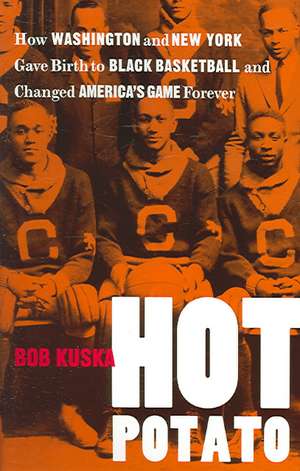
Hot Potato
Autor Bob Kuskaen Limba Engleză Paperback – 20 feb 2006
n a nation distinguished by a great black athletic heritage, there is perhaps no sport that has felt the impact of African American culture more than basketball. Most people assume that the rise of black basketball was a fortuitous accident of the inner-city playgrounds. In "Hot Potato, " Bob Kuska shows that it was in fact a consciously organized movement with very specific goals.
When Edwin Henderson introduced the game to Washington, D.C., in 1907, he envisioned basketball not as an end in itself but as a public-health and civil-rights tool. Henderson believed that, by organizing black athletics, including basketball, it would be possible to send more outstanding black student athletes to excel at northern white colleges and debunk negative stereotypes of the race. He reasoned that in sports, unlike politics and business, the black race would get a fair chance to succeed. Henderson chose basketball as his marquee sport, and he soon found that the game was a big hit on Washington's segregated U Street. Almost simultaneously, black basketball was catching on quickly in New York, and the book establishes that these two cities served as the birthplace of the black game.
"Hot Potato" chronicles the many successes and failures of the early years of black amateur basketball. It also recounts the emergence of black college basketball in America, documenting the origins of the Colored Intercollegiate Athletic Association, or CIAA, which would become the Big Ten of black collegiate sports.
The book also details for the first time the rise of black professional basketball in America, with a particular emphasis on the New York Renaissance, a team considered by experts to be as important in the development of black basketball as the Harlem Globetrotters. Kuska recounts the Renaissance's first victory over the white world champion Original Celtics in 1925, and he evaluates the significance of this win in advancing equality in American sports. By the late 1920s, the Renaissance became one of the sport's top draws in white and black America alike, setting the stage for the team's undisputed world championship in 1939. As Edwin Henderson had hoped and as any fan of the modern-day game can tell you the triumphs certainly did not end there."
Preț: 119.84 lei
Puncte Express: 180
Carte disponibilă
Livrare economică 09-23 noiembrie
Livrare prin curier în România Termenul estimat este afișat lângă disponibilitate.
Transport gratuit de la 400.00 lei Plată online sau ramburs, în funcție de opțiunile comenzii.
Retur gratuit în 14 zile Comandă securizată și suport în română.
Specificații
ISBN-13: 9780813925561
ISBN-10: 0813925568
Pagini: 256
Dimensiuni: 144 x 223 x 17 mm
Greutate: 0.33 kg
Editura: University of Virginia Press
ISBN-10: 0813925568
Pagini: 256
Dimensiuni: 144 x 223 x 17 mm
Greutate: 0.33 kg
Editura: University of Virginia Press
V-ar putea interesa
-
 The Last SeasonPhil JacksonPreț: 105.68 lei
 -
 Counting CoupLarry ColtonPreț: 126.75 lei
 -
 My Losing SeasonPat ConroyPreț: 104.16 lei
 -
 I Love Being the EnemyReggie MillerPreț: 127.24 lei
 -
 -21%Preț: 165.65 lei210.84 lei
 -
 Preț: 126.07 lei
 -
 Basketball AnatomyBrian ColePreț: 143.61 lei
 -
 Basketball EssentialsRyan GoodsonPreț: 113.71 lei
 -
 ShowtimeJeff PearlmanPreț: 117.74 lei
Descriere
When Edwin Henderson introduced the game to Washington, D.C., in 1907, he envisioned basketball as a way for more outstanding black student athletes to excel at northern white colleges and debunk negative stereotypes of the race. Almost simultaneously, black basketball was catching on quickly in New York. Kuska establishes that these two cities served as the birthplace of the black game.
Notă biografică
Bob Kuska, who spent a decade researching this book, is a science writer for the National Institutes of Health.