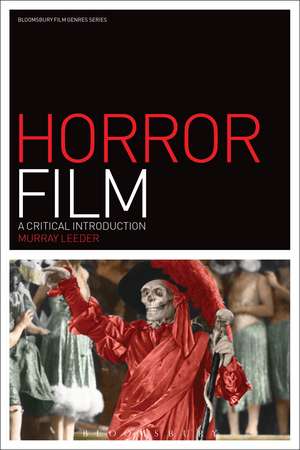
Horror Film: A Critical Introduction: Film Genres
Autor Murray Leederen Limba Engleză Hardback – 25 ian 2018

Preț: 632.53 lei
Preț vechi: 876.11 lei
-28%
Puncte Express: 949
Carte tipărită la comandă
Livrare economică 07-21 decembrie
Livrare prin curier în România Termenul estimat este afișat lângă disponibilitate.
Transport gratuit pentru acest produs Plată online sau ramburs, în funcție de opțiunile comenzii.
Retur gratuit în 14 zile Comandă securizată și suport în română.
Specificații
ISBN-13: 9781501314421
ISBN-10: 1501314424
Pagini: 288
Ilustrații: 37 bw illus
Dimensiuni: 138 x 216 x 22 mm
Greutate: 0.48 kg
Ediția:HPOD
Editura: Bloomsbury Publishing
Colecția Bloomsbury Academic
Seria Film Genres
Locul publicării:New York, United States
ISBN-10: 1501314424
Pagini: 288
Ilustrații: 37 bw illus
Dimensiuni: 138 x 216 x 22 mm
Greutate: 0.48 kg
Ediția:HPOD
Editura: Bloomsbury Publishing
Colecția Bloomsbury Academic
Seria Film Genres
Locul publicării:New York, United States
V-ar putea interesa
-
 Silent ComedyPaul MertonPreț: 111.21 lei
 -
 Preț: 400.87 lei
 -
 The Man with the Golden EyePeter Lamont-21%Preț: 184.25 lei234.39 lei
 -
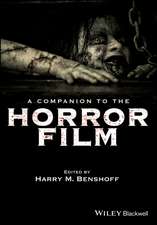 A Companion to the Horror FilmHarry M BenshoffPreț: 424.36 lei
 -
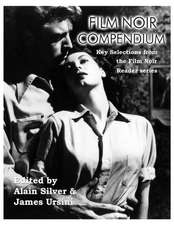 Film Noir CompendiumAlain Silver-40%Preț: 147.89 lei245.98 lei
 -
 A Futile and Stupid GestureJosh KarpPreț: 125.59 lei
 -
 James Bond FAQTom DemichaelPreț: 136.13 lei
 -
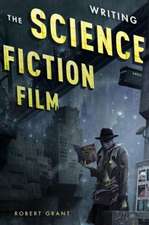 Writing the Science Fiction FilmRobert GrantPreț: 152.97 lei
 -
 The Hidden Tools of ComedySteve Kaplan-18%Preț: 132.12 lei161.47 lei
 -
 Liquid Space: Science Fiction Film and Television in the Digital AgeProfessor Sean Redmond-19%Preț: 175.21 lei217.23 lei
 -
 Projecting Tomorrow: Science Fiction and Popular CinemaProf James Chapman-24%Preț: 193.31 lei254.08 lei
 -
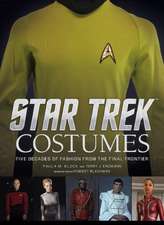 Star TrekPaula M. Block-15%Preț: 246.40 lei290.78 lei
 -
 Black & White Cinema: A Short HistoryProfessor Wheeler Winston Dixon-19%Preț: 191.31 lei236.17 lei
 -
 The Sound of MusicalsSteven Cohan-24%Preț: 227.52 lei300.07 lei
 -
 After Dracula: The 1930s Horror FilmAlison Peirse-25%Preț: 173.18 lei230.52 lei
Cuprins
Acknowledgements
List of Images
Introduction
1: Horror's Process of Genrification, 1895-1938
2: 1939-1973: Horror and the Crisis of Rationality
3: 1974-Present: High and Low
4: What Is Horror?
5: Mind and Body: The 'Why?' of Horror
6: Horror's Audiences, Critics and Censors
7: Shocking and Spooky Sounds
8: Colours of Fear
9: Digital Horrors
Works Cited
Index
List of Images
Introduction
1: Horror's Process of Genrification, 1895-1938
2: 1939-1973: Horror and the Crisis of Rationality
3: 1974-Present: High and Low
4: What Is Horror?
5: Mind and Body: The 'Why?' of Horror
6: Horror's Audiences, Critics and Censors
7: Shocking and Spooky Sounds
8: Colours of Fear
9: Digital Horrors
Works Cited
Index
Recenzii
Concise yet also comprehensive, Leeder's study examines the horror film from its prehistory to its digital future(s), tackling its history, reception contexts, and shifting forms. A delight to read, the book will satisfy newcomers to the horror genre as well as advanced scholars and die-hard fans.
Leeder maps the glorious dark continent of Horror, guiding us through its high metaphic mounatins and low slasher riverbeds, along the way uncovering the hidden treasures of a true art form that, at its most potent, is poetic, emotionally resonant, and quintessentially cinematic.
Horror Film: A Critical Introduction is an excellent, engagingly written book. It is both an indispensable introduction to one of the most consistently popular and culturally resonant film genres, and a work that brings new and imaginative perspectives, and previously neglected films and case studies, to the centre of debate and discussion within the field of horror film studies. Highly recommended for students, teachers, scholars and fans alike.
Ambitious and wide-ranging, Horror Film is a welcome, accessible overview of this most disreputable and delightful of genres. Leeder's focus is the reader new to studying horror: the fan, the student, the film practitioner looking to 'gen up' on genre. With clear, jargon free language, Leeder expertly guides the reader through horror standards including Dracula and Night of the Living Dead, while also making space to explore lesser known gems such as Eyes Without a Face and Ginger Snaps, smart indie films designed to provoke shock, disgust and dark pleasures.
Leeder maps the glorious dark continent of Horror, guiding us through its high metaphic mounatins and low slasher riverbeds, along the way uncovering the hidden treasures of a true art form that, at its most potent, is poetic, emotionally resonant, and quintessentially cinematic.
Horror Film: A Critical Introduction is an excellent, engagingly written book. It is both an indispensable introduction to one of the most consistently popular and culturally resonant film genres, and a work that brings new and imaginative perspectives, and previously neglected films and case studies, to the centre of debate and discussion within the field of horror film studies. Highly recommended for students, teachers, scholars and fans alike.
Ambitious and wide-ranging, Horror Film is a welcome, accessible overview of this most disreputable and delightful of genres. Leeder's focus is the reader new to studying horror: the fan, the student, the film practitioner looking to 'gen up' on genre. With clear, jargon free language, Leeder expertly guides the reader through horror standards including Dracula and Night of the Living Dead, while also making space to explore lesser known gems such as Eyes Without a Face and Ginger Snaps, smart indie films designed to provoke shock, disgust and dark pleasures.
Notă biografică
Murray Leeder is Assistant Lecturer in Film & English at the University of Alberta, Canada. He is the author of Horror Film: A Critical Introduction (Bloomsbury, 2018), The Modern Supernatural and the Beginnings of Cinema (2017) and Halloween (Auteur, 2014), and editor of Cinematic Ghosts: Haunting and Spectrality from Silent Cinema to the Digital Era (Bloomsbury, 2015) and ReFocus: The Films of William Castle (2018). He has published in such journals as Horror Studies, The Canadian Journal of Film Studies, The Journal of Popular Culture and The Journal of Popular Film and Television.