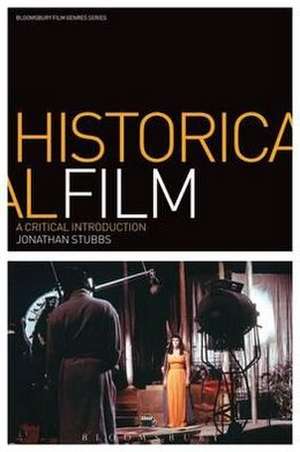
Historical Film: A Critical Introduction: Film Genres
Autor Jonathan Stubbsen Limba Engleză Paperback – 23 mai 2013
Preț: 202.96 lei
Preț vechi: 248.21 lei
-18%
Puncte Express: 304
Carte tipărită la comandă
Livrare economică 08-22 iunie
Specificații
ISBN-13: 9781847884978
ISBN-10: 1847884970
Pagini: 224
Ilustrații: illustrations
Dimensiuni: 156 x 235 x 20 mm
Greutate: 0.31 kg
Editura: Bloomsbury Publishing
Colecția Bloomsbury Academic
Seria Film Genres
Locul publicării:London, United Kingdom
ISBN-10: 1847884970
Pagini: 224
Ilustrații: illustrations
Dimensiuni: 156 x 235 x 20 mm
Greutate: 0.31 kg
Editura: Bloomsbury Publishing
Colecția Bloomsbury Academic
Seria Film Genres
Locul publicării:London, United Kingdom
V-ar putea interesa
-
 -32%Preț: 619.11 lei913.30 lei
 -
 The History of Cinema: A Very Short IntroductionGeoffrey Nowell-Smith-22%Preț: 52.96 lei67.48 lei
 -
 The Oxford History of World CinemaGeoffrey Nowell-SmithPreț: 334.51 lei
 -
 Jean-Luc GodardMichael WittPreț: 255.42 lei
 -
 Film Studies: The BasicsAmy VillarejoPreț: 173.85 lei
 -
 Preț: 395.55 lei
 -
 The Representation of Vikings in Cinema and Television: Epic and Barbarism on ScreenAlberto Robles DelgadoPreț: 352.43 lei
 -
 Film Studies For DummiesJames CateridgePreț: 107.33 lei
 -
 The Horror FilmRick WorlandPreț: 279.93 lei
 -
 -4%Preț: 361.96 lei377.04 lei
 -
 Film History: An Introduction: 2025 Release ISEKristin Thompson-4%Preț: 378.59 lei394.36 lei
 -
 50 Film Ideas You Really Need to KnowHelen O’Hara-28%Preț: 48.53 lei67.87 lei
 -
 -26%Preț: 98.63 lei132.83 lei
 -
 The Story of British Propaganda FilmScott Anthony-26%Preț: 173.25 lei232.78 lei
 -
 The Cinema BookPam Cook-19%Preț: 308.51 lei382.03 lei
 -
 The Italian Cinema BookDr Peter Bondanella-22%Preț: 274.99 lei352.15 lei
 -
 Past and Present: National Identity and the British Historical FilmProf James Chapman-22%Preț: 190.89 lei244.40 lei
 -
 The Story of FilmMark CousinsPreț: 231.93 lei
 -
 Preț: 232.47 lei
 -
 A Short History of Film, Fourth EditionWheeler Winston DixonPreț: 329.39 lei
Cuprins
List of Illustrations
Acknowledgement
Introduction: Film and the Invention of History
Chapter One: What is Historical Cinema?
Chapter Two: Detail, Authenticity and the Uses of the Past
Chapter Three: Hollywood Historical Cinema up to WWII
Chapter Four: The Age of Epics
Chapter Five: New Hollywood, New Histories
Chapter Six: Spectacle, Technology and Aesthetics
Chapter Seven: Prestige, Education and Cultural Value
Conclusion: The Role of the Historian
Annotated Guide to Further Reading
Bibliography
Filmography
Index
Acknowledgement
Introduction: Film and the Invention of History
Chapter One: What is Historical Cinema?
Chapter Two: Detail, Authenticity and the Uses of the Past
Chapter Three: Hollywood Historical Cinema up to WWII
Chapter Four: The Age of Epics
Chapter Five: New Hollywood, New Histories
Chapter Six: Spectacle, Technology and Aesthetics
Chapter Seven: Prestige, Education and Cultural Value
Conclusion: The Role of the Historian
Annotated Guide to Further Reading
Bibliography
Filmography
Index
Recenzii
At the intersection of film and history, no topic has attracted as much scholarly attention in recent years as the genre of historical film. Jonathan Stubbs' book is not only an authoritative guide to the on-going debates about this genre, but also a major new contribution to them, demonstrating that historical films have been at the very heart of Hollywood's operations for much of the industry's history. The book draws on an immense amount of original research and combines wonderfully perceptive, detailed film analyses with surveys of major developments and discussions of key themes. It will be of great interest both to film scholars and to historians.
A hugely insightful and valuable book, which should be required reading for anyone with an interest in the ways that history has been used as a subject and setting for popular cinema. Stubbs provides an outstanding well researched account of the ways that historical film developed as a genre over the last century, which never loses sight of the ways that movies are shaped by cultural, economic and social factors. What's particularly impressive is that this story is told using almost entirely new research into the production and reception of a hugely diverse range of movies. As a result, the book is easily the most thorough account of Hollywood's historical films ever produced.
However, the greatest strength of Stubbs' book is that it combines rigorous research with a truly challenging and convincing exploration of the debates which surround historical film. Too often, historians and scholars become fixated on questions of historical accuracy, and this means that they can assess movies about the past in relatively narrow terms. Stubbs goes far beyond these issues, and instead focuses his attention on how history films provide pleasure through spectacle, as well as how they seek to (or at least claim to) educate viewers. In the final section, he turns his attention to critical debates around historical films and explains how history itself has come to be understood in contemporary culture.
This is, then, a book about historical films, but it is also an account of how historians, filmmakers and ordinary viewers have used cinema to make sense of the past, and the present. It is, quite simply, remarkable.
When reflecting on known theories within the field, and in offering his own, Stubbs' writing is well informed and innovative
A hugely insightful and valuable book, which should be required reading for anyone with an interest in the ways that history has been used as a subject and setting for popular cinema. Stubbs provides an outstanding well researched account of the ways that historical film developed as a genre over the last century, which never loses sight of the ways that movies are shaped by cultural, economic and social factors. What's particularly impressive is that this story is told using almost entirely new research into the production and reception of a hugely diverse range of movies. As a result, the book is easily the most thorough account of Hollywood's historical films ever produced.
However, the greatest strength of Stubbs' book is that it combines rigorous research with a truly challenging and convincing exploration of the debates which surround historical film. Too often, historians and scholars become fixated on questions of historical accuracy, and this means that they can assess movies about the past in relatively narrow terms. Stubbs goes far beyond these issues, and instead focuses his attention on how history films provide pleasure through spectacle, as well as how they seek to (or at least claim to) educate viewers. In the final section, he turns his attention to critical debates around historical films and explains how history itself has come to be understood in contemporary culture.
This is, then, a book about historical films, but it is also an account of how historians, filmmakers and ordinary viewers have used cinema to make sense of the past, and the present. It is, quite simply, remarkable.
When reflecting on known theories within the field, and in offering his own, Stubbs' writing is well informed and innovative