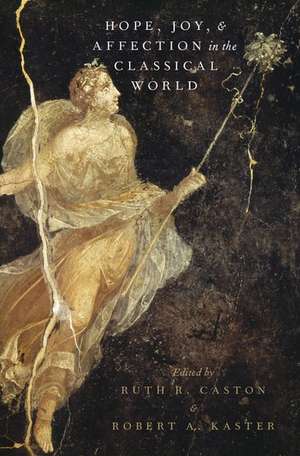
Hope, Joy, and Affection in the Classical World: Emotions of the Past
Editat de Ruth R. Caston, Robert A. Kasteren Limba Engleză Hardback – 23 iun 2016

Preț: 662.18 lei
Preț vechi: 769.97 lei
-14%
Puncte Express: 993
Carte disponibilă
Livrare economică 13-18 noiembrie
Livrare prin curier în România Termenul estimat este afișat lângă disponibilitate.
Transport gratuit pentru acest produs Plată online sau ramburs, în funcție de opțiunile comenzii.
Retur gratuit în 14 zile Comandă securizată și suport în română.
Specificații
ISBN-13: 9780190278298
ISBN-10: 0190278293
Pagini: 296
Dimensiuni: 236 x 155 x 23 mm
Greutate: 0.52 kg
Editura: Oxford University Press
Colecția OUP USA
Seria Emotions of the Past
Locul publicării:New York, United States
ISBN-10: 0190278293
Pagini: 296
Dimensiuni: 236 x 155 x 23 mm
Greutate: 0.52 kg
Editura: Oxford University Press
Colecția OUP USA
Seria Emotions of the Past
Locul publicării:New York, United States
V-ar putea interesa
-
 Cicero: Speech on Behalf of Publius SestiusRobert A. Kaster-29%Preț: 350.72 lei495.81 lei
 -
 A Commentary on Thucydides: Volume III: Books 5.25-8.109Simon Hornblower-23%Preț: 722.89 lei941.82 lei
 -
 Rome's Imperial Economy: Twelve EssaysW. V. Harris-31%Preț: 1139.95 lei1657.87 lei
 -
 -22%Preț: 441.20 lei568.40 lei
 -
 Policing the Roman Empire: Soldiers, Administration, and Public OrderChristopher Fuhrmann-31%Preț: 822.24 lei1193.71 lei
 -
 Studies on the Text of Macrobius' SaturnaliaRobert Kaster-23%Preț: 321.56 lei416.92 lei
 -
 -11%Preț: 385.54 lei434.55 lei
 -
 Trouble in the West: Egypt and the Persian Empire, 525-332 BCStephen Ruzicka-31%Preț: 759.10 lei1101.11 lei
 -
 The Oxford Handbook of PlatoGail Fine-29%Preț: 436.16 lei613.62 lei
 -
 The Greek and Roman MythsPhilip Matyszak-16%Preț: 92.93 lei110.96 lei
 -
 Preț: 233.70 lei
 -
 Latrinae et Foricae: Toilets in the Roman WorldBarry Hobson-37%Preț: 149.67 lei239.38 lei
 -
 The Roman Empire: Roots of ImperialismNeville MorleyPreț: 228.66 lei
 -
 Antony and CleopatraAdrian Goldsworthy-26%Preț: 92.05 lei123.60 lei
 -
 Rome: Empire of the Eagles, 753 BC – AD 476Neil FaulknerPreț: 488.80 lei
 -
 The Darylgac Survey ProjectPia Guldager Bilde-15%Preț: 655.70 lei771.42 lei
 -
 Pottery in the Archaeological RecordMark L. LawallPreț: 175.39 lei
Notă biografică
Ruth R. Caston is an Associate Professor of Classical Studies at the University of Michigan and the author of Elegiac Passion: Jealousy in Roman Love Elegy.Robert A. Kaster is the Kennedy Foundation Professor of Latin Language and Literature and Professor of Classics at Princeton University.
Cuprins
- Contents
- Introduction Ruth R. Caston and Robert A. Kaster
- I. Hope
- 1. Douglas Cairns, Metaphors for Hope in Archaic and Classical Greek Poetry
- 2. Damien Nelis, Emotion in Vergil's Georgics: Farming and the Politics of Hope
- 3. Laurel Fulkerson, 'Torn between Hope and Despair': Narrative Foreshadowing and Suspense in the Greek Novel
- II. Joy and Happiness
- 4. Ruth R. Caston, The Irrepressibility of Joy in Roman Comedy
- 5. Michael C. J. Putnam, Horatius Felix
- 6. Margaret Graver, Anatomies of Joy: Seneca and the Gaudium Tradition
- 7. Christopher Gill, Positive Emotions in Stoicism: Are they Enough?
- III. Fellow-feeling and Kindness
- 8. Ed Sanders, Generating Goodwill and Friendliness in Attic Forensic Oratory
- 9. David Armstrong, Utility and Affection in Epicurean Friendship: Philodemus On the Gods 3, On Property Management, and Horace, Sermones 2.6
- 10. Gillian Clark, Caritas: Augustine on Love and Fellow-feeling
- 11. Martha Nussbaum, 'If You Could See This Heart': Mozart's Mercy
- Works Cited