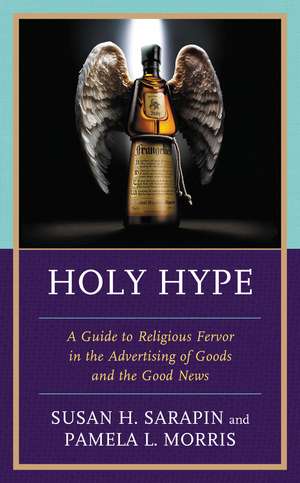
Holy Hype: A Guide to Religious Fervor in the Advertising of Goods and the Good News: Lexington Books
Autor Susan H. Sarapin, Pamela L. Morrisen Limba Engleză Paperback – 22 feb 2024
Din seria Lexington Books
- 19%
 Preț: 426.72 lei
 - 32%
 Preț: 712.23 lei
 - 59%
 Preț: 427.24 lei
 - 23%
 Preț: 318.57 lei
 - 25%
 Preț: 362.03 lei
 - 23%
 Preț: 322.75 lei
 - 27%
 Preț: 355.41 lei
 - 29%
 Preț: 345.71 lei
 - 25%
 Preț: 306.14 lei
 - 33%
 Preț: 710.24 lei
 - 31%
 Preț: 437.25 lei
 - 29%
 Preț: 342.12 lei
 - 25%
 Preț: 361.02 lei
 - 29%
 Preț: 344.18 lei
 - 28%
 Preț: 347.76 lei
 - 28%
 Preț: 346.74 lei
 - 23%
 Preț: 318.96 lei
 - 37%
 Preț: 660.07 lei
 - 24%
 Preț: 309.62 lei
 - 29%
 Preț: 599.98 lei
 - 24%
 Preț: 369.89 lei
 - 36%
 Preț: 730.77 lei
 - 33%
 Preț: 642.37 lei
 - 29%
 Preț: 345.71 lei
 - 27%
 Preț: 354.68 lei
 - 29%
 Preț: 342.63 lei
 - 28%
 Preț: 252.34 lei
 - 27%
 Preț: 354.28 lei
 - 22%
 Preț: 332.36 lei
 - 22%
 Preț: 338.89 lei
 - 23%
 Preț: 321.63 lei
 - 23%
 Preț: 319.79 lei
 - 28%
 Preț: 346.74 lei
 - 23%
 Preț: 321.53 lei
 - 35%
 Preț: 560.77 lei
 - 24%
 Preț: 308.07 lei
 - 23%
 Preț: 321.63 lei
 - 27%
 Preț: 263.04 lei
 - 23%
 Preț: 333.36 lei
 - 34%
 Preț: 630.22 lei
 - 22%
 Preț: 341.76 lei
 - 33%
 Preț: 358.06 lei
 - 34%
 Preț: 418.63 lei
 - 34%
 Preț: 601.39 lei
 - 35%
 Preț: 593.04 lei
 - 25%
 Preț: 884.44 lei
 - 33%
 Preț: 640.95 lei
Preț: 221.03 lei
Preț vechi: 307.07 lei
-28%
Puncte Express: 332
Carte tipărită la comandă
Livrare economică 19 noiembrie-03 decembrie
Livrare prin curier în România Termenul estimat este afișat lângă disponibilitate.
Transport gratuit de la 400.00 lei Plată online sau ramburs, în funcție de opțiunile comenzii.
Retur gratuit în 14 zile Comandă securizată și suport în română.
Specificații
ISBN-13: 9781793629364
ISBN-10: 1793629366
Pagini: 258
Ilustrații: 52 b/w photos;
Dimensiuni: 152 x 226 x 16 mm
Greutate: 0.35 kg
Editura: Bloomsbury Publishing
Colecția Lexington Books
Seria Lexington Books
Locul publicării:New York, United States
ISBN-10: 1793629366
Pagini: 258
Ilustrații: 52 b/w photos;
Dimensiuni: 152 x 226 x 16 mm
Greutate: 0.35 kg
Editura: Bloomsbury Publishing
Colecția Lexington Books
Seria Lexington Books
Locul publicării:New York, United States
V-ar putea interesa
-
 The Big Business CardDale AndersonPreț: 90.61 lei
 -
 Media MagicShannon M. Burnett-GronichPreț: 122.68 lei
 -
 Digital Doesn't MatterJosh SklarPreț: 174.64 lei
 -
 Marketing on the MoveBill Heneghan IIIPreț: 93.07 lei
 -
 Digital Cmo's Guide to Marketing MeasurementBryan S. SemplePreț: 133.30 lei
 -
 The Google Adwords Survival GuideMR Steven Michael TenerielloPreț: 85.48 lei
 -
 Online Marketing for Home InspectorsCartess RossPreț: 89.71 lei
 -
 Preț: 51.04 lei
 -
 Cashing in on Article WritingJinger JarrettPreț: 101.39 lei
 -
 The Infomercial & Drtv HandbookDrew C. CummingsPreț: 79.32 lei
 -
 The Book on WebcastingMark CallPreț: 78.43 lei
 -
 The Customer StreamDoug AndersonPreț: 80.32 lei
 -
 Swipe File 1970's Advertising Campaigns ...Franklin Scott CrawfordPreț: 186.08 lei
 -
 Cmo HurricaneMichael ChevesPreț: 122.04 lei
 -
 Preț: 60.66 lei
 -
 Landscape Marketing That Really WorksDuston McGroartyPreț: 62.45 lei
 -
 Collection Agency MarketingMichelle DunnPreț: 129.80 lei
 -
 Business Owners Guide to an Endless Supply of Loyal CustomersGarry D. JohnsonPreț: 182.88 lei
 -
 Boost Your Business with a MarkAndre Marie Awoumou MangaPreț: 34.41 lei
 -
 Escape the ExpectedTom TrushPreț: 115.93 lei
 -
 Branding from the HeartMS Julia D. StegePreț: 121.67 lei
 -
 NamesDan GudemaPreț: 93.91 lei
 -
 Memories of a Mad ManDon SpectorPreț: 66.73 lei
 -
 Preț: 65.78 lei
 -
 Simply DigitalBrandon TiddPreț: 60.48 lei
 -
 What's Your Unique Selling Proposition?Justin J. PugsleyPreț: 63.85 lei
 -
 Los Mas Simples y Poderosos Secretos del Marketing y de La PersuasionFrancisco Caceres SennPreț: 134.13 lei
Descriere
Holy Hype: Religious Fervor in the Advertising of Goods and the Good News defines and explores the intersection of the sacred-religious symbols, themes, and rhetoric-within the profane realm of advertising and promotion. Susan H. Sarapin and Pamela L. Morris trace the historical overlap of consumer and religious ideologies in society, offering detailed examples of its use throughout history through analyses of over a hundred collected advertisements, from monks selling copiers, to billboard messages from God, to angels and the worship of vodka. Throughout the book, the authors continually evaluate if and when the technique of 'holy hype' is effective through its use of recognizable sacred symbols that capture audiences' attentions and inspire both positive and negative emotions. Scholars of communication, media studies, religion, advertising, and cultural studies will find this book particularly useful.
Cuprins
Chapter 1: Preface: Let There Be Light
Chapter 2: What, in Heaven's Name, Is It?
Chapter 3: Religion and Advertising: Scrambling the Sacred and Profane
Chapter 4: In the Beginning: At the Intersection of Damascus Road and Madison Avenue
Chapter 5: Selling the Goods Amidst the Good News
Chapter 6: Apparel: The Fabric of American Faith
Chapter 7: Marketing Religion on the Streets
Chapter 8: The Bible Tells Me So: Scriptural Metaphors in Advertising for Nonprofits
Chapter 9: Revelations of the Future of Holy Hype
About the Authors
Chapter 2: What, in Heaven's Name, Is It?
Chapter 3: Religion and Advertising: Scrambling the Sacred and Profane
Chapter 4: In the Beginning: At the Intersection of Damascus Road and Madison Avenue
Chapter 5: Selling the Goods Amidst the Good News
Chapter 6: Apparel: The Fabric of American Faith
Chapter 7: Marketing Religion on the Streets
Chapter 8: The Bible Tells Me So: Scriptural Metaphors in Advertising for Nonprofits
Chapter 9: Revelations of the Future of Holy Hype
About the Authors
Recenzii
In Holy Hype, Susan H. Sarapin and Pamela L. Morris describe the religious tropes used to sell religious and nonreligious products. God, Jesus, angels, devils, Noah's ark, the Garden of Eden, rabbis, monks, nuns, and assorted denominational stereotypes have been co-opted in advertisements for computers, cameras, cars, and copiers. Some religious imagery in advertising is clever and relational, some less so. Some ads have sparked backlash for mixing the sacred with the allegedly profane. As the authors note, with increasing secularism, future audiences may have less familiarity with the religious frames associated with such ads. Throughout this book, Sarapin and Morris offer historical perspectives on the holy hype behind both religious and secular consumerism.
Divine or devilish? Holy Hype points out that advertising can be both. Meat processor Hebrew National's advertising slogan "We answer to a higher authority" looks up to Heaven; candymakers often look in another direction to tempt consumers with their "sinfully delicious" chocolates. Sarapin and Morris note that religious themes have been used to sell goods since the Middle Ages. The rise of commerce and Gutenberg's 1448 invention of the printing press spurred more linkages between the nonsecular and the secular. By the 20th century, marketers widely used religious rhetoric, symbols, and images to advertise products ranging from clothing and cars to personal hygiene and food. Even Chicago's Wrigley Field calls itself the "blueprint for Heaven's ballpark." The book has numerous examples and insights into the possibilities and pitfalls of incorporating religion into advertising. Recommended. Advanced undergraduates through faculty and professionals.
Holy Hype is a true passion project, based on the lead author's private collection of over 2,500 religion-related advertisements and other paraphernalia. The authors offer it as a text with potential benefit for "students and teachers of advertising, persuasion, religion, visual communication, public relations, sociology, history, and marketing along with practicing clergy and others" (p. 3). It certainly piqued my interest as an advertising academic, teacher, and former practitioner... the book provides evidence and illustrations that scholars and academics - interested in the nexus between faith and commerce; religion and advertising - might find helpful. All in all, the book provides a comprehensive overview of religious symbolism - and appropriation of these symbols for other than genuine religious purposes - over many generations. While the book is focused on the USA, it also offers a captivating view of global culture expressed in the tolerance - or otherwise - of religious themes and motifs. In this way, the authors more or less deliver on their stated goal of providing benefit for a wide range of interest groups including students of advertising, religion and culture.
Divine or devilish? Holy Hype points out that advertising can be both. Meat processor Hebrew National's advertising slogan "We answer to a higher authority" looks up to Heaven; candymakers often look in another direction to tempt consumers with their "sinfully delicious" chocolates. Sarapin and Morris note that religious themes have been used to sell goods since the Middle Ages. The rise of commerce and Gutenberg's 1448 invention of the printing press spurred more linkages between the nonsecular and the secular. By the 20th century, marketers widely used religious rhetoric, symbols, and images to advertise products ranging from clothing and cars to personal hygiene and food. Even Chicago's Wrigley Field calls itself the "blueprint for Heaven's ballpark." The book has numerous examples and insights into the possibilities and pitfalls of incorporating religion into advertising. Recommended. Advanced undergraduates through faculty and professionals.
Holy Hype is a true passion project, based on the lead author's private collection of over 2,500 religion-related advertisements and other paraphernalia. The authors offer it as a text with potential benefit for "students and teachers of advertising, persuasion, religion, visual communication, public relations, sociology, history, and marketing along with practicing clergy and others" (p. 3). It certainly piqued my interest as an advertising academic, teacher, and former practitioner... the book provides evidence and illustrations that scholars and academics - interested in the nexus between faith and commerce; religion and advertising - might find helpful. All in all, the book provides a comprehensive overview of religious symbolism - and appropriation of these symbols for other than genuine religious purposes - over many generations. While the book is focused on the USA, it also offers a captivating view of global culture expressed in the tolerance - or otherwise - of religious themes and motifs. In this way, the authors more or less deliver on their stated goal of providing benefit for a wide range of interest groups including students of advertising, religion and culture.