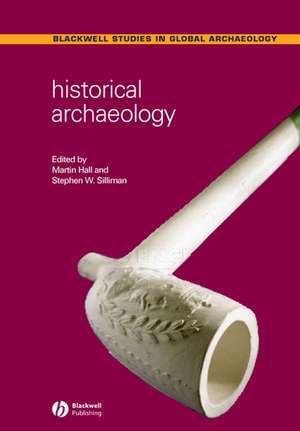
Historical Archaeology
Autor Hall, Sillimanen Limba Engleză Hardback – 23 ian 2006
- Authored by 19 experts in the field.
- Explores how historical archaeologists think about their work, piecing together information from both material culture and documents in an attempt to understand the lives of the people and societies they study.
- Engages with current theory in an accessible manner.
- Truly global in its approach but avoids subsuming local experiences of people into global patterns.
- Summarizes not only the current state of historical archaeology, but also sets the course for the field in decades to come.
Preț: 808.72 lei
Preț vechi: 1107.85 lei
-27%
Puncte Express: 1213
Carte tipărită la comandă
Livrare economică 16-30 noiembrie
Livrare prin curier în România Termenul estimat este afișat lângă disponibilitate.
Transport gratuit pentru acest produs Plată online sau ramburs, în funcție de opțiunile comenzii.
Retur gratuit în 14 zile Comandă securizată și suport în română.
Specificații
ISBN-13: 9781405107501
ISBN-10: 1405107502
Pagini: 360
Dimensiuni: 183 x 260 x 24 mm
Greutate: 0.87 kg
Ediția:Revised.
Editura: Wiley
Locul publicării:Chichester, United Kingdom
ISBN-10: 1405107502
Pagini: 360
Dimensiuni: 183 x 260 x 24 mm
Greutate: 0.87 kg
Ediția:Revised.
Editura: Wiley
Locul publicării:Chichester, United Kingdom
V-ar putea interesa
-
 Attack State RedCol. Richard KempPreț: 116.41 lei
 -
 French ToastHarriet Welty RochefortPreț: 105.02 lei
 -
 An Introduction to the Archaeology of Ancient Egypt 2eKathryn A. BardPreț: 425.44 lei
 -
 Power Generation, Operation, and ControlAllen J. Wood-27%Preț: 879.46 lei1204.74 lei
 -
 Star Trek and HistoryNancy R ReaginPreț: 109.90 lei
 -
 The Greater Journey: Americans in ParisDavid McCulloughPreț: 144.98 lei
 -
 Companion to the Roman ArmyPaul ErdkampPreț: 381.06 lei
 -
 A Companion to CatullusMarilyn B SkinnerPreț: 389.02 lei
 -
 A Companion to Roman ItalyAlison E. Cooley-23%Preț: 927.96 lei1205.15 lei
 -
 Walking VerdunChristina HolsteinPreț: 94.52 lei
 -
 -27%Preț: 78.06 lei106.39 lei
 -
 The Basic Basics Pressure Cooker CookbookMargaret P. Battin-18%Preț: 52.99 lei64.95 lei
Public țintă
advanced undergraduate and graduate students in historical archaeology, history, material culture studies, and heritage management; archaeologists and other professionals in university, museum, and heritage positionsNotă biografică
Martin Hall is Deputy Vice Chancellor and former Professor of Historical Archaeology, University of Cape Town.
Stephen W. Silliman is Assistant Professor of Anthropology, University of Massachusetts, Boston.
Stephen W. Silliman is Assistant Professor of Anthropology, University of Massachusetts, Boston.
Cuprins
List of Figures. Notes on Contributors.
Acknowledgments.
1. Introduction: Archaeology of the Modern World. (Martin Hall and Stephen W. Silliman).
Part I: Dimensions of Practice.
2. Environments of History: Biological Dimensions of Historical Archaeology. (Stephen A. Mrozowski).
3. Material Culture and Text: Exploring the Spaces Within and Between. (Patricia Galloway).
4. The Place of Space: Architecture, Landscape, and Social Life. (Elizabeth P. Pauls).
5. Critical Archaeology: Politics Past and Present. (Matthew M. Palus , Mark P. Leone and Matthew D. Cochran).
Part II: Themes in Interpretation.
6. Engendered Archaeology: Women, Men, and Others. (Barbara L. Voss).
7. Ideology and the Material Culture of Life and Death. (Heather Burke).
8. Struggling with Labor, Working with Identities. (Stephen W. Silliman).
9. Exploring the Institution: Reform, Confinement, Social Change. (Lu Ann De Cunzo).
10. A Class All Its Own: Explorations of Class Formation and Conflict. (LouAnn Wurst).
Part III: World Systems and Local Living.
11. Conquistadors, Plantations, and Quilombo: Latin America in Historical Archaeological Context. Pedro Funari (DH/IFCH/Unicamp).
12. Gold, Black Ivory, and Houses of Stone: Historical Archaeology in Africa. (Innocent Pikirayi).
13. Becoming American: Small Things Remembered. (Diana DiPaolo Loren and Mary C. Beaudry).
14. Mission, Gold, Furs, and Manifest Destiny: Rethinking an Archaeology of Colonialism for Western North America. (Kent G. Lightfoot).
15. Pacific Encounters, or Beyond the Islands of History. (Jane Lydon).
16. The Tide Reversed: Prospects and Potentials for a Postcolonial Archaeology of Europe. (Matthew Johnson).
Index
Acknowledgments.
1. Introduction: Archaeology of the Modern World. (Martin Hall and Stephen W. Silliman).
Part I: Dimensions of Practice.
2. Environments of History: Biological Dimensions of Historical Archaeology. (Stephen A. Mrozowski).
3. Material Culture and Text: Exploring the Spaces Within and Between. (Patricia Galloway).
4. The Place of Space: Architecture, Landscape, and Social Life. (Elizabeth P. Pauls).
5. Critical Archaeology: Politics Past and Present. (Matthew M. Palus , Mark P. Leone and Matthew D. Cochran).
Part II: Themes in Interpretation.
6. Engendered Archaeology: Women, Men, and Others. (Barbara L. Voss).
7. Ideology and the Material Culture of Life and Death. (Heather Burke).
8. Struggling with Labor, Working with Identities. (Stephen W. Silliman).
9. Exploring the Institution: Reform, Confinement, Social Change. (Lu Ann De Cunzo).
10. A Class All Its Own: Explorations of Class Formation and Conflict. (LouAnn Wurst).
Part III: World Systems and Local Living.
11. Conquistadors, Plantations, and Quilombo: Latin America in Historical Archaeological Context. Pedro Funari (DH/IFCH/Unicamp).
12. Gold, Black Ivory, and Houses of Stone: Historical Archaeology in Africa. (Innocent Pikirayi).
13. Becoming American: Small Things Remembered. (Diana DiPaolo Loren and Mary C. Beaudry).
14. Mission, Gold, Furs, and Manifest Destiny: Rethinking an Archaeology of Colonialism for Western North America. (Kent G. Lightfoot).
15. Pacific Encounters, or Beyond the Islands of History. (Jane Lydon).
16. The Tide Reversed: Prospects and Potentials for a Postcolonial Archaeology of Europe. (Matthew Johnson).
Index
Descriere
Offers debates and case studies in historical archaeology selected from around the world. This title explores how historical archaeologists think about their work, piecing together information from both material culture and documents in an attempt to understand the lives of the people and societies they study.