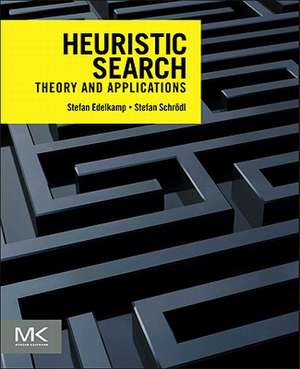
Heuristic Search: Theory and Applications
Autor Stefan Edelkamp, Stefan Schroedlen Limba Engleză Hardback – 28 iul 2011
Cititorul care a aplicat ideile fundamentale din Search in Artificial Intelligence va găsi în acest volum o extensie tehnică necesară, care face trecerea de la teoria clasică la implementările moderne optimizate pentru hardware-ul actual. În timp ce lucrările tradiționale se concentrează pe mecanismele de bază, Heuristic Search se distinge prin rigoarea cu care analizează utilizarea eficientă a memoriei externe și a procesării paralele pe plăci grafice, elemente esențiale în peisajul computațional contemporan.
Apreciem modul în care Stefan Edelkamp și Stefan Schroedl au structurat cele peste 700 de pagini, oferind o progresie logică de la un manual introductiv în prima parte, către soluții complexe pentru limitări de resurse. În contextul operei sale, Stefan Edelkamp continuă aici viziunea din Algorithmic Intelligence, demonstrând că fundamentul inteligenței artificiale rezidă în soluții algoritmice bine proiectate. Cartea explorează variații de căutare adversarială și sub constrângeri, dar punctul forte rămâne secțiunea de aplicații practice.
Spre deosebire de abordările pur teoretice, autorii includ studii de caz din robotică și biologie computațională, oferind o perspectivă aplicată asupra modului în care algoritmii de căutare rezolvă probleme reale de navigație sau verificare de sistem. Structura modulară, susținută de figuri și ilustrații alb-negru, facilitează navigarea prin concepte dificile precum bazele de date de tip pattern sau căutarea simbolică, transformând acest tratat într-o resursă de referință pentru cercetători și studenți la nivel postuniversitar.
Preț: 426.10 lei
Preț vechi: 633.95 lei
-33%
Carte tipărită la comandă
Livrare economică 24 noiembrie-08 decembrie
Specificații
ISBN-10: 0123725127
Pagini: 712
Ilustrații: black & white illustrations, figures
Dimensiuni: 191 x 235 x 48 mm
Greutate: 1.63 kg
Editura: ELSEVIER SCIENCE
V-ar putea interesa
-
 Using Artificial Intelligence Absolute Beginner's GuideMichael Miller-20%Preț: 201.72 lei252.15 lei
 -
 -20%Preț: 2116.13 lei2645.16 lei
 -
 Prolog Programming for Artificial IntelligenceIvan Bratko-20%Preț: 570.78 lei713.49 lei
 -
 AI for Games, Third EditionIan MillingtonPreț: 386.78 lei
 -
 Computer Architecture: A Quantitative ApproachJohn L. Hennessy-39%Preț: 534.37 lei882.55 lei
 -
 -20%Preț: 553.77 lei692.21 lei
 -
 Artificial Intelligence: A Guide to Intelligent SystemsMichael Negnevitsky-20%Preț: 646.12 lei807.65 lei
 -
 Machine Learning For DummiesLuca Massaron-20%Preț: 149.88 lei187.36 lei
 -
 Agentic AI For DummiesPam Baker-20%Preț: 145.95 lei182.44 lei
 -
 The Essential Book of AIAnne Rooney-20%Preț: 76.61 lei95.77 lei
 -
 Programming Game AI by ExampleMat Buckland-19%Preț: 271.62 lei337.03 lei
 -
 Grokking Artificial Intelligence AlgorithmsRishal Hurbans-20%Preț: 369.70 lei462.13 lei
 -
 Classic Computer Science Problems in JavaDavid Kopec-20%Preț: 369.03 lei461.29 lei
 -
 Optimization AlgorithmsAlaa Khamis-20%Preț: 405.89 lei507.37 lei
 -
 -35%Preț: 258.17 lei396.21 lei
 -
 -35%Preț: 300.13 lei465.31 lei
 -
 Handbook of HeuristicsRafael Martí-24%Preț: 5679.41 lei7472.92 lei
 -
 Algorithmic IntelligenceStefan Edelkamp-20%Preț: 1454.69 lei1818.36 lei
 -
 Recent Advances in Artificial Intelligence and Smart ApplicationsJyotsna K. Mandal-18%Preț: 1017.19 lei1240.48 lei
Public țintă
Researchers, professors, and graduate studentsDe ce să citești această carte
Recomandăm această lucrare profesioniștilor care doresc să stăpânească algoritmii de căutare dincolo de nivelul academic. Veți câștiga o înțelegere profundă a modului în care se optimizează căutarea sub constrângeri stricte de memorie și timp, utilizând tehnologii de procesare paralelă. Este un instrument indispensabil pentru cei care dezvoltă sisteme complexe de planificare, robotică sau optimizare combinatorie, oferind puntea necesară între analiza teoretică și implementarea eficientă în lumea reală.
Descriere scurtă
Heuristic search as a problem solving tool is demonstrated in applications for puzzle solving, game playing, constraint satisfaction and machine learning. While no previous familiarity with heuristic search is necessary the reader should have a basic knowledge of algorithms, data structures, and calculus. Real-world case studies and chapter ending exercises help to create a full and realized picture of how search fits into the world of artificial intelligence and the one around us.
- Provides real-world success stories and case studies for heuristic search algorithms
- Includes many AI developments not yet covered in textbooks such as pattern databases, symbolic search, and parallel processing units
Cuprins
Chapter 1 Introduction
Chapter 2 Basic Search Algorithms
Chapter 3 Dictionary Data Structures
Chapter 4 Automatically Created Heuristics
PART II Heuristic Search under Memory Constraints
Chapter 5 Linear-Space Search
Chapter 6 Memory Restricted Search
Chapter 7 Symbolic Search
Chapter 8 External Search
PART III Heuristic Search under Time Constraints
Chapter 9 Distributed Search
Chapter 10 State Space Pruning
Chapter 11 Real-Time Search by Sven Koenig
PART IV Heuristic Search Variants
Chapter 12 Adversary Search
Chapter 13 Constraint Search
Chapter 14 Selective Search
PART V Heurstic Search Applications
Chapter 15 Action Planning
Chapter 16 Automated System Verification
Chapter 17 Vehicle Navigation
Chapter 18 Computational Biology
Chapter 19 Robotics by Sven Koenig
Recenzii
"The authors have done an outstanding job putting together this book on artificial intelligence (AI) heuristic state space search. It comprehensively covers the subject from its basics to the most recent work and is a great introduction for beginners in this field." --BCS.org
"Heuristic search lies at the core of Artificial Intelligence and it provides the foundations for many different approaches in problem solving. This book provides a comprehensive yet deep description of the main algorithms in the field along with a very complete discussion of their main applications. Very well-written, it embellishes every algorithm with pseudo-code and technical studies of their theoretical performance." --Carlos Linares López, Universidad Carlos III de Madrid
"This is an introduction to artificial intelligence heuristic state space search. Authors Edelkamp (U. of Bremen, Germany) and Schrödl (a research scientist at Yahoo! Labs) seek to strike a balance between search algorithms and their theoretical analysis, on the one hand, and their efficient implementation and application to important real-world problems on the other, while covering the field comprehensively from well-known basic results to recent work in the state of the art. Prior knowledge of artificial intelligence is not assumed, but basic knowledge of algorithms, data structures, and calculus is expected. Proofs are included for formal rigor and to introduce proof techniques to the reader. They have organized the material into five sections: heuristic search primer, heuristic search under memory constraints, heuristic search under time constraints, heuristic search variants, and applications." --SciTech Book News
"This almost encyclopedic text is suitable for advanced courses in artificial intelligence and as a text and reference for developers, practitioners, students, and researchers in artificial intelligence, robotics, computational biology, and the decision sciences. The exposition is comparable to texts for a graduate-level or advanced undergraduate course in computer science, and prior exposure or coursework in advanced algorithms, computability, or artificial intelligence would help a great deal in understanding the material. Algorithms are described in pseudocode, accompanied by diagrams and narrative explanations in the text. The vast size of the ‘search algorithms’ subject domain and the variety of applications of search mean that much information--especially pertaining to applications of search algorithms--had to be left out; however, an extensive (though still limited) bibliography is included for follow-up by the reader. Exercises are provided for each chapter, except the five chapters on applications, and bibliographic notes accompany all chapters." --Computing Reviews