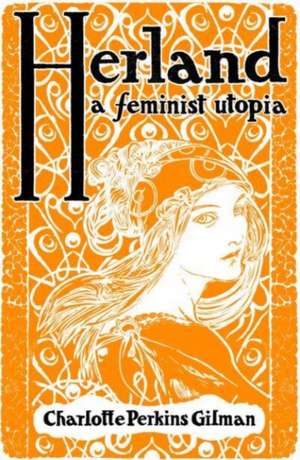
Herland
Autor Charlotte Perkins Gilmanen Limba Engleză Paperback – 26 iul 2023
Preț: 62.13 lei
Puncte Express: 93
Carte disponibilă
Livrare economică 13-27 noiembrie
Livrare express 29 octombrie-04 noiembrie pentru 19.16 lei
Livrare prin curier în România Termenul estimat este afișat lângă disponibilitate.
Transport gratuit de la 400.00 lei Plată online sau ramburs, în funcție de opțiunile comenzii.
Retur gratuit în 14 zile Comandă securizată și suport în română.
Specificații
ISBN-13: 9781804470350
ISBN-10: 180447035X
Pagini: 192
Dimensiuni: 126 x 196 x 17 mm
Greutate: 0.2 kg
Editura: Renard Press Ltd
ISBN-10: 180447035X
Pagini: 192
Dimensiuni: 126 x 196 x 17 mm
Greutate: 0.2 kg
Editura: Renard Press Ltd
V-ar putea interesa
-
 Preț: 64.04 lei
 -
 Death in Venice & a Man and His DogThomas MannPreț: 91.99 lei
 -
 Preț: 65.76 lei
 -
 PlaydateThelma AdamsPreț: 111.97 lei
 -
 Charlotte Perkins Gilman, Complete CollectionCharlotte Perkins GilmanPreț: 148.01 lei
 -
 Die Gelbe Tapete (Translated)Charlotte Perkins GilmanPreț: 36.31 lei
 -
 Moving the MountainCharlotte Perkins GilmanPreț: 55.61 lei
 -
 The Yellow Wallpaper (English Edition)Charlotte Perkins GilmanPreț: 43.88 lei
 -
 Six Macavelly Short Stories, and the Yellow Wallpaper & Other Thirteen Short Stories, (2 Books)Charlotte Perkins GilmanPreț: 61.94 lei
 -
 Herland (1915) Novel byCharlotte Perkins GilmanPreț: 62.45 lei
 -
 Herland and Related WritingsCharlotte Perkins Gilman-16%Preț: 133.63 lei159.53 lei
 -
 Preț: 224.00 lei
 -
 Une Vieille Maîtresse. Tome 1 (Éd.1879)Jules Barbey D'AurevillyPreț: 169.14 lei
 -
 Bruges-La-Morte, Roman (Éd.1892)Georges RodenbachPreț: 144.03 lei
 -
 Felicia Ou Mes Fredaines, Orné de Figures En Taille-Douce. 1-4 P T. 2 (Éd.1782)André-Robert Andréa de NerciatPreț: 135.31 lei
 -
 Preț: 177.00 lei
 -
 L'Atelier d'Un Peintre: Scènes de la Vie Privée. 2 (Éd.1833)Marceline Desbordes-ValmorePreț: 175.55 lei
 -
 L'Élixir Du Diable (Éd.1873)Ernst-Théodor-Amadeus HoffmannPreț: 94.99 lei
 -
 Mon Oncle Benjamin. Oeuvres de Claude Tillier (Éd.1862)Claude TillierPreț: 136.36 lei
 -
 Patira (12e Édition) (Éd.1884)Raoul De NaveryPreț: 214.42 lei
 -
 De economische toestand der vrouwCharlotte Perkins GilmanPreț: 224.29 lei
 -
 HERLAND (Wisehouse Classics - Original Edition 1909-1916)Charlotte Perkins GilmanPreț: 50.97 lei
Descriere
Descriere de la o altă ediție sau format:
Delightfully humorous account of a feminist utopia in which 3 male explorers stumble upon an all-female society isolated in a distant part of the earth. Early 20th-century vehicle for Gilman's then-unconventional views of male-female behavior, motherhood, individuality, sense of community, sexuality, and other topics. Mischievous, ironic approach used to telling effect.
Delightfully humorous account of a feminist utopia in which 3 male explorers stumble upon an all-female society isolated in a distant part of the earth. Early 20th-century vehicle for Gilman's then-unconventional views of male-female behavior, motherhood, individuality, sense of community, sexuality, and other topics. Mischievous, ironic approach used to telling effect.
Notă biografică
Charlotte Perkins Gilman was an American writer, lecturer, social critic, and feminist thinker whose work helped shape modern discussions of women's labour, domestic life, economic dependence, mental health, gender roles, and social reform. Born in 1860, Gilman became one of the most influential feminist intellectuals of the late nineteenth and early twentieth centuries. Her nonfiction study Women and Economics argued that women's social and economic dependence was not natural but produced by social arrangements, domestic convention, and restricted access to meaningful public work. Her fiction often gave imaginative form to those arguments.Gilman is best known today for The Yellow Wallpaper, one of the most important American short stories about women's confinement, medical authority, and mental distress, but Herland is equally central to her legacy. First published in The Forerunner, the magazine she wrote and edited, the novel uses utopian fiction to test assumptions about gender, motherhood, education, work, violence, and civilisation. Her writing remains important to readers of feminist literature, American realism and reform fiction, early science fiction, utopian literature, women's studies, and recovered classics by women writers.