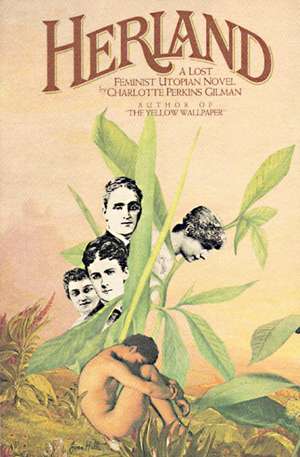
Herland
Autor Charlotte Perkins Gilmanen Limba Engleză Paperback – 12 feb 1979
Preț: 127.33 lei
Puncte Express: 191
Carte tipărită la comandă
Livrare economică 21-28 decembrie
Livrare prin curier în România Termenul estimat este afișat lângă disponibilitate.
Transport gratuit de la 400.00 lei Plată online sau ramburs, în funcție de opțiunile comenzii.
Retur gratuit în 14 zile Comandă securizată și suport în română.
Specificații
ISBN-13: 9780394736655
ISBN-10: 0394736656
Pagini: 174
Dimensiuni: 140 x 210 x 10 mm
Greutate: 0.22 kg
Editura: Knopf Doubleday Publishing Group
ISBN-10: 0394736656
Pagini: 174
Dimensiuni: 140 x 210 x 10 mm
Greutate: 0.22 kg
Editura: Knopf Doubleday Publishing Group
V-ar putea interesa
-
 XYELLOW WALLPAPER_CLASSICS PBCharlotte Perkins GilmanPreț: 29.38 lei
-
 A Magical Girl Retires (Nomad Edition)Park SeolyeonPreț: 78.35 lei
-
 -17%Preț: 60.57 lei72.69 lei
-
 -16%Preț: 18.66 lei22.10 lei
-
 The Yellow Wallpaper and Other WritingsCharlotte Perkins GilmanPreț: 45.60 lei
-
 The Gate to Women's CountrySheri S. TepperPreț: 47.49 lei
-
 Down Among the WomenFay WeldonPreț: 92.94 lei
-
 No Friend to This HouseNatalie Haynes-31%Preț: 76.30 lei110.17 lei
-
 Ancient Myths and Legends Without MenMara GoldPreț: 161.51 lei
-
 I Who Have Never Known Men. Deluxe EditionJacqueline HarpmanPreț: 121.60 lei
-
 Herland and Related WritingsCharlotte Perkins Gilman-16%Preț: 133.63 lei159.53 lei
-
 Women and Economics and Other WritingsCharlotte Perkins Gilman-17%Preț: 144.51 lei173.99 lei
-
 Charlotte Perkins Gilman: Novels, Stories & Poems (LOA #356)Charlotte Perkins Gilman-18%Preț: 271.28 lei331.98 lei
-
 The Book of RevelationsJuliet NicolsonPreț: 159.06 lei
-
 Herland and The Yellow WallpaperCharlotte Perkins Gilman-18%Preț: 59.20 lei71.89 lei
-
 A Vindication of the Rights of WomanMary WollstonecraftPreț: 72.63 lei
-
 The Four Spent the Day TogetherChris KrausPreț: 123.53 lei
-
 UtopiaThomas MorePreț: 35.25 lei
Descriere
One the eve of WWI, three American male explorers stumble onto an all-female society somewhere in the distant reaches of the earth. Unable to believe their eyes, they promptly set out to find some men, convinced that since this is a civilized country--there must be men. So begins this sparkling utopian novel, a romp through a whole world "masculine" and "feminine", as on target today as when it was written 65 years ago.
Notă biografică
Charlotte Perkins Gilman was an American writer, lecturer, social critic, and feminist thinker whose work helped shape modern discussions of women's labour, domestic life, economic dependence, mental health, gender roles, and social reform. Born in 1860, Gilman became one of the most influential feminist intellectuals of the late nineteenth and early twentieth centuries. Her nonfiction study Women and Economics argued that women's social and economic dependence was not natural but produced by social arrangements, domestic convention, and restricted access to meaningful public work. Her fiction often gave imaginative form to those arguments.Gilman is best known today for The Yellow Wallpaper, one of the most important American short stories about women's confinement, medical authority, and mental distress, but Herland is equally central to her legacy. First published in The Forerunner, the magazine she wrote and edited, the novel uses utopian fiction to test assumptions about gender, motherhood, education, work, violence, and civilisation. Her writing remains important to readers of feminist literature, American realism and reform fiction, early science fiction, utopian literature, women's studies, and recovered classics by women writers.