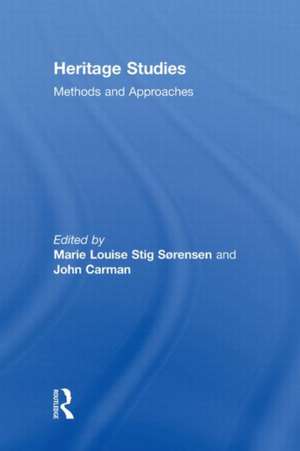
Heritage Studies: Methods and Approaches
Editat de Marie Louise Stig Sørensen, John Carmanen Limba Engleză Hardback – 17 sep 2009
The methods considered fall within three broad categories: textual/discourse analysis, methods for investigating people’s attitudes and behaviour; and methods for exploring the material qualities of heritage. The methods discussed and illustrated range from techniques such as text analysis, interviews, participant observation, to semiotic analysis of heritage sites and the use of GIS. Each paper discusses the ways in which methods used in social analysis generally are explored and adapted to the specific demands that arise when applied to the investigation of heritage in its many forms.
Heritage Studies is a seminal volume that will help to define the field. The global perspective and the shared focus upon the development of reflexive methodologies ensure that the volume explores these central issues in a manner that is simultaneously case-specific and of general relevance.
Preț: 1125.63 lei
Preț vechi: 1372.71 lei
-18%
Puncte Express: 1688
Carte tipărită la comandă
Livrare economică 08-22 decembrie
Livrare prin curier în România Termenul estimat este afișat lângă disponibilitate.
Transport gratuit pentru acest produs Plată online sau ramburs, în funcție de opțiunile comenzii.
Retur gratuit în 14 zile Comandă securizată și suport în română.
Specificații
ISBN-13: 9780415431842
ISBN-10: 0415431840
Pagini: 360
Ilustrații: 4 tables, 30 halftones and 15 line drawings
Dimensiuni: 156 x 234 x 22 mm
Greutate: 0.83 kg
Ediția:1
Editura: Taylor & Francis
Colecția Routledge
Locul publicării:Oxford, United Kingdom
ISBN-10: 0415431840
Pagini: 360
Ilustrații: 4 tables, 30 halftones and 15 line drawings
Dimensiuni: 156 x 234 x 22 mm
Greutate: 0.83 kg
Ediția:1
Editura: Taylor & Francis
Colecția Routledge
Locul publicării:Oxford, United Kingdom
V-ar putea interesa
-
 Mass Media and Free Trade: NAFTA and the Cultural IndustriesEmile G. McAnanyPreț: 331.66 lei
 -
 Preț: 467.81 lei
 -
 -18%Preț: 1297.75 lei1582.62 lei
 -
 -18%Preț: 1299.91 lei1585.26 lei
 -
 The Idea of Cultural HeritageDerek GillmanPreț: 210.60 lei
 -
 Economics and CultureDavid ThrosbyPreț: 346.72 lei
 -
 Art of the DealNoah HorowitzPreț: 222.22 lei
 -
 History and memoryGeoffrey CubittPreț: 232.99 lei
 -
 The Heritage-scape: UNESCO, World Heritage, and TourismDr. Michael A. Di Giovine-30%Preț: 406.60 lei583.13 lei
 -
 -19%Preț: 324.00 lei399.29 lei
 -
 Manual of Museum ManagementGail Dexter Lord-19%Preț: 483.22 lei596.56 lei
 -
 The Risk Society and BeyondBarbara Adam-18%Preț: 694.47 lei846.92 lei
 -
 Preț: 301.72 lei
 -
 A Richer HeritageRobert E. StipePreț: 448.96 lei
 -
 The Historic Urban LandscapeFrancesco Bandarin-8%Preț: 476.53 lei517.97 lei
 -
 Issues in Cultural Tourism StudiesMelanie K. Smith-15%Preț: 557.02 lei655.32 lei
 -
 -9%Preț: 2783.84 lei3059.16 lei
 -
 Eco-Architecture VC. A. Brebbia-9%Preț: 2924.71 lei3213.96 lei
 -
 Cultural Heritage and Value CreationGaetano M. Golinelli-18%Preț: 923.32 lei1126.00 lei
 -
 Cultural EconomicsRuth Towse-18%Preț: 911.34 lei1111.40 lei
 -
 Cultural Economics and Cultural PoliciesA T Peacock-18%Preț: 924.81 lei1127.82 lei
Public țintă
Postgraduate and UndergraduateCuprins
Part 1: Setting the Scene 1. Introduction: Making the Means Transparent: Reasons and Reflections 2. Heritage Studies – An Outline 3. Public Archaeology in United States in the Early Twenty-First Century Part 2: Heritage Methodologies: Investigating Texts 4. The History of Heritage: A Method in Analyzing Legislative Historiography 5. Means Maketh the End – The Context for the Development of Methodologies to Assessing the State of the Historic Environment in the UK 6. Methods Used to Investigate the Use of the Past in the Formation of Regional Identities Part 3: Heritage Methodologies: Investigating People 7. Reflections on the Practice of Ethnography Within Heritage Tourism 8. Heritage Ethnography as a Specialised Craft: Grasping Maritime Heritage in Bermuda 9. Between the Lines and in the Margins: Interviewing People About Attitudes to Heritage and Identity 10. Walking a Fine Line: Obtaining Sensitive Information Using a Valid Methodology 11. Methods for Investigating Locals’ Perceptions of a Cultural Heritage Product for Tourism: Lessons from Botswana Susan 12. The Public Archaeology of African America: Reflections on Pragmatic Methods and their Results Part 4: Heritage Methodologies: Investigating Things 13. The Use of GIS in Landscape Heritage and Attitudes to Place-Digital Deep Maps 14. Making them Draw: The Use of Drawings in Research into Public Attitudes Towards the Past 15. The Heritagescape: Looking at Heritage Sites 16. The Intangible Presence: Investigating Battlefields Part 5: Commentaries Commentary: the View from Social Anthropology Commentary: The View from Environmental Psychology
Recenzii
'... if you are looking for a stimulating collection of case studies that have something
to say about an almost exclusively archaeological understanding of heritage, this would be an excellent place to start.' – Conservation and Management of Archaeological Sites
to say about an almost exclusively archaeological understanding of heritage, this would be an excellent place to start.' – Conservation and Management of Archaeological Sites