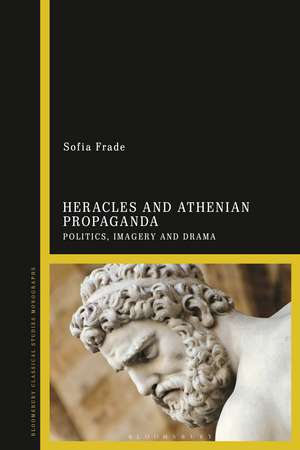
Heracles and Athenian Propaganda: Politics, Imagery and Drama
Autor Sofia Fradeen Limba Engleză Hardback – 15 iun 2023
Examining how Euripides' play fits within the space of the polis and its political ideology, Sofia Frade asks specific questions of tragedy and politics: how does Euripides' tragic drama of grief, insanity and murder reconcile this hero to a palatable, patriotic ideal? How does the tragic hero relate to his own representations and his cult within the polis? In a city so marked by iconographic propaganda, how did the imagery influence the audience?
By looking at the play's larger contexts - literary, civic, political, religious and ideological - new readings are offered to the most problematic elements of the play, including the question of its unity, the nature of the hero's madness and the role of the gods.
Preț: 526.36 lei
Preț vechi: 836.34 lei
-37%
Puncte Express: 790
Carte tipărită la comandă
Livrare economică 08-22 iunie
Specificații
ISBN-13: 9781472505590
ISBN-10: 147250559X
Pagini: 176
Dimensiuni: 160 x 236 x 14 mm
Greutate: 0.41 kg
Editura: Bloomsbury Publishing
Colecția Bloomsbury Academic
Locul publicării:London, United Kingdom
ISBN-10: 147250559X
Pagini: 176
Dimensiuni: 160 x 236 x 14 mm
Greutate: 0.41 kg
Editura: Bloomsbury Publishing
Colecția Bloomsbury Academic
Locul publicării:London, United Kingdom
V-ar putea interesa
-
 -36%Preț: 4881.99 lei7645.47 lei
 -
 Polybius' HistoriesBrian C. McGing-6%Preț: 186.98 lei199.44 lei
 -
 Roman HomosexualityCraig A. Williams-12%Preț: 306.64 lei347.70 lei
 -
 -7%Preț: 675.51 lei729.97 lei
 -
 Aristotle as Poet: The Song for Hermias and Its ContextsAndrew L. Ford-11%Preț: 454.38 lei510.53 lei
 -
 -7%Preț: 601.36 lei644.81 lei
 -
 Lives Behind the LawsSerena ConnollyPreț: 195.66 lei
 -
 -21%Preț: 183.61 lei231.68 lei
 -
 Bathing in the Roman WorldFikret YegülPreț: 246.06 lei
 -
 Res Gestae Divi AugustiAugustusPreț: 218.84 lei
 -
 The Cambridge Companion to Greek LyricFelix BudelmannPreț: 356.34 lei
 -
 The Cambridge Companion to the Roman HistoriansAndrew FeldherrPreț: 298.07 lei
 -
 The Cambridge Companion to TacitusA. J. WoodmanPreț: 273.35 lei
 -
 An Introduction to Greek TragedyRuth ScodelPreț: 271.59 lei
 -
 Are We Rome?Cullen MurphyPreț: 95.25 lei
 -
 The Lagoon: How Aristotle Invented ScienceArmand Marie Leroi-26%Preț: 67.40 lei90.93 lei
 -
 Owning the Earth: The Transforming History of Land OwnershipAndro Linklater-27%Preț: 85.43 lei117.30 lei
 -
 Marcus AureliusFrank McLynn-19%Preț: 96.58 lei118.61 lei
 -
 The ParthenonProfessor Mary Beard-21%Preț: 59.40 lei75.08 lei
Cuprins
1. Introduction
2. Propaganda and Politics Athens
3. Transforming the Hero: Heracles and Athenian Ideology
4. Forsaking the tripod: Heracles in Athenian Architecture
5. Crossing Boundaries: What is it to be a hero?
6. Into Athens: old gods and new gods
7. Conclusion
Notes
Bibliography
Index
2. Propaganda and Politics Athens
3. Transforming the Hero: Heracles and Athenian Ideology
4. Forsaking the tripod: Heracles in Athenian Architecture
5. Crossing Boundaries: What is it to be a hero?
6. Into Athens: old gods and new gods
7. Conclusion
Notes
Bibliography
Index
Recenzii
[I]lluminating and persuasive.
[Frade's] monograph and arguments [are] persuasive and robust, especially considering the 'cultural surface,' which is a strong tool for analyzing the use of myth for identity and shaping political narratives. Therefore, the reviewer strongly recommends reading this excellent monograph for anyone interested in the relationship between politics and myth in ancient Greece.
In Heracles and the Athenian Propaganda: Politics, Imagery, and Drama, with a well-thought-out and well-argued thesis, a clear structure, no unnecessary digressions, and a critical approach to the previous bibliography, Sofia Frade offers a convincing and valuable interpretation of Euripides' Heracles in light of its cultural and ideological context.
[Frade's] monograph and arguments [are] persuasive and robust, especially considering the 'cultural surface,' which is a strong tool for analyzing the use of myth for identity and shaping political narratives. Therefore, the reviewer strongly recommends reading this excellent monograph for anyone interested in the relationship between politics and myth in ancient Greece.
In Heracles and the Athenian Propaganda: Politics, Imagery, and Drama, with a well-thought-out and well-argued thesis, a clear structure, no unnecessary digressions, and a critical approach to the previous bibliography, Sofia Frade offers a convincing and valuable interpretation of Euripides' Heracles in light of its cultural and ideological context.