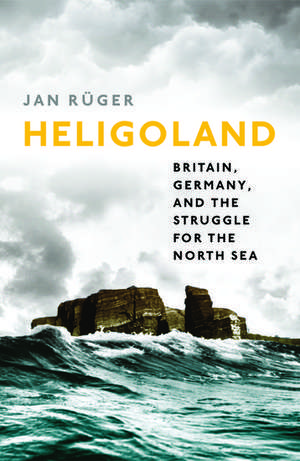
Heligoland: Britain, Germany, and the Struggle for the North Sea
Autor Jan Rügeren Limba Engleză Hardback – 12 ian 2017
Preț: 199.71 lei
Puncte Express: 300
Carte disponibilă
Livrare economică 12-18 noiembrie
Livrare prin curier în România Termenul estimat este afișat lângă disponibilitate.
Transport gratuit de la 400.00 lei Plată online sau ramburs, în funcție de opțiunile comenzii.
Retur gratuit în 14 zile Comandă securizată și suport în română.
Specificații
ISBN-13: 9780199672462
ISBN-10: 0199672466
Pagini: 384
Ilustrații: 29 black & white illustrations, 1 map
Dimensiuni: 162 x 242 x 34 mm
Greutate: 0.64 kg
Editura: OUP OXFORD
Colecția OUP Oxford
Locul publicării:Oxford, United Kingdom
ISBN-10: 0199672466
Pagini: 384
Ilustrații: 29 black & white illustrations, 1 map
Dimensiuni: 162 x 242 x 34 mm
Greutate: 0.64 kg
Editura: OUP OXFORD
Colecția OUP Oxford
Locul publicării:Oxford, United Kingdom
V-ar putea interesa
-
 The RepublicCharles TownshendPreț: 123.23 lei
 -
 -31%Preț: 562.71 lei810.91 lei
 -
 -31%Preț: 548.20 lei791.24 lei
 -
 Reforming Printing: Syon Abbey's Defence of Orthodoxy 1525-1534Alexandra da Costa-31%Preț: 991.41 lei1445.58 lei
 -
 -28%Preț: 530.75 lei737.36 lei
 -
 -34%Preț: 743.38 lei1124.25 lei
 -
 Saltpeter: The Mother of GunpowderDavid Cressy-11%Preț: 352.74 lei397.67 lei
 -
 An Ordinary Marriage: The World of a Gentry Family in Provincial RussiaKatherine Pickering Antonova-31%Preț: 712.95 lei1026.32 lei
 -
 -28%Preț: 467.68 lei651.38 lei
 -
 -19%Preț: 350.84 lei430.88 lei
 -
 A Brief History of the English ReformationMr Derek Wilson-27%Preț: 78.30 lei106.54 lei
 -
 Stoke City Match of My LifeSimon LowePreț: 68.38 lei
Recenzii
The breadth of research - from areas as diverse as music, art, and literature, to naval planning and Nazi propaganda - is impressive, as is the authors skill in selecting what to leave out in what might easily have become an unwieldy study. Heligoland is a valuable addition to the literature to Anglo-German affairs since 1800, and one which - due to its inclusivity and breadth- will be of interest to all scholars interested in either country or indeed the history of Europe, in that period.
One of the book's greatest advantages is its periodization and long-term perspective. It makes it easy to follow, and it places the narrative within broader processes and events. The main arguments are clearly presented and the text is highly readable. Personal stories and anecdotes contribute to this readability. Numerous illustrations are interspersed in the text and support it nicely... the book is a brilliant example of the way in which geographical features can serve as an axis for the study of history.
He provides a rich and highly readable study that is a valuable addition to the literature on Anglo-German relations in the nineteenth and twentieth centuries.
A fascinating insight to the often troubled relations between [Britain and Germany] from the Napoleonic Wars to the Cold War.
Jan Rüger has exploited an impressive array of sources to craft a masterful account not just of the history of this tiny, unique place, but of the Anglo-German relationship in general a model microhistory with an approach well worth emulating.
Fascinating.
Pacey and erudite... succeeds admirably.
A Rüger's work on this small island is historiography at its best.
Rüger's book moves seamlessly between the views and demands of the inhabitants of Heligoland... and the considerations and policies impacting the island in the halls of government in Great Britain and Germany. Well-researched from multiple archives... the book also provides a useful and important reminder to historians of the need to consider a "long view".
Masterful... fascinating... this is microhistory at its best.
A thought-provoking treatise of how nations coexist -- or dont.
This brilliant, quirky book tells the almost unknown story of the tiny North Sea German island that became an unlikely corner of the British Empire.
The reader of Rüger's volume will be fascinated, surprised, horrified and moved.
A fascinating book which uses a scrap of land in the North Sea to illustrate the tumultuous relationship between Britain and Germany.
Rüger's book brilliantly spins a far bigger history out of one small, half-forgotten place. For so long the fault line between two powers, Heligoland deserves to be rescued from oblivion; it has found an admirable historian.
The whole book is studded with unexpected gems about extraordinary people ... a fine tale.
Resonant... a prism through which to view the entire span of Anglo-German rivalry, conflict and, eventually, reconciliation.
Utterly fascinating ... impeccable, original, scholarly and superbly written
Mr Ruger makes his case that Heligoland's fortunes are a useful bellwether of wider relations and he relates his story in an engaging style ... More people should know Heligoland's story for the echoes it has today.
A gem of a study ... concise, scholarly, and readable. On one level it is simply an authoritative narrative history of an island and ist people, but on another it represents so much more: a case study of the twists and turns of Britain's relationship with Germany, Europe, and the wider world over two tumultuous centuries.
Visitors today may be quite unaware of Heligoland's curious history or of the weight of symbolism it once bore. Day trippers come now to enjoy the bird watching, the 1950s architecture, the duty-free cigarettes. Before setting out, they should read Mr. Ruger's fascinating book.
For those devourers of "forgotten" history, this book is a must ... riveting
distinguished German historian Jan Rüger ... has written a micro-history that captures the complexity of Anglo-German relations
The author deserves to be congratulated on his achievement.
This scholarship underpinning this work is impressive ... The result is a work of ambitious inclusivity and breadth. While it might be said that micro-history is fast becoming an established genre, Ruger's approach is nevertheless genuinely innovative and offers a succession of new insights.
A brilliant and subtle history of Anglo-German relations, told through the evocative study of a contested island. This fascinating book is a triumphant demonstration of the power of microhistory.
This is a brilliant demonstration of how the very small can have a significance over time on the very large. Drawing on literature, cartography, art, music and film, as well as a wide spread of archives, Jan Rüger shows how and why Heligoland became caught up in a succession of epic and destructive wars, conflicting but also overlapping national identities, the rise and fall of Anglo-German antagonism, and the competition for empire.
Jan Rüger's new book takes the North Sea island of Heligoland as a lens through which to examine Anglo-German relations over the past two centuries. The result is an entertaining and illuminating study full of colourful detail, that traces the phases of co-operation and hostility between the two powers over the decades from the Kaiser to Hitler and beyond.
Ruger's Heligoland: Britain, Germany, and the Struggle for the North Sea succeeds brilliantly in exposing how Britons and Germans moved from admiration to antagonism, from cooperation to conflict, intermingling elements of both during the long nineteenth century, between the world wars, and after the Second World War. Focusing on the specific, it illustrates the shifting dynamics of the general relationship. The micro-study references higher level diplomacy and the military dimensions of the Anglo-German relationship but focuses on how art, poetry, music, and the everyday interactions of islanders, visitors, and representatives of the state made Heligoland into something more than two small islands buffeted by the waves of the North Sea.
One of the book's greatest advantages is its periodization and long-term perspective. It makes it easy to follow, and it places the narrative within broader processes and events. The main arguments are clearly presented and the text is highly readable. Personal stories and anecdotes contribute to this readability. Numerous illustrations are interspersed in the text and support it nicely... the book is a brilliant example of the way in which geographical features can serve as an axis for the study of history.
He provides a rich and highly readable study that is a valuable addition to the literature on Anglo-German relations in the nineteenth and twentieth centuries.
A fascinating insight to the often troubled relations between [Britain and Germany] from the Napoleonic Wars to the Cold War.
Jan Rüger has exploited an impressive array of sources to craft a masterful account not just of the history of this tiny, unique place, but of the Anglo-German relationship in general a model microhistory with an approach well worth emulating.
Fascinating.
Pacey and erudite... succeeds admirably.
A Rüger's work on this small island is historiography at its best.
Rüger's book moves seamlessly between the views and demands of the inhabitants of Heligoland... and the considerations and policies impacting the island in the halls of government in Great Britain and Germany. Well-researched from multiple archives... the book also provides a useful and important reminder to historians of the need to consider a "long view".
Masterful... fascinating... this is microhistory at its best.
A thought-provoking treatise of how nations coexist -- or dont.
This brilliant, quirky book tells the almost unknown story of the tiny North Sea German island that became an unlikely corner of the British Empire.
The reader of Rüger's volume will be fascinated, surprised, horrified and moved.
A fascinating book which uses a scrap of land in the North Sea to illustrate the tumultuous relationship between Britain and Germany.
Rüger's book brilliantly spins a far bigger history out of one small, half-forgotten place. For so long the fault line between two powers, Heligoland deserves to be rescued from oblivion; it has found an admirable historian.
The whole book is studded with unexpected gems about extraordinary people ... a fine tale.
Resonant... a prism through which to view the entire span of Anglo-German rivalry, conflict and, eventually, reconciliation.
Utterly fascinating ... impeccable, original, scholarly and superbly written
Mr Ruger makes his case that Heligoland's fortunes are a useful bellwether of wider relations and he relates his story in an engaging style ... More people should know Heligoland's story for the echoes it has today.
A gem of a study ... concise, scholarly, and readable. On one level it is simply an authoritative narrative history of an island and ist people, but on another it represents so much more: a case study of the twists and turns of Britain's relationship with Germany, Europe, and the wider world over two tumultuous centuries.
Visitors today may be quite unaware of Heligoland's curious history or of the weight of symbolism it once bore. Day trippers come now to enjoy the bird watching, the 1950s architecture, the duty-free cigarettes. Before setting out, they should read Mr. Ruger's fascinating book.
For those devourers of "forgotten" history, this book is a must ... riveting
distinguished German historian Jan Rüger ... has written a micro-history that captures the complexity of Anglo-German relations
The author deserves to be congratulated on his achievement.
This scholarship underpinning this work is impressive ... The result is a work of ambitious inclusivity and breadth. While it might be said that micro-history is fast becoming an established genre, Ruger's approach is nevertheless genuinely innovative and offers a succession of new insights.
A brilliant and subtle history of Anglo-German relations, told through the evocative study of a contested island. This fascinating book is a triumphant demonstration of the power of microhistory.
This is a brilliant demonstration of how the very small can have a significance over time on the very large. Drawing on literature, cartography, art, music and film, as well as a wide spread of archives, Jan Rüger shows how and why Heligoland became caught up in a succession of epic and destructive wars, conflicting but also overlapping national identities, the rise and fall of Anglo-German antagonism, and the competition for empire.
Jan Rüger's new book takes the North Sea island of Heligoland as a lens through which to examine Anglo-German relations over the past two centuries. The result is an entertaining and illuminating study full of colourful detail, that traces the phases of co-operation and hostility between the two powers over the decades from the Kaiser to Hitler and beyond.
Ruger's Heligoland: Britain, Germany, and the Struggle for the North Sea succeeds brilliantly in exposing how Britons and Germans moved from admiration to antagonism, from cooperation to conflict, intermingling elements of both during the long nineteenth century, between the world wars, and after the Second World War. Focusing on the specific, it illustrates the shifting dynamics of the general relationship. The micro-study references higher level diplomacy and the military dimensions of the Anglo-German relationship but focuses on how art, poetry, music, and the everyday interactions of islanders, visitors, and representatives of the state made Heligoland into something more than two small islands buffeted by the waves of the North Sea.
Notă biografică
Jan Rüger is Professor of History at Birkbeck, University of London. He is the author of The Great Naval Game: Britain and Germany in the Age of Empire and joint editor of Rewriting German History.
Cuprins
- Prologue: Between Worlds
- 1: Edge of Europe
- 2: Nation and Empire
- 3: A Matter of Sentiment
- 4: Making Germans
- 5: Island Fortress
- 6: To Heligoland and Back
- 7: Disarming Germany
- 8: Hitler's Island
- 9: Out of Ruins
- Epilogue: No More Heligolands
- List of Abbreviations
- Notes
- Sources
- Acknowledgements
- Picture Credits
- Index