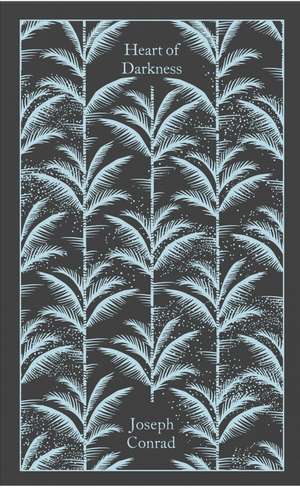
Heart of Darkness
Autor Joseph Conraden Limba Engleză Hardback – 4 iul 2024
Descoperim în Heart of Darkness o nuvelă care subversează convențiile literaturii de aventură maritimă pentru a plonja într-o explorare psihologică densă și tulburătoare. Deși la suprafață urmărim călătoria lui Charles Marlow pe fluviul Congo în căutarea faimosului agent Kurtz, credem că miza reală a lui Joseph Conrad este demascarea fragilității structurilor morale europene. Stilul are ceva din proza lui Thomas Hardy, fără să fie o imitație — acolo unde Hardy analizează forțele implacabile ale naturii asupra individului rural, Conrad proiectează această confruntare pe fundalul brutal al imperialismului, transformând peisajul african într-o oglindă a inconștientului uman. Notăm cu interes structura acestui volum de la Dover Publications, care nu se limitează la textul canonic. Cartea este organizată riguros: prima parte oferă textul integral, urmat de un aparat critic impresionant ce include perspective moderne precum criticismul feminist semnat de Johanna M. Smith sau analize postcoloniale de Patrick Brantlinger. Această abordare transformă lectura dintr-o simplă experiență estetică într-un studiu academic aprofundat. În contextul operei sale, dacă în Lord Jim autorul se concentra pe onoarea pierdută și rătăcirea exotică în Arhipelagul Malaez, aici limbajul devine mai fluid, aproape impresionist, anticipând marile teme ale modernismului. Tonul este unul de o claritate neliniștitoare, unde fiecare descriere a junglei sau a ceții de pe râu servește la acumularea unei tensiuni metafizice ce depășește simplul realism al secolului al XIX-lea.
Preț: 97.85 lei
Preț vechi: 121.61 lei
-20%
Carte disponibilă
Livrare economică 06-17 noiembrie
Livrare express 21-27 octombrie pentru 47.67 lei
Specificații
ISBN-10: 0241655579
Pagini: 192
Dimensiuni: 131 x 201 x 18 mm
Greutate: 0.3 kg
Editura: Penguin Books
Colecția Penguin Clothbound Classics
V-ar putea interesa
-
 Great ExpectationsCharles DickensPreț: 28.01 lei
 -
 Tess of the D'UrbervillesThomas HardyPreț: 28.01 lei
 -
 XGULLIVERS TRAVELS_CLASSICS PBJonathan SwiftPreț: 28.01 lei
 -
 The Adventures Of Huckleberry FinnMark TwainPreț: 28.01 lei
 -
 The Great GatsbyF. Scott FitzgeraldPreț: 28.01 lei
 -
 Mrs DallowayVirginia WoolfPreț: 28.01 lei
 -
 Leaves of GrassWalt WhitmanPreț: 28.46 lei
 -
 The Rime of the Ancient Mariner and Other PoemsSamuel Taylor ColeridgePreț: 28.47 lei
 -
 HomeToni Morrison-20%Preț: 57.09 lei71.08 lei
 -
 The Bunker DiaryKevin Brooks-26%Preț: 53.04 lei71.92 lei
 -
 Fifty Shades of GreyE. L. JamesPreț: 158.90 lei
 -
 Preț: 27.62 lei
 -
 Lord of the FliesWilliam GoldingPreț: 71.68 lei
 -
 A Gathering Light: WINNER OF THE CARNEGIE MEDAL 2003Jennifer Donnelly-25%Preț: 53.54 lei71.83 lei
 -
 Alex Rider 01. StormbreakerAnthony Horowitz-7%Preț: 60.13 lei64.69 lei
 -
 Monsters of MenPatrick Ness-13%Preț: 64.29 lei73.69 lei
 -
 Caesar and CleopatraGeorge Bernard ShawPreț: 40.67 lei
 -
 Of Mice and MenJohn SteinbeckPreț: 65.35 lei
 -
 My Swordhand is SingingMarcus Sedgwick-27%Preț: 51.84 lei70.67 lei
 -
 Pride and PrejudiceJane AustenPreț: 31.54 lei
 -
 Tess of the d'UrbervillesThomas HardyPreț: 31.11 lei
 -
 Moby DickHerman MelvillePreț: 39.32 lei
 -
 Lord JimJoseph ConradPreț: 28.01 lei
 -
 Northanger AbbeyJane AustenPreț: 28.01 lei
 -
 The Portrait of a LadyHenry JamesPreț: 38.21 lei
 -
 A Pair of Blue EyesThomas HardyPreț: 36.77 lei
 -
 Coram BoyJamila GavinPreț: 76.72 lei
De ce să citești această carte
Recomandăm această ediție cititorilor care doresc să înțeleagă rădăcinile modernismului literar și complexitatea etică a colonialismului. Dincolo de narațiunea fascinantă a lui Marlow, câștigați acces la o serie de analize critice care explică de ce acest text rămâne fundamental în canonul vestic. Este o lectură esențială pentru cei care apreciază proza densă, simbolică și interogarea profundă a naturii umane.
Despre autor
Joseph Conrad, născut Józef Teodor Konrad Korzeniowski, a fost un scriitor polonezo-britanic recunoscut ca unul dintre cei mai mari stiliști ai limbii engleze, deși a început să o vorbească fluent abia la maturitate. Experiența sa vastă în marina franceză și britanică i-a oferit materia primă pentru romane ce explorează încercările spiritului uman într-un univers adesea impasibil. Operând la granița dintre realism și modernism, Conrad a folosit contextul imperiului colonial pentru a sonda psihicul uman, influențând generații de scriitori prin personajele sale anti-eroice și tehnica narativă inovatoare.
Textul de pe ultima copertă
In its combination of narrative and symbolic power, masterly character study and acute psychological penetration, "Heart of Darkness" ranks as a landmark of modern fiction. It is a book no serious student of literature can afford to miss."
Descriere
In Conrad's haunting tale, Marlow, a seaman and wanderer, recounts his physical and psychological journey in search of the enigmatic Kurtz. Traveling to the heart of the African continent, he discovers how Kurtz has gained his position of power and influence over the local people. Marlow's struggle to fathom his experience involves him in a radical questioning of not only his own nature and values but the nature and values of his society.