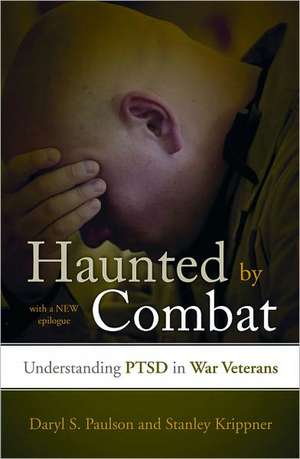
Haunted by Combat: Understanding PTSD in War Veterans
Autor Daryl S. Paulson, Stanley Krippneren Limba Engleză Paperback – 16 aug 2010
Preț: 218.93 lei
Preț vechi: 293.68 lei
-25%
Puncte Express: 328
Carte tipărită la comandă
Livrare economică 26 noiembrie-10 decembrie
Livrare prin curier în România Termenul estimat este afișat lângă disponibilitate.
Transport gratuit de la 400.00 lei Plată online sau ramburs, în funcție de opțiunile comenzii.
Retur gratuit în 14 zile Comandă securizată și suport în română.
Specificații
ISBN-13: 9781442203914
ISBN-10: 1442203919
Pagini: 203
Dimensiuni: 157 x 230 x 17 mm
Greutate: 0.34 kg
Editura: Bloomsbury Publishing
Colecția Rowman & Littlefield
Locul publicării:New York, United States
ISBN-10: 1442203919
Pagini: 203
Dimensiuni: 157 x 230 x 17 mm
Greutate: 0.34 kg
Editura: Bloomsbury Publishing
Colecția Rowman & Littlefield
Locul publicării:New York, United States
V-ar putea interesa
-
 Psychology, Mental Health and DistressJohn Cromby-21%Preț: 432.62 lei545.57 lei
 -
 Cry of Pain: Understanding Suicide and the Suicidal MindProfessor Mark Williams-26%Preț: 89.23 lei120.83 lei
 -
 DepressionAnn CvetkovichPreț: 171.33 lei
 -
 Clinical Sports PsychiatryDavid A Baron-8%Preț: 662.65 lei720.27 lei
 -
 Mental Health WorldwideS. Fernando-15%Preț: 638.95 lei751.70 lei
 -
 The ADD MythMartha BurgePreț: 110.79 lei
 -
 -27%Preț: 113.72 lei155.34 lei
 -
 -27%Preț: 77.62 lei105.94 lei
 -
 -19%Preț: 119.64 lei147.50 lei
 -
 -18%Preț: 122.06 lei149.59 lei
 -
 -19%Preț: 162.18 lei201.05 lei
 -
 Living with VoicesJacqui DillonPreț: 213.50 lei
Cuprins
Introduction: Private Traumas, Personal Mythologies: Post-Traumatic Stress Disorder Among Combat Veterans
Chapter 1: An Overview of Trauma and the Mind/Body
Chapter 2: History of the Diagnosis and Treatment of PTSD
Chapter 3: The Phenomenology of PTSD
Chapter 4: The Experiences of Reserve Soldiers
Chapter 5: Coming Home from the War
Chapter 6: Preparing for What Is to Come
Chapter 7: Civilians at Risk9 Chapter 8: Treatment Approaches to Traumatic Disorders
Chapter 9: Keys to Treating Trauma
Chapter 10: Alternative Approaches to Treating PTSD
Chapter 11: Remembrance 135
Chapter 12: Gold Along the Path
Epilogue
Chapter 1: An Overview of Trauma and the Mind/Body
Chapter 2: History of the Diagnosis and Treatment of PTSD
Chapter 3: The Phenomenology of PTSD
Chapter 4: The Experiences of Reserve Soldiers
Chapter 5: Coming Home from the War
Chapter 6: Preparing for What Is to Come
Chapter 7: Civilians at Risk9 Chapter 8: Treatment Approaches to Traumatic Disorders
Chapter 9: Keys to Treating Trauma
Chapter 10: Alternative Approaches to Treating PTSD
Chapter 11: Remembrance 135
Chapter 12: Gold Along the Path
Epilogue
Recenzii
This book is an outstanding guide for the understanding of war trauma. Every professional linked to the subject should take the time to analyze not only the veterans' experiences and the techniques for treatment, but also the high sensibility of the authors to the need of fighting the global calamity of war and hostility among humans.
Including empirical research and anecdotal prose and poetry about combat veterans, this book discusses post-traumatic stress disorder among war veterans and present debates about diagnoses. Paulson and Krippner also take up other important issues-for example, the difficulty in determining who combatants are (in the case of Iraq) and coping when returning home....Readers will appreciate the volume's general assurance that most veterans get beyond their combat experiences, despite the fact that most receive no formal intervention. Those involved with veterans may wish to explore this existential view of intervention. Recommended. Graduate students through professionals.
The history of our species is a history of war, and the history of war is a history of deep human trauma and suffering. In this clinically important and highly approachable text, Paulson and Krippner help us understand the psychological and spiritual basis for the post-traumatic stress disorder experienced by today's combat veterans. The authors poignantly describe how the PTSD of the men and women they interviewed resulted from "the loss of individual perspective or personal myth that ensure the security and safety of the world." Paulson and Krippner provide clinicians, family members, and concerned citizens with the cross-cultural tools we need to help Iraqi combat veterans move from post-traumatic stress to post-traumatic strength. The authors help us see that by approaching combat veterans with compassionate understanding, rather than denial, we may, collectively, realize a world of peace that knows no end.
Haunted by Combat introduces the reader to an in-depth examination of posttraumatic stress disorder (PTSD) as seen through combat experiences. Paulson and Krippner present PTSD in a historical and developmental context, the implications of warfare and other accounts upon combatants and civilians, and the need for consideration of cultural and individual differences when considering the diagnosis of PTSD. They introduce researched and newer approaches that are and can be employed to help facilitate the healing of ongoing traumatic stress wounds, along with their own treatment proposal. First hand accounts through vignettes are also incorporated within the chapters to provide personal "faces" to the struggles people endure when experiencing ongoing traumatic stress. . . . The authors' passion for the field is palpable and clear. They speak with great authority and humility and their knowledge is evident in their presentation of the topics discussed supported by current research. An original appeal this book has in combination with all the other themes and bases it covers, is that it is an encouraging read for all audiences, especially veterans.
Allying the authors' personal experience with first-hand accounts of veterans from current war scenarios, especially from Iraq and Afghanistan, this book provides a compelling account of the psychosocial sequelae of war on soldiers and their loved ones. The book presents a clinical and sociological analysis of post-traumatic stress disorder in combat veterans and war-afflicted civilians, as well as useful guidelines for treatment in this population. The bridging of soldier stress and war stress in civilians emphasizes the human struggle with healing the lasting wounds of war and conflict. The combination of personal and clinical approaches makes this book powerful and helpful reading to both professionals working with war-afflicted soldiers and civilians as well as victims and their families.
The testimonials by Paulson and other war veterans, the easily comprehensible discussion of neurobiologic mechanisms, and the author's recommendations of essential therapeutic elements make Haunted by Combat a solid contribution.
Paulson and Krippner have given us a remarkable look at one of the most insidious and yet hidden plagues of our time. This book is both a rich resources and a tale as hard to put down as any mystery story.
Paulson and Krippner examine the psychological trauma of combat from perspectives as diverse as endocrine and neurological research to Jung and Campbell's discussions of the myth of The Hero. They weave these into sophisticated, sound suggestions for therapy.
A Marine veteran and a distinguished psychology researcher specializing in the study of human experience have collaborated in a remarkable account of what thousands upon thousands of soldiers bring back with them following their participation in war. Many have killed others including children and civilians, seen comrades die, faced death themselves. Beyond the labeled designation of PTSD, the book reveals a vast world of conflicted experience, unresolved psychological terrors, disillusionments often combined with physical injury and brain damage. Some have come to question the purposes for which the war was fought. They return haunted by flashbacks to a society that often delays or withholds appropriate treatment. They know they are changed but often feel that no one, family included, can possibly understand what they are facing and many have difficulty reweaving any network of support. But the authors emphasize that the affected soldiers are not just a diagnosis but rather people struggling to create the inner stories that can make sense of their experience and help them to continue their lives.
A message that is clear from this book is that the focus of connecting with and treating veterans is not about the "disorder," it's about the person. Paulson and Krippner help to illuminate that it takes courage to walk through the darkness of war experiences and to remember that everything, the mind, body, soul, and relationships are impacted. The personal accounts of veterans along with the poetry included by various authors add an in-depth and meaningful understanding to the nature of combat trauma by making it a personal journey of being with our soldiers and those forever changed by both the wars on the battlefield and the invisible wounds carried home.
The Paulson-Krippner book, an important contribution to public thinking about the wars the USA is waging, is an emotional appeal, based on sound detailing of military practices and what is happening to people who survive and are expected to return to "normal" civilian lives. In the preface, Krippner and Paulson give a gripping motivation for this "very personal book," exemplified by Paulson's dedication to his psychotherapist after his participation in the Vietnam War and by Krippner to his cousin, a heroic Bataan nurse in World War II, who died without recognition of her condition. The book is an excellent historical analysis of the ways in which the psychiatric diagnostic category of Post-Traumatic Stress Disorder has been dealt with in the USA. The chapter by Jeffrey Kirkwood as well as those by both authors on different approaches to treatment of traumatic disorders will stimulate controversial discussions among those postulating different treatments. But the book offers important additions to the literature on PSTD and the current political policies and military practices in pursuing the wars in the Middle East. Understandably, the book is aimed at the American people who carry out the military practices. Nonetheless, it is written so well that the public response is likely to be supportive of their views.
Haunted by Combat includes Paulson's autobiographical journal of his life before, during, and after the war.It is a well-written, interesting, and highly informative description, one that might well have been expanded into a separate volume. Such a book would certainly have been recommended for mental health trainees and also for other clinicians who work with combat veterans. It is by far the most coherent and useful part of this volume. The list of references in Haunted by Combat is also valuable and demonstrates the authors' extensive knowledge of the literature on PTSD.
Including empirical research and anecdotal prose and poetry about combat veterans, this book discusses post-traumatic stress disorder among war veterans and present debates about diagnoses. Paulson and Krippner also take up other important issues-for example, the difficulty in determining who combatants are (in the case of Iraq) and coping when returning home....Readers will appreciate the volume's general assurance that most veterans get beyond their combat experiences, despite the fact that most receive no formal intervention. Those involved with veterans may wish to explore this existential view of intervention. Recommended. Graduate students through professionals.
The history of our species is a history of war, and the history of war is a history of deep human trauma and suffering. In this clinically important and highly approachable text, Paulson and Krippner help us understand the psychological and spiritual basis for the post-traumatic stress disorder experienced by today's combat veterans. The authors poignantly describe how the PTSD of the men and women they interviewed resulted from "the loss of individual perspective or personal myth that ensure the security and safety of the world." Paulson and Krippner provide clinicians, family members, and concerned citizens with the cross-cultural tools we need to help Iraqi combat veterans move from post-traumatic stress to post-traumatic strength. The authors help us see that by approaching combat veterans with compassionate understanding, rather than denial, we may, collectively, realize a world of peace that knows no end.
Haunted by Combat introduces the reader to an in-depth examination of posttraumatic stress disorder (PTSD) as seen through combat experiences. Paulson and Krippner present PTSD in a historical and developmental context, the implications of warfare and other accounts upon combatants and civilians, and the need for consideration of cultural and individual differences when considering the diagnosis of PTSD. They introduce researched and newer approaches that are and can be employed to help facilitate the healing of ongoing traumatic stress wounds, along with their own treatment proposal. First hand accounts through vignettes are also incorporated within the chapters to provide personal "faces" to the struggles people endure when experiencing ongoing traumatic stress. . . . The authors' passion for the field is palpable and clear. They speak with great authority and humility and their knowledge is evident in their presentation of the topics discussed supported by current research. An original appeal this book has in combination with all the other themes and bases it covers, is that it is an encouraging read for all audiences, especially veterans.
Allying the authors' personal experience with first-hand accounts of veterans from current war scenarios, especially from Iraq and Afghanistan, this book provides a compelling account of the psychosocial sequelae of war on soldiers and their loved ones. The book presents a clinical and sociological analysis of post-traumatic stress disorder in combat veterans and war-afflicted civilians, as well as useful guidelines for treatment in this population. The bridging of soldier stress and war stress in civilians emphasizes the human struggle with healing the lasting wounds of war and conflict. The combination of personal and clinical approaches makes this book powerful and helpful reading to both professionals working with war-afflicted soldiers and civilians as well as victims and their families.
The testimonials by Paulson and other war veterans, the easily comprehensible discussion of neurobiologic mechanisms, and the author's recommendations of essential therapeutic elements make Haunted by Combat a solid contribution.
Paulson and Krippner have given us a remarkable look at one of the most insidious and yet hidden plagues of our time. This book is both a rich resources and a tale as hard to put down as any mystery story.
Paulson and Krippner examine the psychological trauma of combat from perspectives as diverse as endocrine and neurological research to Jung and Campbell's discussions of the myth of The Hero. They weave these into sophisticated, sound suggestions for therapy.
A Marine veteran and a distinguished psychology researcher specializing in the study of human experience have collaborated in a remarkable account of what thousands upon thousands of soldiers bring back with them following their participation in war. Many have killed others including children and civilians, seen comrades die, faced death themselves. Beyond the labeled designation of PTSD, the book reveals a vast world of conflicted experience, unresolved psychological terrors, disillusionments often combined with physical injury and brain damage. Some have come to question the purposes for which the war was fought. They return haunted by flashbacks to a society that often delays or withholds appropriate treatment. They know they are changed but often feel that no one, family included, can possibly understand what they are facing and many have difficulty reweaving any network of support. But the authors emphasize that the affected soldiers are not just a diagnosis but rather people struggling to create the inner stories that can make sense of their experience and help them to continue their lives.
A message that is clear from this book is that the focus of connecting with and treating veterans is not about the "disorder," it's about the person. Paulson and Krippner help to illuminate that it takes courage to walk through the darkness of war experiences and to remember that everything, the mind, body, soul, and relationships are impacted. The personal accounts of veterans along with the poetry included by various authors add an in-depth and meaningful understanding to the nature of combat trauma by making it a personal journey of being with our soldiers and those forever changed by both the wars on the battlefield and the invisible wounds carried home.
The Paulson-Krippner book, an important contribution to public thinking about the wars the USA is waging, is an emotional appeal, based on sound detailing of military practices and what is happening to people who survive and are expected to return to "normal" civilian lives. In the preface, Krippner and Paulson give a gripping motivation for this "very personal book," exemplified by Paulson's dedication to his psychotherapist after his participation in the Vietnam War and by Krippner to his cousin, a heroic Bataan nurse in World War II, who died without recognition of her condition. The book is an excellent historical analysis of the ways in which the psychiatric diagnostic category of Post-Traumatic Stress Disorder has been dealt with in the USA. The chapter by Jeffrey Kirkwood as well as those by both authors on different approaches to treatment of traumatic disorders will stimulate controversial discussions among those postulating different treatments. But the book offers important additions to the literature on PSTD and the current political policies and military practices in pursuing the wars in the Middle East. Understandably, the book is aimed at the American people who carry out the military practices. Nonetheless, it is written so well that the public response is likely to be supportive of their views.
Haunted by Combat includes Paulson's autobiographical journal of his life before, during, and after the war.It is a well-written, interesting, and highly informative description, one that might well have been expanded into a separate volume. Such a book would certainly have been recommended for mental health trainees and also for other clinicians who work with combat veterans. It is by far the most coherent and useful part of this volume. The list of references in Haunted by Combat is also valuable and demonstrates the authors' extensive knowledge of the literature on PTSD.