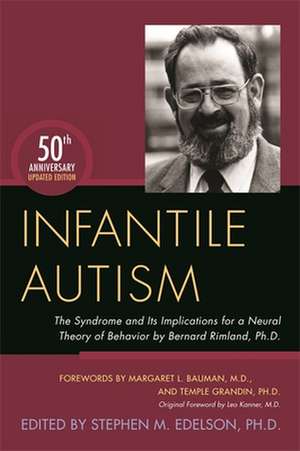
Infantile Autism: The Syndrome and Its Implications for a Neural Theory of Behavior by Bernard Rimland, Ph.D.
Editat de Stephen M. Edelson Contribuţii de Robert K. Naviaux, Paul Millard Hardy, Lucy Jane Miller, Matthew Goodwin, Jillian Sullivan, Jon Pangborn, Simon Baron-Cohen, Bonnie Auyeung, Michael Lombardo, V. Mark Durand, Richard E. Frye, Darold A. Treffert, Martha R. Herbert Cuvânt după de Sidney M. Baker Cuvânt înainte de Temple Grandin, Margaret L. Bauman Contribuţii de James B. Adams Cuvânt înainte de Leo Kanneren Limba Engleză Paperback – 21 noi 2014
Bringing Dr. Rimland's findings up to date for a new generation of readers, this book will be fascinating reading for parents and those on the autism spectrum as well as professionals working with autism and anyone with an interest in autism and/or psychological theory.
Preț: 166.97 lei
Preț vechi: 205.12 lei
-19%
Puncte Express: 250
Carte disponibilă
Livrare economică 10-24 noiembrie
Livrare prin curier în România Termenul estimat este afișat lângă disponibilitate.
Transport gratuit de la 400.00 lei Plată online sau ramburs, în funcție de opțiunile comenzii.
Retur gratuit în 14 zile Comandă securizată și suport în română.
Specificații
ISBN-13: 9781849057899
ISBN-10: 1849057893
Pagini: 352
Dimensiuni: 170 x 231 x 21 mm
Greutate: 0.55 kg
Ediția:Revised
Editura: JESSICA KINGSLEY PUBLISHERS
Colecția Jessica Kingsley Publishers
Locul publicării:London, United Kingdom
ISBN-10: 1849057893
Pagini: 352
Dimensiuni: 170 x 231 x 21 mm
Greutate: 0.55 kg
Ediția:Revised
Editura: JESSICA KINGSLEY PUBLISHERS
Colecția Jessica Kingsley Publishers
Locul publicării:London, United Kingdom
V-ar putea interesa
-
 Madness ExplainedRichard P BentallPreț: 123.75 lei
 -
 -26%Preț: 414.31 lei558.33 lei
 -
 -26%Preț: 736.92 lei996.82 lei
 -
 The Oxford Handbook of Perinatal PsychologyAmy Wenzel-29%Preț: 1310.38 lei1846.49 lei
 -
 StuffGail SteketeePreț: 96.64 lei
 -
 Preț: 67.37 lei
 -
 War and the SoulEdward TickPreț: 122.11 lei
 -
 Sacred SparkLisa K. SykesPreț: 127.16 lei
 -
 -15%Preț: 515.34 lei606.28 lei
 -
 -29%Preț: 170.98 lei240.98 lei
 -
 -20%Preț: 116.08 lei145.10 lei
 -
 Bittersweet on the Autism SpectrumLuke Beardon-20%Preț: 115.65 lei145.12 lei
 -
 -25%Preț: 206.55 lei274.79 lei
 -
 -19%Preț: 119.64 lei147.50 lei
 -
 -20%Preț: 309.80 lei389.43 lei
 -
 -21%Preț: 130.44 lei164.39 lei
Recenzii
This book is an unparalleled testament to [Dr. Rimland's] long and productive career, to his determination to solve the puzzle of autism and to a brilliant and inquisitive mind. Please enjoy this book. It is a testament to this man's exceptional journey to find answers to one of the most complex medical disorders of our time.
Dr. Rimland is to be commended for presenting the first evidence that autism was a biological condition. When his book was published, he was a lone visionary.
Bernard Rimland was an astonishingly farsighted pioneer in drawing a road map towards a neuroscience of autism. It is a fitting tribute that his seminal book, published fifty years ago, is made available to a new generation of researchers, together with reflections on its influence on our understanding of autism today.
Bernie Rimland's substantial impact on the field of autism can still be felt today. It is fitting that his legacy be honored with this reprint of his original book which was written 50 years ago. The added commentaries by today's experts highlight how Dr. Rimland's original insights permeate current perspectives on autism. Every student of autism should read Dr. Rimland's book.
Bernard Rimland wrote with both passion and scientific fervor. The end result was a classic that reinterpreted the prevailing view on autism by the medical profession. His book enriched our minds with a neurobiological perspective that continues to generate interest across generations with ideas that are still relevant.
While still in fellowship training in pediatric neurology, my chief Richmond Paine handed me a copy of the book on infantile autism by Bernard Rimland and told me to read it. I was impressed by the book and began to schedule young patients with autistic features. I got in touch with Bernard Rimland and offered to test blood levels in children with autism in a serotonin laboratory I had just started. The rest is history - that prescient book by Bernard Rimland to some extent altered my lifelong professional focus.
Bernie Rimland was a pioneer in the field of autism. From his work in being one of the founders of the Autism Society of America in 1965 to his work in setting up the Autism Research Institute, Bernie's legacy is one of caring, compassion and results. As we celebrate the 50th anniversary of Bernie's writings helping so many impacted by autism, we also celebrate the strong legacy of this man and his work.?
This book is a remarkable testament to where the neurobiology of autism began and thus where the recognition of autism as a brain disorder originated. The understanding of the neural, cognitive, and genetic basis of autism has come light years beyond its origins in this original treatise and is moving very fast. The updates to the original chapters provide a wonderful sense of the distance that has been covered. I would recommend this book to everyone with an interest in autism or as we call it now, autism spectrum disorder.
Bernard Rimland's book "Infantile Autism: The Syndrome and Its Implication for a Neural Theory of Behavior" (1964), was a pioneering effort, especially noteworthy because, as a parent as well as a scientist, he stuck out strongly for an objective, science-based approach to understanding autism at a time when the field was rocked by mysticism. The book was prescient, pointing at the connections between the underlying neural deficits in autism, and effective behavioral treatment which are only today being proven. Rimland's book, along with Rosalind Oppenheim's "Effective Teaching Methods for Children with Autism," were the very first in the field, both strongly promoted objective, systematic behavioral strategies and both were written by parents. Remarkable.
Dr. Rimland is to be commended for presenting the first evidence that autism was a biological condition. When his book was published, he was a lone visionary.
Bernard Rimland was an astonishingly farsighted pioneer in drawing a road map towards a neuroscience of autism. It is a fitting tribute that his seminal book, published fifty years ago, is made available to a new generation of researchers, together with reflections on its influence on our understanding of autism today.
Bernie Rimland's substantial impact on the field of autism can still be felt today. It is fitting that his legacy be honored with this reprint of his original book which was written 50 years ago. The added commentaries by today's experts highlight how Dr. Rimland's original insights permeate current perspectives on autism. Every student of autism should read Dr. Rimland's book.
Bernard Rimland wrote with both passion and scientific fervor. The end result was a classic that reinterpreted the prevailing view on autism by the medical profession. His book enriched our minds with a neurobiological perspective that continues to generate interest across generations with ideas that are still relevant.
While still in fellowship training in pediatric neurology, my chief Richmond Paine handed me a copy of the book on infantile autism by Bernard Rimland and told me to read it. I was impressed by the book and began to schedule young patients with autistic features. I got in touch with Bernard Rimland and offered to test blood levels in children with autism in a serotonin laboratory I had just started. The rest is history - that prescient book by Bernard Rimland to some extent altered my lifelong professional focus.
Bernie Rimland was a pioneer in the field of autism. From his work in being one of the founders of the Autism Society of America in 1965 to his work in setting up the Autism Research Institute, Bernie's legacy is one of caring, compassion and results. As we celebrate the 50th anniversary of Bernie's writings helping so many impacted by autism, we also celebrate the strong legacy of this man and his work.?
This book is a remarkable testament to where the neurobiology of autism began and thus where the recognition of autism as a brain disorder originated. The understanding of the neural, cognitive, and genetic basis of autism has come light years beyond its origins in this original treatise and is moving very fast. The updates to the original chapters provide a wonderful sense of the distance that has been covered. I would recommend this book to everyone with an interest in autism or as we call it now, autism spectrum disorder.
Bernard Rimland's book "Infantile Autism: The Syndrome and Its Implication for a Neural Theory of Behavior" (1964), was a pioneering effort, especially noteworthy because, as a parent as well as a scientist, he stuck out strongly for an objective, science-based approach to understanding autism at a time when the field was rocked by mysticism. The book was prescient, pointing at the connections between the underlying neural deficits in autism, and effective behavioral treatment which are only today being proven. Rimland's book, along with Rosalind Oppenheim's "Effective Teaching Methods for Children with Autism," were the very first in the field, both strongly promoted objective, systematic behavioral strategies and both were written by parents. Remarkable.
Cuprins
Foreword to the New Edition. Margaret L. Bauman, M.D, Department of Anatomy and Neurobiology, Boston University School of Medicine, Integrated Center for Child Development, Newton, Massachusetts, US. Foreword to the New Edition. Temple Grandin, Ph.D, autism advocate and Associate Professor of Animal Science, Colorado State University, US. Introduction to the New Edition. Stephen M. Edelson, Ph.D, Director, Autism Research Institute, US. Foreword by Leo Kanner. Preface. General Introduction. Introduction to Part I. The Controversies and their Resolution: A Critical Analysis of the Literature. Introduction to Chapter 1. Stephen M. Edelson. 1. The Syndrome of Early Infantile Autism: Background, Course, Diagnosis and Prognosis. A. Background. B. Course and Symptom of the Disease. C. Prognosis. D. The Diagnosis of Autism. Introduction to Chapter 2. Stephen M. Edelson. 2. The Parents of Autistic Children. Parent Occupations. Stephen M. Edelson. Introduction to Chapter 3. Stephen M. Edelson. 3. The Etiology of Infantile Autism: The Problem of Biological versus Psychological Causation. A. The Arguments for Psychogenesis of Infantile Autism. B. The Case for Biological Causation. C. Psychogenesis as an Inadequate and Pernicious Hypothesis. A Commentary on Chapter 3. Robert K. Naviaux, M.D., Ph.D., Professor of Genetics, Department of Medicine, Pediatrics, and Pathology, University of California, San Diego School of Medicine, US. Introduction to Chapter 4. Stephen M. Edelson. 4. The Differentiation of Early Infantile Autism from Childhood Schizophrenia. Introduction to Part II. A Theory of Autism: Its Nature and Cause. Introduction to Chapter 5. Stephen M. Edelson. 5. Autism as a Cognitive Dysfunction. A. The Conceptual Impairment. B. A Hypothesized Relationship Between the Cognitive Dysfunction in Autism and the Reticular Formation of the Brain Stem. Cognitive Dysfunction: Impairment in Memory. Stephen M. Edelson. Introduction to Chapter 6. Stephen M. Edelson. 6. The Specific Biology of Infantile Autism: Sensory Phenomena, Psychopharmacology, Autopsy Reports and Hyperoxia as Related to the Reticular Formation. A. The Reticular Formation and Perception. B. Psychopharmacology. C. Autopsy Findings and Other Attempts to Determine the Organic Basis of Autism. D. Hyperoxia as a Possible Causative Factor. E. Discussion. Reflections on Bernard Rimland and the 50th Anniversary of Infantile Autism. Paul Millard Hardy, M.D., Hardy Healthcare PLLC, US. Rimland's Contributions: The Role of Sensory Processing Challenges in Autism Spectrum Disorders. Lucy Jane Miller, Ph.D., OTR, Clinical Director, Sensory Therapies And Research (STAR) Center and Research Directory, Sensory Processing Disorder (SPD) Foundation, US. Matthew S. Goodwin, Ph.D., Assistant Professor, Department of Health Sciences, Northeastern University, US. Jillian C. Sullivan, Sensory Processing Disorder (SPD) Foundation, US. Vitamin B6. Jon B. Pangborn, Ph.D., Former Consultant to the Autism Research Institute and Co-Founder of “Defeat Autism Now”, US. Introduction to Chapter 7. Stephen M. Edelson. 7. The Theory: Integration and Support. A. The Inheritance of Intelligence and its Biological Substrate. B. The Paradoxes of Intelligence. C. The Hypothesis of Oxygen Intolerance and the Cerebral Vasculature. Introduction to Chapter 8. James B. Adams, Ph.D., Director, Autism/Asperger's Research Program, Arizona State University, US. 8. Ideas for Research. A. Diagnosis. B. Etiology. C. Therapy and Training. D. Broader Implications of Research on Autism. The Fetal Steroid Theory of Autism. Simon Baron-Cohen, Ph.D., Autism Research Centre (ARC), Cambridge University, UK. Bonnie Auyeung, Ph.D., Autism Research Centre (ARC), Cambridge University, UK. Michael Lombardo, Ph.D., Autism Research Centre (ARC), Cambridge University, UK. Wisdom and Vision: A Comment on Rimland's Concept of “Training” for Children with Autism. V. Mark Durand, University of South Florida, St. Petersburg, US. Relevance to Modern Biomarker of Autism. Richard E. Frye, M.D., Ph.D., University of Arkansas for Medical Sciences, Arkansas Children's Hospital, US. Introduction to Part III. Some Possible Implications for the Theory of Autism for a Theory of Behavior. Introduction to Chapter 9. Stephen M. Edelson. 9. Some Implications of Early Infantile Autism for the Study of Personality. A. Emotion and Parental Personalities. B. Drive and the Parental Personalities. C. Cyclothymia, Schizothymia, and the Parental Personalities. D. The Relationship Between Autism and Schizophrenia: A Hypothesis. Introduction to Chapter 10. Stephen M. Edelson. 10. Further Implications of the Study of Autism. A. The Abilities of Autistic Children. B. Distractability, Concentration, and Intelligence. C. Delayed Mental Audition. D. The Problem of Innateness of the Specific Affective Disturbance. Special Abilities and Savant Syndrome: An update on Dr. Rimlands observations. Darold A. Treffert, M.D., Behavioral Health, Agnesian Health Care, Wisconsin, US. Introduction to Chapter 11. Stephen M. Edelson. 11. Some Implications of Early Infantile Autism for a Theory of Behavior. A. A Hypothesis Concerning Reticular Function. B. Toward a Neuron Entelechy Theory of Cognition. Rimland's Reticular Formation Theory of Autism in the Light of 50 Years of Brain Research. Martha R. Herbert, Ph.D., M.D., Assistant Professor of Neurology, Harvard Medical School, US. Appendix. Suggested Diagnostic Check List. Appendix. The Invisible Wall. Stephen M. Edelson. Appendix. Environmental Vulnerability and Everday Epigenetics: Empowering Treatment and Recovery. Martha R. Herbert. Appendix. Mark Rimland: An inspiration to us all. Stephen M. Edelson. Afterword. Sidney M. Baker, Ph.D., Coordinator of the Autism Database Project for the Autism Research Institute. Bibliography. Name Index. Subject Index.