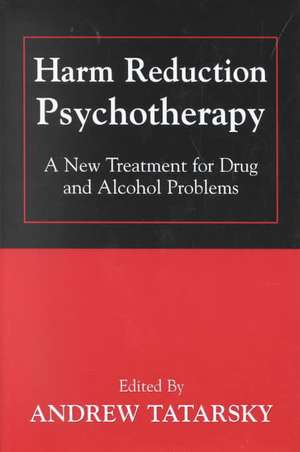
Harm Reduction Psychotherapy: A New Treatment for Drug and Alcohol Problems
Editat de Andrew Tatarskyen Limba Engleză Hardback – 30 iun 2002
În cadrul volumului Harm Reduction Psychotherapy, observăm o reevaluare clinică a managementului dependențelor de droguri și alcool, propunând o alternativă pragmatică la modelele clasice de tratament. Terapeutica prezentată aici nu se limitează la dezideratul restrictiv al abstinenței, ci explorează intervenții psihologice menite să reducă consecințele nocive ale consumului pentru pacienții care nu pot sau nu doresc să renunțe complet la substanțe. Descoperim o structură riguroasă, coordonată de Andrew Tatarsky, care îmbină fundamentarea teoretică a paradigmei de „harm reduction” cu o dimensiune practică esențială: zece studii de caz detaliate, provenite de la terapeuți cu orientări diverse.
Putem afirma că forța acestui text rezidă în capacitatea de a integra principii de bună practică clinică — precum validarea, respectul și întâlnirea clientului în punctul în care se află pe parcursul său — într-o metodologie de lucru coerentă. Această abordare completează excelent lucrarea Harm Reduction, Second Edition de G. Alan Marlatt, aducând un plus de cazuistică aplicată și perspective clinice multiple care ilustrează adaptabilitatea metodei în funcție de profilul pacientului. Dacă volumul lui Marlatt stabilește bazele și strategiile generale, Harm Reduction Psychotherapy oferă „vocea” practicianului în cabinet, demonstrând cum schimbarea accentului de la interdicție la diminuarea riscului îmbunătățește radical alianța terapeutică.
Tonul lucrării este unul clinic și empatic, evitând judecățile de valoare în favoarea eficienței terapeutice. Este o resursă fundamentală pentru specialiștii care activează în psihologie clinică și psihiatrie, oferind instrumente pentru a naviga procesul complex al schimbării comportamentale în adicții, fără a aliena pacientul prin standarde de succes nerealiste în etapele inițiale ale tratamentului.
Preț: 701.82 lei
Preț vechi: 1009.88 lei
-31%
Carte tipărită la comandă
Livrare economică 30 noiembrie-14 decembrie
Specificații
ISBN-10: 0765703521
Pagini: 392
Dimensiuni: 163 x 236 x 35 mm
Greutate: 0.77 kg
Editura: Bloomsbury Publishing
Colecția Jason Aronson Inc
Locul publicării:New York, United States
V-ar putea interesa
-
 -31%Preț: 64.47 lei93.01 lei
 -
 Addiction TreatmentKatherine Van Wormer-25%Preț: 480.53 lei639.20 lei
 -
 -25%Preț: 80.50 lei107.17 lei
 -
 Twenty-Four Hours a DayANONYMOUSPreț: 105.65 lei
 -
 The Handbook of Person-Centred Psychotherapy and CounsellingDr. Gina Di Malta-23%Preț: 286.45 lei370.91 lei
 -
 Preț: 354.32 lei
 -
 Group Treatment for Substance Abuse, Second Edition: A Stages-of-Change Therapy ManualMary Marden Velasquez-5%Preț: 346.41 lei364.65 lei
 -
 Preț: 106.93 lei
 -
 Treating Addiction, Second Edition: A Guide for ProfessionalsWilliam R. Miller-5%Preț: 518.27 lei545.54 lei
 -
 Cognitive-Behavioral Therapy of Addictive DisordersBruce S. LiesePreț: 363.47 lei
 -
 -5%Preț: 338.88 lei356.72 lei
 -
 -5%Preț: 320.42 lei337.28 lei
 -
 -18%Preț: 66.03 lei80.10 lei
 -
 -26%Preț: 103.49 lei140.16 lei
 -
 -19%Preț: 103.44 lei128.39 lei
 -
 -26%Preț: 103.49 lei140.16 lei
 -
 -26%Preț: 105.52 lei142.19 lei
 -
 HookedTalitha Fosh-5%Preț: 99.28 lei104.51 lei
 -
 -29%Preț: 194.42 lei273.53 lei
 -
 The Rehab Playbook: Demystifying Addiction TreatmentJaime Welsh Vinck MC, LPC-19%Preț: 85.63 lei106.07 lei
De ce să citești această carte
Această carte se adresează psihologilor și consilierilor care lucrează cu pacienți dependenți și care caută o metodă de tratament mai flexibilă și mai umană. Cititorul câștigă o înțelegere profundă a modului în care obiectivele mici, incrementale, pot preveni abandonul terapeutic. Este un instrument esențial pentru a învăța cum să construiești o relație solidă de încredere cu pacienții care se simt respinși de sistemele clasice bazate doar pe abstinență.
Descriere
Recenzii
Although this book is a good read for substance misuse specialists too, its readership should be predominantly out with the specialist field. It should be on the bookshelves of the legions of individual psychotherapists who claim no expertise with substance misusers, but who are probably working with some anyway.
Andrew Tatarsky's book, using cases submitted by practitioners from different psychological schools of thought, clearly elucidates the way harm reduction philosophy can be integrated into clinical work. The cases are varied, the practitioners have unique styles and varying approaches, and the realistic conclusions offer the reader a way to integrate slow, incremental change at the client's pace into whatever treatment model they currently use. No longer do therapists have to send people away to become abstinent before they can work with them; no longer do therapists have to feel responsible to set goals for their clients' drug use. This is a must-read for today's psychotherapists who want to practice state-of-the-art healing.