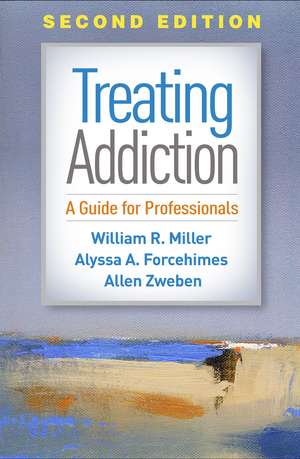
Treating Addiction, Second Edition: A Guide for Professionals
Autor William R. Miller, Alyssa A. Forcehimes, Allen Zwebenen Limba Engleză Hardback – 20 sep 2019
This widely respected text and practitioner guide, now revised and expanded, provides a roadmap for effective clinical practice with clients with substance use disorders. Specialists and nonspecialists alike benefit from the authors' expert guidance for planning treatment and selecting from a menu of evidence-based treatment methods. Assessment and intervention strategies are described in detail, and the importance of the therapeutic relationship is emphasized throughout. Lauded for its clarity and accessibility, the text includes engaging case examples, up-to-date knowledge about specific substances, personal reflections from the authors, application exercises, reflection questions, and end-of-chapter bulleted key points.
New to This Edition
New to This Edition
- Chapters on additional treatment approaches: mindfulness, contingency management, and ways to work with concerned significant others.
- Chapters on overcoming treatment roadblocks and implementing evidence-based treatments with integrity.
- Covers the new four-process framework for motivational interviewing, diagnostic changes in DSM-5, and advances in pharmacotherapy.
- Updated throughout with current research and clinical recommendations.
Preț: 518.27 lei
Preț vechi: 545.54 lei
-5%
Puncte Express: 777
Carte disponibilă
Livrare economică 09-23 noiembrie
Livrare express 23-29 octombrie pentru 52.76 lei
Livrare prin curier în România Termenul estimat este afișat lângă disponibilitate.
Transport gratuit pentru acest produs Plată online sau ramburs, în funcție de opțiunile comenzii.
Retur gratuit în 14 zile Comandă securizată și suport în română.
Specificații
ISBN-13: 9781462540440
ISBN-10: 1462540449
Pagini: 520
Dimensiuni: 152 x 229 x 36 mm
Greutate: 0.86 kg
Ediția:2 ed
Editura: Guilford Publications
Colecția Guilford Press
ISBN-10: 1462540449
Pagini: 520
Dimensiuni: 152 x 229 x 36 mm
Greutate: 0.86 kg
Ediția:2 ed
Editura: Guilford Publications
Colecția Guilford Press
V-ar putea interesa
-
 The American Society of Addiction Medicine Handbook of Addiction MedicineDarius A. Rastegar-21%Preț: 633.95 lei803.03 lei
 -
 Addiction Psychiatric Medicine: A Comprehensive Board ReviewHéctor Colón-Rivera-28%Preț: 361.50 lei504.36 lei
 -
 Addiction TreatmentKatherine Van Wormer-25%Preț: 480.53 lei639.20 lei
 -
 Motivational Interviewing in GroupsChristopher C. Wagner-8%Preț: 432.76 lei470.38 lei
 -
 Group Treatment for Substance Abuse, Second Edition: A Stages-of-Change Therapy ManualMary Marden Velasquez-5%Preț: 346.41 lei364.65 lei
 -
 -5%Preț: 321.64 lei338.57 lei
 -
 -5%Preț: 297.60 lei313.26 lei
 -
 Cognitive-Behavioral Therapy of Addictive DisordersBruce S. LiesePreț: 363.47 lei
 -
 -5%Preț: 338.88 lei356.72 lei
 -
 -5%Preț: 496.39 lei522.52 lei
 -
 -5%Preț: 320.42 lei337.28 lei
 -
 -5%Preț: 317.29 lei333.99 lei
 -
 -5%Preț: 344.14 lei362.26 lei
 -
 -18%Preț: 66.03 lei80.10 lei
 -
 Seeking Safety: A Treatment Manual for PTSD and Substance AbuseLisa M. Najavits-15%Preț: 469.35 lei552.18 lei
 -
 -5%Preț: 246.01 lei258.95 lei
 -
 -29%Preț: 111.87 lei157.58 lei
 -
 -30%Preț: 189.75 lei269.25 lei
 -
 The ASAM Principles of Addiction Medicine: Print + eBook with MultimediaShannon C. Miller-23%Preț: 1493.46 lei1938.44 lei
 -
 The Rehab Playbook: Demystifying Addiction TreatmentJaime Welsh Vinck MC, LPC-19%Preț: 85.63 lei106.07 lei
Cuprins
I. An Invitation to Addiction Treatment
1. Why Treat Addiction?
2. What Is Addiction?
3. How Do Drugs Work?
II. A Context for Addiction Treatment
4. Engaging
5. Screening, Evaluation, and Diagnosis
6. Withdrawal Management and Health Care Needs
7. Individualizing Treatment
8. Case Management
III. A Menu of Evidence-Based Options in Treating Addiction
9. Brief Interventions
10. Motivational Interviewing
11. Behavioral Coping Skills
12. Meditation and Mindfulness
13. Contingency Management
14. A Community Reinforcement Approach
15. Working with Significant Others
16. Strengthening Relationships
17. Mutual Help Groups
18. Medications in Treatment
IV. Professional Issues
19. Stuff That Comes Up
20. Treating Co-Occurring Conditions
21. Facilitating Maintenance
22. Working with Groups
23. Addressing the Spiritual Side
24. Professional Ethics
25. Implementing Evidence-Based Practice
References
Index
1. Why Treat Addiction?
2. What Is Addiction?
3. How Do Drugs Work?
II. A Context for Addiction Treatment
4. Engaging
5. Screening, Evaluation, and Diagnosis
6. Withdrawal Management and Health Care Needs
7. Individualizing Treatment
8. Case Management
III. A Menu of Evidence-Based Options in Treating Addiction
9. Brief Interventions
10. Motivational Interviewing
11. Behavioral Coping Skills
12. Meditation and Mindfulness
13. Contingency Management
14. A Community Reinforcement Approach
15. Working with Significant Others
16. Strengthening Relationships
17. Mutual Help Groups
18. Medications in Treatment
IV. Professional Issues
19. Stuff That Comes Up
20. Treating Co-Occurring Conditions
21. Facilitating Maintenance
22. Working with Groups
23. Addressing the Spiritual Side
24. Professional Ethics
25. Implementing Evidence-Based Practice
References
Index
Recenzii
"This second edition provides up-to-date coverage of essential topics in addiction treatment, deftly integrating clinical science and practice. Readers in the early stages of training will find it clear and accessible, while more advanced clinicians and clinical scientists will be attracted to the deep knowledge base of the experienced authors. I strongly recommend this book as a source of foundational information in any graduate course or professional training program in addiction."--Stephen A. Maisto, PhD, ABPP, Department of Psychology, Syracuse University
"This is not an ordinary second edition. The changes are substantial, including five new chapters on important topics such as mindfulness and implementation of evidence-based treatments. Clinical examples are plentiful. A new chapter titled 'Stuff That Comes Up' addresses a variety of clinical situations that can occur with any treatment--for example, dealing with intoxicated patients. Treating Addiction is a text that can be used in both undergraduate and graduate substance use courses, and is a useful update for practitioners as well."--Mark B. Sobell, PhD, ABPP, President's Distinguished Professor, and Linda C. Sobell, PhD, ABPP, President's Distinguished Professor, College of Psychology, Nova Southeastern University
"'Must' reading for all who work with persons with substance use disorders. What makes this book unique is that it goes beyond specialist care in addictions to offer a practical guide for professionals in a wide range of fields. It draws on a variety of strategies of proven effectiveness that can be individualized to meet client needs. The case management section is especially useful, as is the new chapter on mindfulness. This is an invaluable text for advanced courses in addictions, family studies, and mental health counseling. Miller and his coauthors have helped to revolutionize substance abuse treatment by moving the field from a focus on harsh confrontation to a more compassionate approach."--Katherine van Wormer, PhD, MSSW, Department of Social Work (Emerita), University of Northern Iowa
"A comprehensive, easy-to-follow text. Although substance use disorders are inherently complex, this text manages to provide a clear overview of their biological underpinnings; how they develop; and how to assess, diagnose, and treat them. The first edition was an instant classic; the second edition is greatly enhanced by new data and additional content, including a critical new chapter on implementation of evidence-based treatment methods. This is an excellent resource and a 'must have' for students and clinicians who are looking to apply state-of-the-science knowledge to understanding and treating addiction."--Katie Witkiewitz, PhD, Regents’ Professor, Department of Psychology and Center on Alcohol, Substance Abuse, and Addictions, University of New Mexico
“I assigned the first edition to my graduate students in two different addiction courses. They read the entire book and we discussed it in class--a significant percentage of the final exam was based on this text. Miller is a living legend in counseling, and I have used his motivational interviewing techniques for almost two decades to move my clients through the stages of change. This is my go-to book for college seniors and graduate students who want to learn about addiction treatment and helping clients into and throughout the recovery process. It is also an excellent resource for professionals with addictions certifications to stay current on the latest information about our incredibly important field.”--Frank L. Greenagel II, MPAP, MSW, LCSW, LCADC, CJC, CCS, Center of Alcohol Studies and School of Social Work, Rutgers, The State University of New Jersey
-Like its first edition…this guidebook continues to serve as an essential resource for those interested in understanding the development, identification, and treatment of addictions….This remains one of the best texts for applying research and theory to clinical practice using case examples, analysis, and synthesis; given the promise of ongoing editions, it should remain a mainstay in the addictions field….Highly recommended [for] upper-division undergraduates through faculty and professionals.--Choice Reviews, 4/1/2020ƒƒThe authors have provided an excellent foundation for the understanding of addiction and its context and recommendations for intervention. New and experienced practitioners will be interested in this book and will make reference to it throughout their working lives. (on the first edition)--Drug and Alcohol Review, 7/1/2013"This is not an ordinary second edition. The changes are substantial, including five new chapters on important topics such as mindfulness and implementation of evidence-based treatments. Clinical examples are plentiful. A new chapter titled 'Stuff That Comes Up' addresses a variety of clinical situations that can occur with any treatment--for example, dealing with intoxicated patients. Treating Addiction is a text that can be used in both undergraduate and graduate substance use courses, and is a useful update for practitioners as well."--Mark B. Sobell, PhD, ABPP, President's Distinguished Professor, and Linda C. Sobell, PhD, ABPP, President's Distinguished Professor, College of Psychology, Nova Southeastern University
"'Must' reading for all who work with persons with substance use disorders. What makes this book unique is that it goes beyond specialist care in addictions to offer a practical guide for professionals in a wide range of fields. It draws on a variety of strategies of proven effectiveness that can be individualized to meet client needs. The case management section is especially useful, as is the new chapter on mindfulness. This is an invaluable text for advanced courses in addictions, family studies, and mental health counseling. Miller and his coauthors have helped to revolutionize substance abuse treatment by moving the field from a focus on harsh confrontation to a more compassionate approach."--Katherine van Wormer, PhD, MSSW, Department of Social Work (Emerita), University of Northern Iowa
"A comprehensive, easy-to-follow text. Although substance use disorders are inherently complex, this text manages to provide a clear overview of their biological underpinnings; how they develop; and how to assess, diagnose, and treat them. The first edition was an instant classic; the second edition is greatly enhanced by new data and additional content, including a critical new chapter on implementation of evidence-based treatment methods. This is an excellent resource and a 'must have' for students and clinicians who are looking to apply state-of-the-science knowledge to understanding and treating addiction."--Katie Witkiewitz, PhD, Regents’ Professor, Department of Psychology and Center on Alcohol, Substance Abuse, and Addictions, University of New Mexico
“I assigned the first edition to my graduate students in two different addiction courses. They read the entire book and we discussed it in class--a significant percentage of the final exam was based on this text. Miller is a living legend in counseling, and I have used his motivational interviewing techniques for almost two decades to move my clients through the stages of change. This is my go-to book for college seniors and graduate students who want to learn about addiction treatment and helping clients into and throughout the recovery process. It is also an excellent resource for professionals with addictions certifications to stay current on the latest information about our incredibly important field.”--Frank L. Greenagel II, MPAP, MSW, LCSW, LCADC, CJC, CCS, Center of Alcohol Studies and School of Social Work, Rutgers, The State University of New Jersey
Notă biografică
William R. Miller, PhD, is Emeritus Distinguished Professor of Psychology and Psychiatry at the University of New Mexico. He introduced motivational interviewing in a 1983 article and in the first edition of Motivational Interviewing (1991), coauthored with Stephen Rollnick. Dr. Miller’s research has focused particularly on the treatment and prevention of addictions and more broadly on the psychology of change. He is a recipient of two career achievement awards from the American Psychological Association, the international Jellinek Memorial Award, and an Innovators Award from the Robert Wood Johnson Foundation, among many other honors. His publications include 65 books and over 400 articles and chapters. His website is https://williamrmiller.net.
Alyssa A. Forcehimes, PhD, is President of The Change Companies and Train for Change. Prior to joining these organizations, she was on the faculty of Psychiatry and Psychology at the University of New Mexico Health Sciences Center. Her research focuses on processes of motivation for change and on effective methods for disseminating and teaching evidence-based behavioral treatments in real-world settings. Dr. Forcehimes works in addiction, mental health, and health care settings to develop, implement, and evaluate behavior change practices.
Allen Zweben, PhD, LCSW, is Professor Emeritus and Associate Dean at the Columbia University School of Social Work. His research and publications have focused primarily on innovative assessment and treatment approaches for substance use problems. Dr. Zweben has been a principal investigator on numerous behavioral and medication trials, including two landmark studies funded by the National Institute on Alcohol Abuse and Alcoholism: Project MATCH, a patient–treatment matching study, and the COMBINE study, a project examining the efficacy of combining pharmacotherapy and psychotherapy interventions for alcohol problems.
Alyssa A. Forcehimes, PhD, is President of The Change Companies and Train for Change. Prior to joining these organizations, she was on the faculty of Psychiatry and Psychology at the University of New Mexico Health Sciences Center. Her research focuses on processes of motivation for change and on effective methods for disseminating and teaching evidence-based behavioral treatments in real-world settings. Dr. Forcehimes works in addiction, mental health, and health care settings to develop, implement, and evaluate behavior change practices.
Allen Zweben, PhD, LCSW, is Professor Emeritus and Associate Dean at the Columbia University School of Social Work. His research and publications have focused primarily on innovative assessment and treatment approaches for substance use problems. Dr. Zweben has been a principal investigator on numerous behavioral and medication trials, including two landmark studies funded by the National Institute on Alcohol Abuse and Alcoholism: Project MATCH, a patient–treatment matching study, and the COMBINE study, a project examining the efficacy of combining pharmacotherapy and psychotherapy interventions for alcohol problems.
Descriere
This widely respected text and practitioner guide, now revised and expanded, provides a roadmap for effective clinical practice with clients with substance use disorders.