Eichmann in Jerusalem
Autor Hannah Arendt
5 mai 2022
Paperback
Preț: 64.97 lei 93.37 lei
24-30 zile | 5-11 zile
-30%

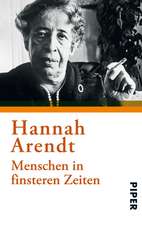
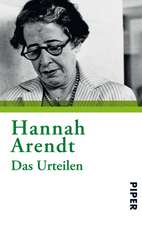
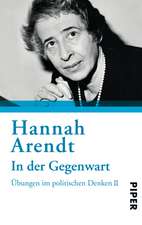
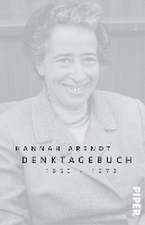
Hannah Arendt (, US also , German: [ˈaːʁənt]; 14 October 1906 – 4 December 1975) was a political philosopher, author, and Holocaust survivor. Her contributions influenced 20th and 21st century political theorists.
Arendt was born in Linden, a district of Hanover, in 1906, to a Jewish family. At the age of three, her family moved to Königsberg, the capital of East Prussia, so that her father's syphilis could be treated. Paul Arendt had contracted the disease in his youth, and it was thought to be in remission when Arendt was born. He died when she was seven. Arendt was raised in a politically progressive, secular family. Her mother was an ardent supporter of the Social Democrats. After completing her secondary education in Berlin, she studied at the University of Marburg under Martin Heidegger, with whom she had a brief affair. She obtained her doctorate in philosophy writing on Love and Saint Augustine at the University of Heidelberg in 1929 under the direction of the existentialist philosopher Karl Jaspers.
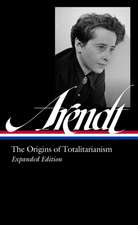
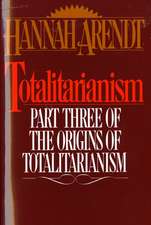
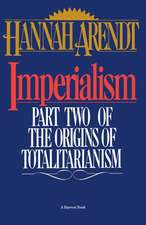
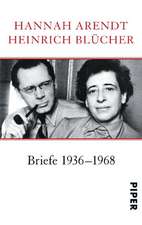
Hannah Arendt married Günther Stern in 1929, but soon began to encounter increasing anti-Jewish discrimination in 1930s Nazi Germany. In 1933, the year Adolf Hitler came to power, Arendt was arrested and briefly imprisoned by the Gestapo for performing illegal research into antisemitism in Nazi Germany. On release, she fled Germany, living in Czechoslovakia and Switzerland before settling in Paris. There she worked for Youth Aliyah, assisting young Jews to emigrate to the British Mandate of Palestine. Divorcing Stern in 1937, she married Heinrich Blücher in 1940, but when Germany invaded France in 1940 she was detained by the French as an alien, despite having been stripped of her German citizenship in 1937. She escaped and made her way to the United States in 1941 via Portugal. She settled in New York, which remained her principal residence for the rest of her life. She became a writer and editor and worked for the Jewish Cultural Reconstruction, becoming an American citizen in 1950. With the publication of The Origins of Totalitarianism in 1951, her reputation as a thinker and writer was established and a series of works followed. These included the books The Human Condition in 1958, as well as Eichmann in Jerusalem and On Revolution in 1963. She taught at many American universities, while declining tenure-track appointments. She died suddenly of a heart attack in 1975, at the age of 69, leaving her last work, The Life of the Mind, unfinished.
Her works cover a broad range of topics, but she is best known for those dealing with the nature of power and evil, as well as politics, direct democracy, authority, and totalitarianism. In the popular mind she is best remembered for the controversy surrounding the trial of Adolf Eichmann, her attempt to explain how ordinary people become actors in totalitarian systems, which was considered by some an apologia, and for the phrase "the banality of evil". She is commemorated by institutions and journals devoted to her thinking, the Hannah Arendt Prize for political thinking, and on stamps, street names and schools, amongst other things.