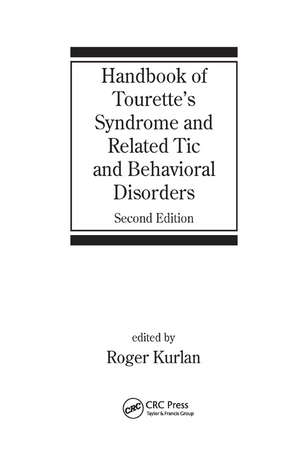
Handbook of Tourette's Syndrome and Related Tic and Behavioral Disorders
Editat de Roger Kurlanen Limba Engleză Paperback – 19 iun 2019
| Toate formatele și edițiile | Preț | Express |
|---|---|---|
| Paperback (1) | 547.83 lei 43-57 zile | |
| CRC Press – 19 iun 2019 | 547.83 lei 43-57 zile | |
| Hardback (1) | 1492.65 lei 43-57 zile | |
| CRC Press – 27 oct 2004 | 1492.65 lei 43-57 zile |
Preț: 547.83 lei
Preț vechi: 576.67 lei
-5% Nou
Puncte Express: 822
Preț estimativ în valută:
96.96€ • 113.70$ • 85.01£
96.96€ • 113.70$ • 85.01£
Carte tipărită la comandă
Livrare economică 26 ianuarie-09 februarie 26
Preluare comenzi: 021 569.72.76
Specificații
ISBN-13: 9780367393717
ISBN-10: 0367393719
Pagini: 560
Dimensiuni: 152 x 229 x 30 mm
Greutate: 1.02 kg
Ediția:1
Editura: CRC Press
Colecția CRC Press
ISBN-10: 0367393719
Pagini: 560
Dimensiuni: 152 x 229 x 30 mm
Greutate: 1.02 kg
Ediția:1
Editura: CRC Press
Colecția CRC Press
V-ar putea interesa
-
 Treatment-Resistant Mood DisordersAndré F Carvalho-20%Preț: 258.46 lei322.53 lei
 -
 -20%Preț: 488.61 lei607.25 lei
 -
 -20%Preț: 600.30 lei747.43 lei
 -
 Oxford Textbook of Correctional PsychiatryRobert Trestman-31%Preț: 1023.63 lei1475.26 lei
 -
 Medical PsychotherapyJessica Yakeley-31%Preț: 463.67 lei673.40 lei
 -
 Psychological Assessment and Therapy with Older AdultsBob G. Knight-10%Preț: 494.67 lei552.58 lei
 -
 Examination Notes in PsychiatryPeter Buckley-5%Preț: 385.38 lei405.66 lei
 -
 Attention-Deficit Hyperactivity Disorder in Adults and ChildrenLenard A. Adler-5%Preț: 935.59 lei984.83 lei
 -
 Excited Delirium Syndrome: Cause of Death and PreventionTheresa G. DiMaio-18%Preț: 1010.56 lei1232.39 lei
 -
 Psychiatry ReconsideredH. Middleton-5%Preț: 355.48 lei374.18 lei
 -
 Poetry, Therapy and Emotional LifeDiana Hedges-5%Preț: 313.99 lei330.51 lei
 -
 Posttraumatic and Acute Stress DisordersMatthew J. Friedman-5%Preț: 620.82 lei653.50 lei
 -
 An Outline of Psychiatry in Clinical Lectures: The Lectures of Carl WernickeRobert Miller, ONZM, B.A., B.Sc., Ph.D.-5%Preț: 1077.24 lei1133.94 lei
 -
 Bipolar Disorder: An Evidence-Based Guide to Manic DepressionKostas N. Fountoulakis-5%Preț: 712.69 lei750.19 lei
Public țintă
Professional Practice & DevelopmentCuprins
Phenomenology of the Tic Disorder o Associated Behavioral Disorders o Diagnosis and Assessment o Neurobiology o Genetics and Epidemiology o Clinical Care o The Child and Adolescent with Tourette's Syndrome: Clinical Perspectives on Phenomenology and Treatment
Descriere
Relating breakthroughs in phenomenology and neurobiology and current strategies for diagnosis, assessment, and clinical care, this long-anticipated Second Edition provides expanded descriptions of clinical features, further evidence linking heritability to etiology, and revised epidemiological estimates as observed in the most recent research on Tourette's syndrome (TS) and associated disorders. The latest information about the controversial poststreptococcal hypothesis is also presented and discussed.