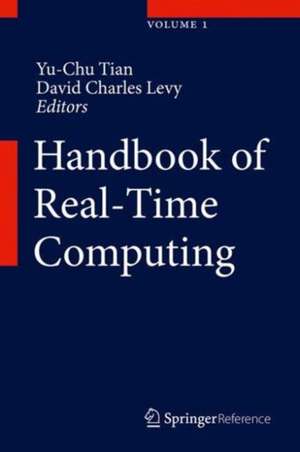
Handbook of Real-Time Computing: Handbook of Real-Time Computing
Editat de Yu-Chu Tian, David Charles Levyen Limba Engleză Hardback – 9 aug 2022
Ecosistemul tehnologic prezentat în Handbook of Real-Time Computing este unul vast, gravitând în jurul sistemelor de operare în timp real (RTOS), al middleware-ului și al instrumentelor de analiză și proiectare. Remarcăm o abordare tehnică riguroasă care pornește de la principiile fundamentale ale calculului în timp real — precum determinismul și concurența — și avansează către soluții complexe pentru sisteme multi-core și rețele de senzori fără fir. Suntem de părere că această lucrare se distinge prin capacitatea de a sintetiza teorii matematice, precum lanțurile Markov sau rețelele Petri, cu necesitățile practice de gestionare a resurselor partajate și controlul accesului. Subliniem progresia logică a conținutului: volumul debutează cu o bază teoretică solidă, continuă cu o secțiune extensivă dedicată planificării (scheduling), unde sunt analizate algoritmi de prioritate fixă și dinamică, și culminează cu aplicații în sisteme distribuite și baze de date în timp real. Complementar volumului Real-Time Systems Scheduling 1 de Maryline Chetto, care se concentrează intens pe rezultatele academice ale ultimului deceniu în domeniul planificării sarcinilor, Handbook of Real-Time Computing oferă o perspectivă mai largă, acoperind zone pe care celălalt nu le atinge, cum ar fi co-design-ul hardware/software și aspectele de eficiență energetică. În contextul operei editorului Yu-Chu Tian, această lucrare reprezintă o extindere naturală a expertizei sale. Dacă în Computation of Mathematical Models for Complex Industrial Processes accentul era pus pe modelarea numerică a proceselor industriale, în prezentul manual, autorul integrează aceste competențe într-un cadru sistemic mai vast, orientat spre infrastructura de calcul care susține aceste procese. Astfel, volumul devine o resursă de referință pentru cercetătorii care au nevoie de o documentație tehnică detaliată și actualizată la nivelul anului 2022.
Preț: 4970.42 lei
Preț vechi: 6213.03 lei
-20%
Carte disponibilă
Livrare economică 16-30 noiembrie
Livrare express 31 octombrie-06 noiembrie pentru 127.65 lei
Specificații
ISBN-10: 9812872507
Pagini: 1568
Ilustrații: XXIV, 1515 p. 352 illus., 227 illus. in color. In 2 volumes, not available separately.
Dimensiuni: 160 x 241 x 89 mm
Greutate: 2.83 kg
Ediția:1st ed. 2022
Editura: Springer
Colecția Handbook of Real-Time Computing
Seria Handbook of Real-Time Computing
Locul publicării:Singapore, Singapore
V-ar putea interesa
-
 Computer Networks: A Systems ApproachLarry L. Peterson-40%Preț: 577.87 lei956.74 lei
 -
 High Performance Computing: Modern Systems and PracticesThomas Sterling-40%Preț: 437.18 lei729.97 lei
 -
 Introduction to Real-Time Computing for Mechanical Engineers, AnJoseph L. Garbini-15%Preț: 523.51 lei617.19 lei
 -
 Distributed SystemsGeorge Coulouris-20%Preț: 634.44 lei793.05 lei
 -
 -20%Preț: 574.25 lei717.80 lei
 -
 -40%Preț: 458.81 lei768.90 lei
 -
 -30%Preț: 445.71 lei639.30 lei
 -
 Computer Architecture: A Quantitative ApproachJohn L. Hennessy-39%Preț: 539.69 lei882.55 lei
 -
 -39%Preț: 628.79 lei1028.93 lei
 -
 Concurrent and Distributed Computing in JavaVijay K Garg-20%Preț: 759.28 lei949.11 lei
 -
 -20%Preț: 377.89 lei472.36 lei
 -
 Operating Systems: Internals and Design Principles, Global EditionWilliam Stallings-20%Preț: 678.19 lei847.74 lei
 -
 Modern C, Third EditionJens Gustedt-20%Preț: 350.34 lei437.92 lei
 -
 -36%Preț: 284.35 lei440.95 lei
 -
 Advances in AI for Cloud, Edge, and Mobile Computing ApplicationsShrikaant Kulkarni-20%Preț: 1296.62 lei1620.78 lei
 -
 SchedulingMichael L. PinedoPreț: 541.95 lei
 -
 Concise Guide to the Internet of ThingsMichael Mccarthy-20%Preț: 421.74 lei527.18 lei
 -
 Concurrent and Real-time ProgrammingManuel I. Capel-20%Preț: 353.05 lei441.31 lei
Public țintă
ResearchDe ce să citești această carte
Această lucrare este esențială pentru inginerii de sistem și cercetătorii care proiectează arhitecturi critice unde timpul de răspuns este vital. Cititorul câștigă acces la o resursă enciclopedică de 1800 de pagini ce acoperă tot parcursul, de la modelarea teoretică la implementarea în sisteme multi-core. Este un instrument practic pentru optimizarea performanței și a consumului energetic în rețelele industriale moderne.
Despre autor
Yu-Chu Tian este un expert recunoscut în domeniul informaticii industriale și al sistemelor de control, cu o activitate editorială axată pe modelarea matematică și arhitecturile de rețea. Contribuțiile sale anterioare includ lucrări fundamentale despre procesele industriale complexe și planificarea rețelelor la scară largă. În Handbook of Real-Time Computing, acesta colaborează cu David Charles Levy pentru a coordona o echipă de specialiști, reușind să ofere o viziune integrată asupra calculului în timp real, reflectând experiența sa vastă în aplicarea metodelor de calcul numeric în medii de producție exigente.
Descriere scurtă
- Real-time operating systems
- Real-time scheduling
- Timing analysis
- Programming languages and run-time systems
- Middleware systems
- Design and analysis tools
- Real-time aspects of wireless sensor networks
- Energy aware real-time methods
Cuprins
Notă biografică
Professor Tian received the B.E. degree in Electrical Engineering (industrial automation) from Wuhan Institute of Technology, China, in 1982, the M.E. degree in Electrical Engineering (industrial automation/systems engineering) from East China University of Science and Technology, China, in 1987, the Ph.D. degree in Electrical Engineering (Industrial Automation/Intelligent Control and Decision) from Zhejiang University, China, in 1993, and the Ph.D. degree in Computer and Software Engineering from The University of Sydney, Australia, in 2009.
Professor Tian joined the Naval Academy of Engineering, China, in 1987, as a Lecturer in systems engineering. From 1994 to 1998, he worked at the Department of Electrical Engineering and the Institute of Industrial Process Control, Zhejiang University, China, where he was promoted to Associate Professor in Electrical Engineering in 1995. From 1996 to 1998, he was on leave from Zhejiang University to Hong Kong University of Science and Technology, as a Research Associate working on complex systems and process control. He moved to Australia in 1998, working as a Research Fellow at Curtin University of Technology. In 1999, he was elected as one of the four Western Australia Strategic Research Fellows. Since 2002, he has been working at Queensland University of Technology, Brisbane, Australia, initially as a Lecturer, later as a Senior Lecturer, the Networking Teaching Group Leader and Associate Professor in Computer Science, and currently as a Professor of Computer Science and the Head of the Discipline of Networks and Communications (NetCom). He also worked as a visiting professor in 2007 at the Department of Computer Science, The University of Maryland at College Park, USA.
Professor Tian received the prestigious Outstanding Young Researcher Award from Zhejiang Province in 1995 while working at Zhejiang University. He also won the Western Australia State Government Strategic Research Fellowship in 1999.
As the Chief Investigator, Professor Tian has won/completed over 20 research grants and projects, including 5 funded by Australian Research Council (ARC), 2 funded by Australian Cooperative Research Centre (CRC) and 1 funded by Australian Government Department of Education, Science and Training (DEST). He holds a patent on real-time control of large-scale and continuous galvanizing line. He has published a monograph on computation of mathematical models for complex industrial processes. He has also credited over 160 refereed papers in his publication record.
David C Levy is an Honorary Associate Professor in the School of Electrical and Information Engineering at the University of Sydney. He was Head of the disciplines of Computer and Software Engineering and Head of School prior to his leaving to pursue a private consulting career. He now acts as a technical advisor to two start-ups, does some occasional teaching in Australia and China and continues to supervise several graduate research projects. He has supervised over 50 graduate students to completion, received grants totaling in excess of 2.5 million and been on the organizing committee of 17 conferences, chairing 6, He is a member of the IEEE, ACM and served on the CDIO Council and on the Real Time Architectures committee of IFAC. He has acted as an assessor for grant applications in South Africa and Australia and has served as a reviewer for many conference papers.
Dr Levy received the B.E. degree in Electrical Engineering from the University of Natal, Durban, South Africa in 1970, followed by the MSc and PhD from the same institution. He taught Electronic Engineering at the University of Natal, with stints at the Technion, Israel and Clemson, USA. After an extended visit to the CSIRO in Australia, Dr Levy took up a position at the University of Sydney in 1994 where he led major curriculum revisions and served as Head of School.
Dr Levy holds two patents on embedded systems for chemical sensors. He has over 200 refereed papers on his publication record, along with a book and two book chapters.
Caracteristici
Organized to cater for students, academics and professionals from diverse scientific and engineering communities
Written by foremost experts from the field