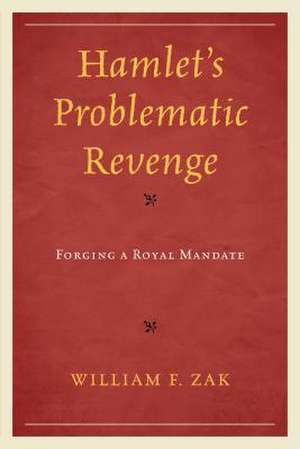
Hamlet's Problematic Revenge
Autor William F. Zaken Limba Engleză Hardback – 19 mai 2015
| Toate formatele și edițiile | Preț | Express |
|---|---|---|
| Paperback (1) | 248.85 lei 6-8 săpt. | |
| Bloomsbury Publishing – 12 apr 2019 | 248.85 lei 6-8 săpt. | |
| Hardback (1) | 609.35 lei 6-8 săpt. | |
| Rowman & Littlefield – 19 mai 2015 | 609.35 lei 6-8 săpt. |
Preț: 609.35 lei
Preț vechi: 716.88 lei
-15%
Puncte Express: 914
Preț estimativ în valută:
107.73€ • 127.03$ • 94.19£
107.73€ • 127.03$ • 94.19£
Carte tipărită la comandă
Livrare economică 04-18 aprilie
Specificații
ISBN-13: 9781498513104
ISBN-10: 1498513107
Pagini: 150
Ilustrații: black & white illustrations
Dimensiuni: 152 x 229 x 13 mm
Greutate: 0.39 kg
Editura: Rowman & Littlefield
ISBN-10: 1498513107
Pagini: 150
Ilustrații: black & white illustrations
Dimensiuni: 152 x 229 x 13 mm
Greutate: 0.39 kg
Editura: Rowman & Littlefield
V-ar putea interesa
-
 Loving Justice, Living ShakespeareRegina Mara Schwartz-14%Preț: 249.20 lei290.41 lei
 -
 Mr Foote's Other LegIan Kelly-18%Preț: 97.22 lei119.25 lei
 -
 Shakespeare, Adaptation, Psychoanalysis: Better than NewMatthew BibermanPreț: 411.21 lei
 -
 Preț: 417.16 lei
 -
 Preț: 410.31 lei
 -
 -34%Preț: 739.65 lei1118.50 lei
 -
 Shakespeare's Reading AudiencesCyndia Susan Clegg-30%Preț: 559.30 lei794.06 lei
 -
 Shakespeare as Literary DramatistLukas ErnePreț: 368.43 lei
 -
 Americans on Shakespeare, 1776-1914Peter RawlingsPreț: 469.83 lei
 -
 Unearthing Shakespeare: Embodied Performance and the GlobeValerie Clayman PyePreț: 367.85 lei
 -
 The Shakespeare Hut: A Story of Memory, Performance and Identity, 1916-1923Ailsa Grant Ferguson-26%Preț: 229.40 lei311.51 lei
 -
 -25%Preț: 263.35 lei349.98 lei
 -
 Shakespeare's Big MenRichard van Oort-19%Preț: 446.90 lei551.73 lei
 -
 Early Modern Actors and Shakespeare's Theatre: Thinking with the BodyProf Evelyn Tribble-26%Preț: 672.75 lei906.70 lei
 -
 Shakespeare's Fathers and DaughtersOliver Ford Davies-34%Preț: 585.29 lei882.92 lei
 -
 The Shakespearean InsideMarcus Nordlund-26%Preț: 573.80 lei770.74 lei
 -
 Shakespeare Films: A Re-Evaluation of 100 Years of AdaptationsPeter E. S. BabiakPreț: 224.35 lei
 -
 The Tragedy of Antony and Cleopatra: Asps amidst the FigsWilliam F. Zak-35%Preț: 541.42 lei835.94 lei
 -
 Finding Shakespeare's New PlaceKevin CollsPreț: 491.13 lei
 -
 Shakespeare's StormsGwilym JonesPreț: 215.31 lei
 -
 Montaigne and ShakespeareRobert EllrodtPreț: 211.70 lei
 -
 Cultural Value in Twenty-First-Century EnglandKate McLuskiePreț: 257.24 lei
 -
 -30%Preț: 42.52 lei60.42 lei
 -
 -29%Preț: 365.32 lei515.53 lei
 -
 'Volpone' in ContextKeith LinleyPreț: 186.54 lei
 -
 Covering McKellen: An Understudy's TaleDavid Weston-22%Preț: 132.06 lei168.49 lei
 -
 -37%Preț: 643.97 lei1023.36 lei
 -
 Shakespeare's History PlaysC W R D MoseleyPreț: 124.15 lei
 -
 Shakespeare and Protestant PoeticsJason Gleckman-15%Preț: 568.50 lei668.82 lei
Notă biografică
By William F. Zak
Cuprins
Forging a Royal Mandate: Hamlet¿s Problematic Revenge
Table of Contents
Acknowledgments
Introduction
Chapter One: A Theater of Arrested Development
Chapter Two: How All Occasions Do Inform Against Me and Spur a Dull Revenge
Chapter Three: Forced Causes and Purposes Mistook
Notes
Works Cited
Descriere
Amidst a wealth of previously unremarked figurative mirrorings, as well as much of the seemingly digressive material in Hamlet within Shakespearean studies, Hamlet's Problematic Revenge brings to light a new interpretation of the tragic problem in the play.
Recenzii
Romantic-period thinkers loved Hamlet for his obdurate questionings; T. S. Eliot thought he lacked an objective correlative. The protagonist of Shakespeare's tragedy now seems rehabilitated, but Zak is a sharp dissenter. He pokes holes in all the arguments of Hamlet adulators, portraying the Danish prince as self-centered, prone to 'risk both his private and the public's good,' and having an 'unacknowledged beam' in his own eye even as he castigates his mother and stepfather for having motes in theirs. Zak finds Hamlet's revenge flawed from inception, as the prince seeks extremes rather than compromises . . . His book is a provocative, stimulating minority report in the tradition of Harold Goddard's sometimes infuriating but always cogent The Meaning of Shakespeare (1951). Zak grounds his contention in past and current Shakespeare scholarship, agreeing with Paul Kottman's sense for Shakespeare as anti-Romantic. . . .Summing Up: Recommended. Lower-division undergraduates and above.
William Zak's iconoclastic analysis of Hamlet upends critical and audience consensus in arguing that most of the other characters of the play deserve better, assessing the beloved Horatio as a failure and bungler, and revealing the Danish Prince himself to be an embarrassingly immature, vain, myopic, self-deluded, hypocritical, toxic, malicious criminal. For Zak, Hamlet is not so much a tragedy as Hamlet is a disaster. An inventive and daring new approach.
William Zak's iconoclastic analysis of Hamlet upends critical and audience consensus in arguing that most of the other characters of the play deserve better, assessing the beloved Horatio as a failure and bungler, and revealing the Danish Prince himself to be an embarrassingly immature, vain, myopic, self-deluded, hypocritical, toxic, malicious criminal. For Zak, Hamlet is not so much a tragedy as Hamlet is a disaster. An inventive and daring new approach.