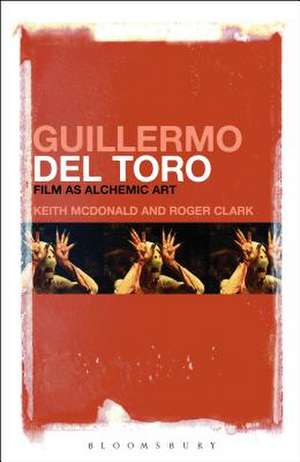
Guillermo del Toro: Film as Alchemic Art
Autor Keith McDonald, Roger Clarken Limba Engleză Paperback – 27 aug 2015
Preț: 277.39 lei
Preț vechi: 329.21 lei
-16%
Puncte Express: 416
Carte tipărită la comandă
Livrare economică 30 noiembrie-14 decembrie
Livrare prin curier în România Termenul estimat este afișat lângă disponibilitate.
Transport gratuit de la 400.00 lei Plată online sau ramburs, în funcție de opțiunile comenzii.
Retur gratuit în 14 zile Comandă securizată și suport în română.
Specificații
ISBN-13: 9781501308611
ISBN-10: 1501308610
Pagini: 242
Dimensiuni: 148 x 228 x 14 mm
Greutate: 0.33 kg
Editura: Bloomsbury Publishing
Colecția Bloomsbury Academic
Locul publicării:New York, United States
ISBN-10: 1501308610
Pagini: 242
Dimensiuni: 148 x 228 x 14 mm
Greutate: 0.33 kg
Editura: Bloomsbury Publishing
Colecția Bloomsbury Academic
Locul publicării:New York, United States
V-ar putea interesa
-
 -25%Preț: 208.80 lei280.21 lei
 -
 The Oxford Handbook of Dance and the Popular ScreenMelissa Blanco Borelli-14%Preț: 1049.52 lei1220.37 lei
 -
 Lady in the Dark – Iris Barry and the Art of FilmRobert SittonPreț: 374.20 lei
 -
 Ian McEwan's Enduring LoveRoger Clark-22%Preț: 126.72 lei161.47 lei
 -
 -33%Preț: 770.33 lei1146.69 lei
 -
 The Perils of Moviegoing in America: 1896-1950PhD Gary D. Rhodes-25%Preț: 830.65 lei1109.38 lei
 -
 World Cinema and the Ethics of RealismProfessor Lúcia Nagib-24%Preț: 631.62 lei827.86 lei
 -
 -24%Preț: 295.38 lei390.15 lei
 -
 Post-Yugoslav Literature and Film: Fires, Foundations, FlourishesProfessor Gordana P. Crnkovic-33%Preț: 899.40 lei1337.79 lei
 -
 Hitchcock's Ear: Music and the Director's ArtDavid Schroeder-16%Preț: 278.18 lei329.64 lei
 -
 Picture ThisMolly Bang-14%Preț: 120.73 lei139.76 lei
 -
 Preț: 213.83 lei
Cuprins
Acknowledgments
Introduction
Part 1
Chapter 1. Influences and Intertexts
Chapter 2. Accented Fantasy and the Gothic Perverse
Chapter 3. Fan as Filmmaker
Part 2
Chapter 4. Twisted Genres: Cronos and Mimic
Chapter 5. Trauma - Childhood -History: The Devil's Backbone and Pan's Labyrinth
Chapter 6. Gothic Superheroes: Blade II, Hellboy and Hellboy II: The Golden Army
Chapter 7. From Development Hell to the Pacific Depths: The Strain and Pacific Rim
Bibliography
Filmography and Comicography
Index
Introduction
Part 1
Chapter 1. Influences and Intertexts
Chapter 2. Accented Fantasy and the Gothic Perverse
Chapter 3. Fan as Filmmaker
Part 2
Chapter 4. Twisted Genres: Cronos and Mimic
Chapter 5. Trauma - Childhood -History: The Devil's Backbone and Pan's Labyrinth
Chapter 6. Gothic Superheroes: Blade II, Hellboy and Hellboy II: The Golden Army
Chapter 7. From Development Hell to the Pacific Depths: The Strain and Pacific Rim
Bibliography
Filmography and Comicography
Index
Recenzii
As a scholar of del Toro myself, [after reading Film as Alchemic Art] I found my understanding of this filmmaker enriched by readings of his works that I had never considered and furthermore, my comprehension of contemporary auterism expanded. [...] McDonald and Clark's book lays a solid foundation for whatever work may follow in this impressive and comprehensive reading of del Toro's cinema.
In this study, McDonald and Clark achieve a comprehensive and scholarly examination of the director and his cinema. In a thoroughly researched account of del Toro's literary and cinematic influences, his experimentation with genre, the trans-national quality of his work and his self-identification as a fan, the authors build a sharp and fascinating portrait of del Toro. To this they add a series of lucid and critical readings of the director's films that show an admirable command of del Toro's multi-generic and multicultural points of reference. Building the study around the apposite metaphor of del Toro as alchemist, McDonald and Clark's study captures the person and the work brilliantly, combining exhaustive research with an evident enthusiasm for the subject matter. The result, as alchemical as del Toro's cinema, is an in-depth yet highly approachable book that will appeal to scholars and fans alike.
A lucid, rigorous mid-career study of Guillermo del Toro's films, Guillermo del Toro: Film as Alchemic Art is critical reading for students and scholars of del Toro's cinematic oeuvre. McDonald and Clark situate del Toro's films as transnational, hybrid narratives informed by traditional and non-traditional styles as well as the fantasy and horror genres and auteurist tradition. The result is a nuanced portrait of the transformative nature or "alchemic art" of del Toro's narratives, which the authors point out feature "counter-narratives," non-Hollywood endings, and imagery that is alternately brutal and beautiful. This hybrid, "accented" cinema illustrates the mystery, violence, and transformations inherent in the stories del Toro tells.
This is as good an account of del Toro's influences, preoccupations and films as one could hope for. It combines detailed analysis of the films with a wide-ranging examination of the cultural context of his work, including cinematic, literary and artistic influences, as well as considering him from the perspectives of transnational cinema, queer cinema, and the rich relationship that he has with the world of fandom. A well informed, lucid and stimulating study.
In this study, McDonald and Clark achieve a comprehensive and scholarly examination of the director and his cinema. In a thoroughly researched account of del Toro's literary and cinematic influences, his experimentation with genre, the trans-national quality of his work and his self-identification as a fan, the authors build a sharp and fascinating portrait of del Toro. To this they add a series of lucid and critical readings of the director's films that show an admirable command of del Toro's multi-generic and multicultural points of reference. Building the study around the apposite metaphor of del Toro as alchemist, McDonald and Clark's study captures the person and the work brilliantly, combining exhaustive research with an evident enthusiasm for the subject matter. The result, as alchemical as del Toro's cinema, is an in-depth yet highly approachable book that will appeal to scholars and fans alike.
A lucid, rigorous mid-career study of Guillermo del Toro's films, Guillermo del Toro: Film as Alchemic Art is critical reading for students and scholars of del Toro's cinematic oeuvre. McDonald and Clark situate del Toro's films as transnational, hybrid narratives informed by traditional and non-traditional styles as well as the fantasy and horror genres and auteurist tradition. The result is a nuanced portrait of the transformative nature or "alchemic art" of del Toro's narratives, which the authors point out feature "counter-narratives," non-Hollywood endings, and imagery that is alternately brutal and beautiful. This hybrid, "accented" cinema illustrates the mystery, violence, and transformations inherent in the stories del Toro tells.
This is as good an account of del Toro's influences, preoccupations and films as one could hope for. It combines detailed analysis of the films with a wide-ranging examination of the cultural context of his work, including cinematic, literary and artistic influences, as well as considering him from the perspectives of transnational cinema, queer cinema, and the rich relationship that he has with the world of fandom. A well informed, lucid and stimulating study.