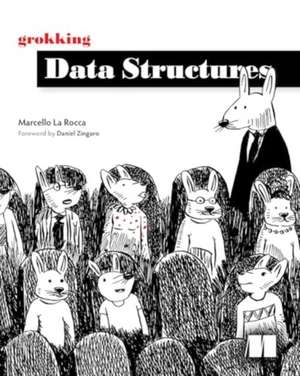
Grokking Data Structures
Autor Marcello Roccaen Limba Engleză Hardback – 12 aug 2024
Pe linia practică a volumului Codeless Data Structures and Algorithms, dar cu focus pe implementarea directă în Python și vizualizarea conceptelor, Grokking Data Structures reușește să demistifice un subiect adesea considerat arid. Suntem de părere că această lucrare publicată de Manning Publications reprezintă puntea necesară între teoria computer science și practica zilnică a unui programator, eliminând demonstrațiile matematice complexe în favoarea intuiției vizuale. Considerăm că abordarea autorului Marcello Rocca este una riguroasă din punct de vedere tehnic, dar extrem de accesibilă, structurând informația de la simplu la complex. Subliniem importanța celor 13 capitole care ghidează cititorul prin anatomia tablourilor statice și dinamice, înainte de a trece la structuri abstracte precum stivele, cozile și cozile de prioritate. Spre deosebire de Data Structures and Algorithms Made Easy, care se concentrează pe rezolvarea de puzzle-uri pentru interviuri în C/C++, volumul de față pune accent pe înțelegerea compromisurilor (trade-offs) dintre diferite structuri în scenarii reale. De exemplu, analiza tabelelor hash și a grafurilor este însoțită de exemple concrete, precum triajul într-o unitate de primiri urgențe sau modelarea relațiilor complexe de date. Fiecare structură este analizată prin prisma eficienței resurselor, utilizând cadrul Big-O pentru a măsura performanța operațiunilor. Considerăm un avantaj major prezența codului Python gata de experimentare, ceea ce transformă lectura dintr-o activitate pasivă într-una de laborator. Experiența autorului în infrastructuri la scară largă (Twitter, Apple) se simte în calitatea explicațiilor despre cum alegerea corectă a unei structuri de date poate preveni catastrofe de performanță în producție.
Preț: 271.92 lei
Preț vechi: 339.89 lei
-20%
Carte disponibilă
Livrare economică 08-22 iulie
Livrare express 24-30 iunie pentru 102.52 lei
Specificații
ISBN-10: 1633436993
Pagini: 280
Dimensiuni: 185 x 232 x 14 mm
Greutate: 0.49 kg
Editura: Manning Publications
V-ar putea interesa
-
 Data Structures & Algorithms in PythonAlan Broder-20%Preț: 418.58 lei523.22 lei
 -
 -19%Preț: 34.10 lei41.88 lei
 -
 Data Structures and Algorithms in JavaRobert Lafore-20%Preț: 352.37 lei440.46 lei
 -
 HTML & CSSJon Duckett-20%Preț: 255.59 lei319.48 lei
 -
 The Self-Taught Computer ScientistCory Althoff-20%Preț: 151.76 lei189.70 lei
 -
 Daphne Draws DataCole Nussbaumer KnaflicPreț: 117.79 lei
 -
 Data Science Essentials For DummiesLillian Pierson-20%Preț: 73.68 lei92.11 lei
 -
 The Data Hero PlaybookMalcolm HawkerPreț: 194.94 lei
 -
 Data Engineering for BeginnersChisom Nwokwu-20%Preț: 352.04 lei440.05 lei
 -
 Writing Graphic Novels For DummiesKensuke OkabayashiPreț: 113.58 lei
 -
 Advanced Topics in CNoel Kalicharan-20%Preț: 359.54 lei449.43 lei
 -
 Character Design Made EasyBrookes EgglestonPreț: 122.62 lei
 -
 -17%Preț: 78.67 lei95.28 leiRecomandat
 -
 Grokking Deep LearningAndrew W Trask-20%Preț: 275.00 lei343.76 lei
 -
 Algorithms and Data Structures in ActionMarcello La Rocca-20%Preț: 396.83 lei496.03 lei
 -
 Grokking AlgorithmsAditya Bhargava-20%Preț: 275.61 lei344.51 lei
 -
 -38%Preț: 189.69 lei307.07 lei
 -
 Data Structures and Algorithms in JavaScriptFederico Kereki-36%Preț: 295.37 lei462.69 lei
 -
 -37%Preț: 289.33 lei458.11 lei
 -
 Speak DataGiorgia Lupi-20%Preț: 171.67 lei214.60 lei
De ce să citești această carte
Recomandăm această carte programatorilor care dețin baze de Python și doresc să își optimizeze codul fără a parcurge tratate academice greoaie. Veți câștiga o înțelegere clară a modului în care funcționează organizarea datelor „sub capotă”, devenind capabili să alegeți structura optimă pentru orice provocare de codare, un avantaj esențial atât în producție, cât și la interviurile tehnice.