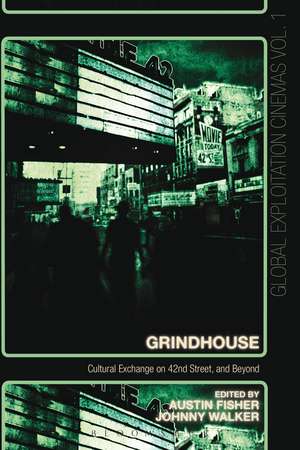
Grindhouse: Cultural Exchange on 42nd Street, and Beyond: Global Exploitation Cinemas
Editat de Prof Austin Fisher, Johnny Walkeren Limba Engleză Paperback – 22 sep 2016
The contributors to Grindhouse: Cultural Exchange on 42nd Street, and Beyond consider "grindhouse cinema" from a variety of cultural and methodological positions. Some seek to deconstruct the etymology of "grindhouse" itself, add flesh to the bones of its cadaverous history, or examine the term's contemporary relevance in the context of both media production and consumerism. Others offer new inroads into hitherto unexamined examples of exploitation film history, presenting snapshots of cultural moments that many of us thought we already knew.





Preț: 208.86 lei
Preț vechi: 249.97 lei
-16%
Puncte Express: 313
Carte tipărită la comandă
Livrare economică 05-19 decembrie
Livrare prin curier în România Termenul estimat este afișat lângă disponibilitate.
Transport gratuit de la 400.00 lei Plată online sau ramburs, în funcție de opțiunile comenzii.
Retur gratuit în 14 zile Comandă securizată și suport în română.
Specificații
ISBN-13: 9781628927498
ISBN-10: 1628927496
Pagini: 280
Ilustrații: 31 bw illus
Dimensiuni: 152 x 229 x 23 mm
Greutate: 0.44 kg
Editura: Bloomsbury Publishing
Colecția Bloomsbury Academic
Seria Global Exploitation Cinemas
Locul publicării:New York, United States
ISBN-10: 1628927496
Pagini: 280
Ilustrații: 31 bw illus
Dimensiuni: 152 x 229 x 23 mm
Greutate: 0.44 kg
Editura: Bloomsbury Publishing
Colecția Bloomsbury Academic
Seria Global Exploitation Cinemas
Locul publicării:New York, United States
V-ar putea interesa
-
 Code NameJohnny WalkerPreț: 101.44 lei
 -
 Preț: 246.80 lei
 -
 Preț: 263.13 lei
 -
 Reinventing Film StudiesChristine Gledhill-21%Preț: 377.79 lei476.38 lei
 -
 French Cinema: A Student's GuidePhil Powrie-16%Preț: 243.11 lei287.83 lei
 -
 Studying Contemporary American Film: A Guide to Movie AnalysisThomas Elsaesser-15%Preț: 281.15 lei331.24 lei
 -
 Preț: 281.29 lei
 -
 Contemporary British Horror CinemaJohnny Walker-18%Preț: 596.55 lei727.49 lei
 -
 Preț: 392.03 lei
 -
 -24%Preț: 265.87 lei347.83 lei
 -
 -25%Preț: 248.04 lei330.84 lei
 -
 American Eccentric CinemaDr. Kim Wilkins-25%Preț: 241.33 lei321.59 lei
 -
 Snuff: Real Death and Screen MediaDr Neil Jackson-15%Preț: 266.20 lei312.19 lei
 -
 -37%Preț: 796.07 lei1267.53 lei
 -
 -21%Preț: 183.45 lei231.96 lei
 -
 -37%Preț: 736.65 lei1171.85 lei
 -
 Global Hollywood 2Prof. Toby Miller-27%Preț: 263.29 lei360.43 lei
 -
 Global Hollywood 2Prof. Toby Miller-32%Preț: 670.83 lei980.80 lei
 -
 The Hollywood Studio System: A HistoryDouglas Gomery-25%Preț: 262.97 lei350.75 lei
 -
 -21%Preț: 182.02 lei229.10 lei
Cuprins
Table of Contents
Acknowledgments
Introduction: 42nd Street, and Beyond
Austin Fisher and Johnny Walker
Chapter 1
Grinding out the Grindhouse: Exploitation, Myth and Memory
Glenn Ward
Chapter 2
Where Did We Come In?: The Economics of Unruly Audiences, Their Cinemas and Tastes, From Serial Houses to Grind Houses.
Phyll Smith
Chapter 3
Temporary Fleapits and Scabs' Alley:The Theatrical Dissemination of Italian Cannibal Films in Melbourne, Australia
Dean Brandum
Chapter 4
Run, Angel, Run: Serial Production and the Biker Movie, 1966-72
Peter Stanfield
Chapter 5
"The Smashing, Crashing, Pileup of the Century": The Carsploitation Film
Robert J Read
Chapter 6
Cars and Girls (and Burgers and Weed): Branding, Mainstreaming, and Crown International Pictures' SoCal Drive-in Movies
Richard Nowell
Chapter 7
From "Sex Entertainment for the Whole Family" to Mature Pictures: I Jomfruens Tegn and Transnational Erotic Cinema
Kevin Heffernan
Chapter 8
'Bigger Than A Payphone, Smaller Than A Cadillac': Porn Stardom in Exhausted: John C Holmes The Real Story
Neil Jackson
Chapter 9
From Opera House to Grindhouse (And Back Again): Ozploitation In and Beyond Australia
Alexandra Heller-Nicholas
Chapter 10
Go West, Brother: the Politics of Landscape in the Blaxploitation Western
Austin Fisher
Chapter 11
Red Power, White Movies: Billy Jack, Johnny Firecloud, and the Cultural Politics of the "Indiansploitation" Cycle
David Church
Chapter 12
Sleazy Strip-Joints and Perverse Porn Circuses: The Remediation of Grindhouse in the Porn Productions of Jack the Zipper
Clarissa Smith
Select Bibliography
Contributors
Acknowledgments
Introduction: 42nd Street, and Beyond
Austin Fisher and Johnny Walker
Chapter 1
Grinding out the Grindhouse: Exploitation, Myth and Memory
Glenn Ward
Chapter 2
Where Did We Come In?: The Economics of Unruly Audiences, Their Cinemas and Tastes, From Serial Houses to Grind Houses.
Phyll Smith
Chapter 3
Temporary Fleapits and Scabs' Alley:The Theatrical Dissemination of Italian Cannibal Films in Melbourne, Australia
Dean Brandum
Chapter 4
Run, Angel, Run: Serial Production and the Biker Movie, 1966-72
Peter Stanfield
Chapter 5
"The Smashing, Crashing, Pileup of the Century": The Carsploitation Film
Robert J Read
Chapter 6
Cars and Girls (and Burgers and Weed): Branding, Mainstreaming, and Crown International Pictures' SoCal Drive-in Movies
Richard Nowell
Chapter 7
From "Sex Entertainment for the Whole Family" to Mature Pictures: I Jomfruens Tegn and Transnational Erotic Cinema
Kevin Heffernan
Chapter 8
'Bigger Than A Payphone, Smaller Than A Cadillac': Porn Stardom in Exhausted: John C Holmes The Real Story
Neil Jackson
Chapter 9
From Opera House to Grindhouse (And Back Again): Ozploitation In and Beyond Australia
Alexandra Heller-Nicholas
Chapter 10
Go West, Brother: the Politics of Landscape in the Blaxploitation Western
Austin Fisher
Chapter 11
Red Power, White Movies: Billy Jack, Johnny Firecloud, and the Cultural Politics of the "Indiansploitation" Cycle
David Church
Chapter 12
Sleazy Strip-Joints and Perverse Porn Circuses: The Remediation of Grindhouse in the Porn Productions of Jack the Zipper
Clarissa Smith
Select Bibliography
Contributors
Recenzii
The Grindhouse is a fascinating phenomenon but it is too often seen as a wild and eclectic one, something that is praised for being chaotic and anarchic. The current collection goes beyond this celebratory rhetoric to examine the multiple forms and histories that converge in the Grindhouse. It unpicks and unpacks the phenomenon in ways that demonstrate its richness and variety, but also make sense of that richness and variety. Most significantly, it does so without destroying the pleasures of the Grindhouse. On the contrary it manages to question the experience while preserving its sense of fascination. And that is a very rare thing.
Grindhouse sets a new standard for the study of exploitation cinema history. In a time when grindhouse aesthetics have become retro chic, this book moves us beyond the seedy, cult mythologies of grindhouse. Examining grindhouse cinema beyond myth and morality, beyond genre conventions or industrial norms, and even beyond the U.S. context, this collection takes a nuanced look at this complex body-no cadaver-of film history. The book demands that we interrogate how the turbulent racial, national and sexual politics of the 1960s to 1980s gave birth to a movement in cinema whose significance to the popular and film cultures of today cannot be underestimated. A tour de force and a must read for anyone interested in film on the (not so) perverse margins of cinema history.
Grindhouse sets a new standard for the study of exploitation cinema history. In a time when grindhouse aesthetics have become retro chic, this book moves us beyond the seedy, cult mythologies of grindhouse. Examining grindhouse cinema beyond myth and morality, beyond genre conventions or industrial norms, and even beyond the U.S. context, this collection takes a nuanced look at this complex body-no cadaver-of film history. The book demands that we interrogate how the turbulent racial, national and sexual politics of the 1960s to 1980s gave birth to a movement in cinema whose significance to the popular and film cultures of today cannot be underestimated. A tour de force and a must read for anyone interested in film on the (not so) perverse margins of cinema history.