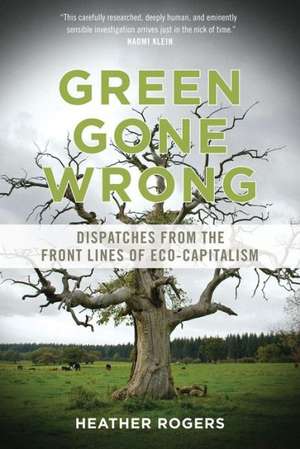
Green Gone Wrong
Autor Heather Rogersen Limba Engleză Paperback – 16 ian 2013
Complementar volumului Eco-Hustle! de Bruce E. Johansen, care definește mecanismele publicitare ale sustenabilității aparente, Green Gone Wrong trece dincolo de teorie pentru a oferi o investigație de teren brutal de onestă. În timp ce alte lucrări se limitează la a critica retorica, Heather Rogers documentează fizic modul în care promisiunea salvării planetei prin simpla schimbare a produselor „murdare” cu cele „curate” eșuează sistematic. Considerăm că forța acestui volum rezidă în capacitatea sa de a demonta mitul conform căruia forțele pieței pot corecta criza climatică fără o schimbare structurală a paradigmei de consum. Recomandăm această lectură pentru rigoarea cu care analizează sectoare fundamentale: hrana, adăpostul și transportul. Heather Rogers explorează ce înseamnă cu adevărat etichetele „Fair Trade” pe plantațiile sud-americane sau de ce proiectele de compensare a emisiilor de carbon eșuează lamentabil, lăsând în urmă ecosisteme distruse și comunități sărace. Această abordare continuă direcția începută de autoare în Gone Tomorrow, unde analiza costului ascuns al bunurilor de unică folosință a stabilit-o ca o voce autoritară în critica industrială. Dacă în lucrările anterioare accentul cădea pe deșeuri, aici accentul se mută pe iluzia regenerării. Spre deosebire de The Greenwash Effect, care se concentrează pe campaniile de PR ale corporațiilor, Green Gone Wrong este o radiografie a infrastructurii verzi, de la birourile executive din Detroit până la pădurile din India, oferind o perspectivă globală și sobră asupra a ceea ce funcționează și ce reprezintă doar un zgomot de marketing.
Preț: 222.54 lei
Carte disponibilă
Livrare economică 05-19 noiembrie
Specificații
ISBN-10: 1844679012
Pagini: 288
Dimensiuni: 128 x 198 x 25 mm
Greutate: 0.32 kg
Editura: VERSO
Locul publicării:United States
V-ar putea interesa
-
 Green and Prosperous LandDieter HelmPreț: 71.61 lei
 -
 Ecological IntelligenceDaniel GolemanPreț: 94.52 lei
 -
 Preț: 202.50 lei
 -
 -19%Preț: 74.61 lei92.59 lei
 -
 This Changes EverythingNaomi Klein-18%Preț: 89.87 lei109.17 lei
 -
 The Sustainable EconomyRobert S DevinePreț: 108.17 lei
 -
 Harris, M: All We WantMichael HarrisPreț: 105.52 lei
 -
 Preț: 194.39 lei
 -
 Your Shopping SuperpowerDiane Osgood-22%Preț: 71.74 lei92.51 lei
 -
 Greenwashing Practices in Company Marketing CommunicationsAnita Proszowska-8%Preț: 449.76 lei488.87 lei
 -
 -27%Preț: 57.88 lei78.82 lei
 -
 Preț: 119.29 lei
 -
 Clearing the AirHannah RitchiePreț: 121.89 lei
 -
 Consumed: How Big Brands Got Us Hooked on PlasticSaabira ChaudhuriPreț: 124.58 lei
 -
 Buy Better, Consume LessSian Conway-WoodPreț: 106.36 lei
 -
 The Price is WrongBrett ChristophersPreț: 101.15 lei
 -
 BreatheSadiq Khan-19%Preț: 63.34 lei78.53 lei
 -
 Green CrimeJulia ShawPreț: 122.38 lei
 -
 Carbon Credits are CrapJaye Connolly-30%Preț: 85.16 lei122.23 lei
 -
 Lean & Green: Best PracticeDaniel ReichertPreț: 451.09 lei
De ce să citești această carte
Credem că orice consumator responsabil trebuie să citească această carte pentru a înțelege de ce „cumpărăturile verzi” nu sunt suficiente. Veți învăța să identificați capcanele marketingului ecologic și veți înțelege barierele politice care blochează tehnologiile eficiente. Este un instrument esențial pentru a trece de la bune intenții la acțiuni care au cu adevărat un impact sistemic asupra mediului, oferind claritate într-o piață saturată de promisiuni deșarte.
Despre autor
Heather Rogers este o jurnalistă de investigație și realizatoare de filme documentare stabilită în Brooklyn, New York. Este cunoscută pentru stilul său incisiv de a analiza intersecția dintre economie și ecologie, debutând cu documentarul Gone Tomorrow (2002), care a explorat cultura risipei. Scrierile sale au apărut în publicații prestigioase precum The Nation și Utne Reader. Prin Green Gone Wrong, Rogers își consolidează poziția de critic al consumerismului modern, folosindu-și experiența de reporter de teren pentru a aduce la lumină realități complexe din cele mai izolate colțuri ale lumii.
Recenzii
"Heather Rogers brilliantly and lethally exposes "green" capitalism for the chicanery that it is. While it may be disappointing to find out that "organic" and even "fair trade" don't mean squat - not to mention, of course, "carbon offsetting," which turns out to be even stupider than it sounds - these pages make clear what the answer is: stop making colorful excuses for the system that's driving us off the cliff, and instead make shifts in our economic priorities to bring about real change. May Rogers's book guide our feet."--The Yes Men
"Heather Rogers reminds us with vivid examples that there's no way we can just subcontract our environmental conscience to the new breed of green marketers. We have a very narrow window to preserve some version of our planet, and we can't afford the kind of egregious mistakes this volume identifies with such precision. If it's too good to be true, it's not true--even if it comes with a shiny green wrapper."--Bill McKibben, author "Earth: Making a Life on a Tough New Planet
"
"With deft and adventuresome reporting from around the world, Heather Rogers looks beneath the surface of today's market- based "solutions" to our environmental challenges and skillfully distinguishes between reality and illusion. Business as usual won't do, Rogers tells us, no matter how much we green it."--Annie Leonard, author of "The Story of Stuff"
Rogers "exposes how the "green" movement is failing to live up to the promise of sustainability and stewardship of the environment when the solutions are hijacked by economic and political interests. [Her] clear-headed approach proves effective in uncovering the truths behind the mantle of greenwashing."--Booklist
"The climate crisis is far too urgent to squander another decade on false solutions. This carefully researched, deeply human, and eminently sensible investigation arrives just in the nick of time. Let's hope it inspires a radical course correction."--Naomi Klein, author of "The Shock Doctrine"
Excellent anatomy of greenwashing in corporate culture and personal life.
Carefully researched, deeply human, and eminently sensible. --Naomi Klein
Well-written and exhaustively reported.
Green Gone Wrong doesn't just go after easy targets like big corporations ... Rogers offers plenty of evidence that consumers who load up their shopping carts with organic food, for instance, may be unwittingly subsidizing big farm companies that are eradicating forests and defiling the soil in some developing countries.
Heather Rogers offers a compelling commentary on the state of our contemporary civilization. --David Harvey
Readers will be troubled by the laundry list of fallacies at the heart of 'green business, ' but the book's final chapter, which discusses developing and very positive alternatives, will keep them from despairing.
Self-proclaimed environmentalists should read Heather Rogers's stories and weep.
Heather Rogers ... makes a convincing argument that, as most of us have probably already suspected, we can't simply buy our way out of the crisis that our planet is experiencing.
"[An] excellent anatomy of greenwashing in corporate culture and personal life."--"Guardian"
"The climate crisis is far too urgent to squander another decade on false solutions. This carefully researched, deeply human, and eminently sensible investigation arrives just in the nick of time. Let's hope it inspires a radical course correction."--Naomi Klein
"Heather Rogers offers a compelling commentary on the state of our contemporary civilisation."--David Harvey
"Our livelihood is in conflict with our planet. Heather Rogers paints a vivid picture of the crisis to come unless we fundamentally change what and how much we consume. Green Gone Wrong is a book of hope because it tells us what is necessary--not what we want to hear."--Neal Lawson
"Heather Rogers reminds us with vivid examples that there's no way we can just subcontract our environmental conscience to the new breed of green marketers. We have a very narrow window to preserve some version of our planet, and we can't afford the kind of egregious mistakes this volume identifies with such precision. If it's too good to be true, it's not true--even if it comes with a shiny green wrapper."--Bill McKibben, author "Eaarth: Making a Life on a Tough New Planet"
"With deft and adventuresome reporting from around the world, Heather Rogers looks beneath the surface of today's market-based "solutions" to our environmental challenges and skillfully distinguishes between reality and illusion. Business as usual won't do, Rogers tells us, no matter how much we green it."--Annie Leonard, author of "The Story of Stuff"
"Heather Rogers brilliantly and lethally exposes 'green' capitalism for the chicanery that it is. While it may be disappointing to find out that 'organic' and even 'fair trade' don't mean squat--not to mention, of course, 'carbon offsetting, ' which turns out to be even stupider than it sounds--these pages make clear what the answer is: stop making colorful excuses for the
Notă biografică
Descriere scurtă
A new afterword considers various ways in which national development might be freed from its dependence on economic growth, allowing for a decent standard of living without exhausting the planet’s resources.