
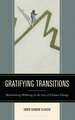
Gratifying Transitions: Maintaining Wellbeing in the Face of Climate Change: Key Issues in Climate Change and Sustainability: Ethics, Politics and Policy
Autor Søren Harnow Klausenen Limba Engleză Paperback – 22 iul 2027


Preț: 174.11 lei
Preț vechi: 227.05 lei
-23% Precomandă
Puncte Express: 261
Carte nepublicată încă
Livrare prin curier în România Precomanda se expediază când titlul devine disponibil.
Transport gratuit de la 400.00 lei Plată online sau ramburs, în funcție de opțiunile comenzii.
Retur gratuit în 14 zile Comandă securizată și suport în română.
Doresc să fiu notificat când acest titlu va fi disponibil:
Se trimite...
Specificații
ISBN-13: 9798216396178
Pagini: 240
Dimensiuni: 152 x 229 x 25 mm
Greutate: 0.45 kg
Editura: Bloomsbury Publishing
Colecția Bloomsbury Academic
Seria Key Issues in Climate Change and Sustainability: Ethics, Politics and Policy
Locul publicării:New York, United States
Pagini: 240
Dimensiuni: 152 x 229 x 25 mm
Greutate: 0.45 kg
Editura: Bloomsbury Publishing
Colecția Bloomsbury Academic
Seria Key Issues in Climate Change and Sustainability: Ethics, Politics and Policy
Locul publicării:New York, United States
V-ar putea interesa
-
 Positive Tipping Points: How to Fix the Climate CrisisTim Lenton OBE-16%Preț: 121.82 lei145.83 lei
-
 Climate-Just Behavior: Foundations and Transformational ApproachesSusanne Stoll-KleemannPreț: 502.77 lei
-
 Harris, M: All We WantMichael HarrisPreț: 105.52 lei
-
 Catastrophe EthicsTravis RiederPreț: 79.52 lei
-
 -30%Preț: 133.26 lei191.34 lei
-
 A Liveable Future is PossibleNoam ChomskyPreț: 78.95 lei
-
 Flourish: A Visionary New Understanding of Happiness and Well-BeingMartin E P SeligmanPreț: 114.00 lei
-
 Preț: 325.55 lei
-
 -25%Preț: 59.60 lei79.46 lei
-
 -19%Preț: 218.49 lei269.24 lei
-
 How to Be HopefulElin KelseyPreț: 147.29 lei
-
 Clearing the AirHannah RitchiePreț: 121.89 lei
-
 Post-Growth LivingKate SoperPreț: 103.62 lei
-
 Beyond SustainabilityNimue BrownPreț: 83.43 lei
-
 -25%Preț: 103.87 lei137.70 lei
-
 The Other Side of ChangeMaya ShankarPreț: 122.07 lei
-
 -19%Preț: 97.64 lei121.22 leiRecomandat
-
 The Well-being TransitionÉloi Laurent-18%Preț: 1001.22 lei1221.00 lei
-
 Climate, Psychology, and ChangeSteffi Bednarek-21%Preț: 103.36 lei130.72 lei
Cuprins
Chapter 1: Introduction
1.1 The role of wellbeing in responding to climate change
1.2 Wellbeing and change
1.3 Wellbeing, motivation and action
1.4 Views on the relationship between climate change, climate action and wellbeing
1.4 Why not gamble on green growth?
1.5 Why not just politics?
1.6 Wellbeing for whom?
1.7 An interdisciplinary, philosophy-driven approach
Chapter 2: Life in the Future
2.1 The ubiquity of change
2.2 Change for better or worse?
2.3 Going through changes
2.4 Quantity and quality of change
2.5 Living with climate change
2.6 Living with mitigation
Chapter 3: A Theory of Wellbeing for Green Transition
3.1 A plethora of theories and a provisional assessment
3.2 Problems with subjective wellbeing? Immeasurability, growth ideology and adaptation
3.3 Virtues of subjective wellbeing
3.4 Growth ideology and individualism?
3.5 Why not a needs approach?
3.6 Genuinely basic needs?
3.7 Adaptation for good and for bad
3.8 Richer and poorer lives
3.9 Getting the most out of it: Cultivation as the key?
3.10 Putting it together: A theory of wellbeing for green transition
Chapter 4: Living with Change
4.1 Remaining, losing and becoming yourself
4.2 The shape, meaning and management of life
4.3 Temporal styles and agents of change
4.4 Keeping the good things alive - variation as the key to wellbeing?
4.4 Values and impacts of personal change
Chapter 5: Shaping behavior: Self-control, cultivation and emulation
5.1 The bad news: How not to change behavior
5.2 The (somewhat) better news: How we might change behavior
5.3 Limits of behavioral design
5.4 Bildung to the rescue?
5.5 Getting it right: Bildung and the situationist challenge
5.6 Bildung and behavior change as social process
5.7 Return of the environmental humanities?
Chapter 6: Acceptable Transitions
6.1 Only soft interventions?
6.2 Goodbye to liberalism?
6.3 Harm and sustainability
6.4 Learning from the pandemic
6.5 Realism, but not too much: Balancing feasibility concerns and the role of hope
6.6 Moral aesthetics
6.7 Unjustified interventions?
Chapter 7: Changemaking: Gratifying transitions and strategies for green transition
Coda: Living with change in an uncertain world
References
About the Author