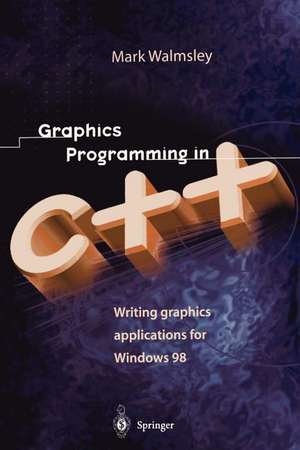
Graphics Programming in C++
Autor Mark Walmsleyen Limba Engleză Paperback – 27 sep 2011
Preț: 333.13 lei
Preț vechi: 416.42 lei
-20%
Puncte Express: 500
Carte tipărită la comandă
Livrare economică 28 noiembrie-12 decembrie
Livrare prin curier în România Termenul estimat este afișat lângă disponibilitate.
Transport gratuit de la 400.00 lei Plată online sau ramburs, în funcție de opțiunile comenzii.
Retur gratuit în 14 zile Comandă securizată și suport în română.
Specificații
ISBN-13: 9781447112310
ISBN-10: 1447112318
Pagini: 264
Ilustrații: X, 250 p.
Dimensiuni: 155 x 235 x 15 mm
Greutate: 0.41 kg
Ediția:Softcover reprint of the original 1st ed. 1998
Editura: Springer
Locul publicării:London, United Kingdom
ISBN-10: 1447112318
Pagini: 264
Ilustrații: X, 250 p.
Dimensiuni: 155 x 235 x 15 mm
Greutate: 0.41 kg
Ediția:Softcover reprint of the original 1st ed. 1998
Editura: Springer
Locul publicării:London, United Kingdom
V-ar putea interesa
-
 Advanced Methods in Computer GraphicsRamakrishnan Mukundan-20%Preț: 323.84 lei404.81 lei
 -
 Beginning ScribusRobert White-20%Preț: 292.34 lei365.42 lei
 -
 Modular Design FrameworksJames Cabrera-20%Preț: 203.16 lei253.96 lei
 -
 Digital Video Editing FundamentalsWallace Jackson-20%Preț: 276.18 lei345.22 lei
 -
 Pro Photo Colorizing with GIMPPhillip Whitt-20%Preț: 342.66 lei428.32 lei
 -
 VFX FundamentalsWallace Jackson-20%Preț: 236.10 lei295.13 lei
 -
 Beginning Pixlr EditorPhillip Whitt-20%Preț: 180.36 lei225.45 lei
 -
 Guide to Graphics Software ToolsJim X. Chen-20%Preț: 343.05 lei428.80 lei
 -
 Volume GraphicsMin Chen-20%Preț: 330.20 lei412.75 lei
 -
 Digital MediaRimon Elias-20%Preț: 357.61 lei447.01 lei
 -
 -20%Preț: 311.98 lei389.98 lei
 -
 Discrete and Computational Geometry and GraphsJin Akiyama-20%Preț: 335.46 lei419.34 lei
 -
 Austrographics '88Alexander Clauer-20%Preț: 421.52 lei526.91 lei
 -
 -20%Preț: 322.61 lei403.26 lei
 -
 -20%Preț: 328.79 lei410.99 lei
 -
 -20%Preț: 395.14 lei493.92 lei
 -
 -20%Preț: 318.67 lei398.33 lei
 -
 Digital Preservation Technology for Cultural HeritageMingquan Zhou-20%Preț: 626.57 lei783.22 lei
 -
 Models and Techniques in Computer AnimationNadia Magnenat Thalmann-20%Preț: 319.29 lei399.11 lei
 -
 Scientific Visualization of Physical PhenomenaNicholas M. Patrikalakis-20%Preț: 343.68 lei429.60 lei
 -
 Visual ComputingTosiyasu L. Kunii-20%Preț: 692.50 lei865.62 lei
Public țintă
Popular/generalCuprins
1. Message-Based Programming.- 1.1 Windows 98 Programming.- 1.2 Window Components.- 1.3 Message Queues.- 1.4 Window Callback Functions.- 1.5 The WinMain () Function.- 1.6 Windows 98 Messages.- 1.7 Some Important Messages.- 1.8 Summary.- 2. Window Management.- 2.1 Window Classes.- 2.2 Creating a Window.- 2.3 WinMain () Revisited.- 2.4 Message Handlers.- 2.5 The Hello Program.- 2.6 Windows 98 Program Framework.- 2.7 Summary.- 3. Object Orientation.- 3.1 Object Oriented Programming.- 3.2 The Manager Object.- 3.3 Windows and Objects.- 3.4 Message Boxes.- 3.5 Popup Menus.- 3.6 The VIEW Class.- 3.7 Summary.- 4. Pens and Brushes.- 4.1 Graphics Device Interface.- 4.2 GDI Objects.- 4.3 Windows 98 Coordinate Systems.- 4.4 GDI Drawing Functions.- 4.5 Tracking the Mouse.- 4.6 Summary.- 5. Bitmaps.- 5.1 Pixels and Colours.- 5.2 Windows 98 Resources.- 5.3 Displaying a Bitmap Resource.- 5.4 The DIB Class.- 5.5 Storing Images in Files.- 5.6 Summary.- 6. Palettes.- 6.1 Logical and System Palettes.- 6.2 Palette Messages.- 6.3 Creating a Palette.- 6.4 The PALETTE Class.- 6.5 Updating the DIB Class.- 6.6 Summary.- 7. Sprite Animation.- 7.1 The SPRITE Class.- 7.2 Animation.- 7.3 Flicker.- 7.4 Transparency.- 7.5 Threads.- 7.6 Summary.- 8. Wire-Frame Graphics.- 8.1 Polygon Worlds.- 8.2 The WORLD and SCENE Objects.- 8.3 Line Drawing.- 8.4 Line Clipping.- 8.5 Summary.- 9. Polygon-Fill Techniques.- 9.1 The GDI Approach.- 9.2 Polygon Outlines.- 9.3 Filling with a Solid Colour.- 9.4 Drawing 3D Images.- 9.5 Virtual World Chunks.- 9.6 Summary.- 10. Assembly Language Programming.- 10.1 Computer Basics.- 10.2 Updating the Message Loop.- 10.3 The 80x86 Registers.- 10.4 Data Transfer.- 10.5 Arithmetic and Logical Operations.- 10.6 Flow Control.- 10.7 Faster Polygon-Fill Routines.- 10.8 Program Stack.- 10.9 Summary.- 11. Mathematics of 3D Geometry.- 11.1 Vectors and Matrices.- 11.2 The VECTOR Class.- 11.3 Scalar Product.- 11.4 Vector Product.- 11.5 Triple Product.- 11.6 Lines and Planes.- 11.7 Summary.- 12. Projection of the Viewing Volume.- 12.1 Perspective Projections.- 12.2 The Viewing Volume.- 12.3 Taking a Snapshot.- 12.4 Projecting and Clipping.- 12.5 A Vanishing Cube.- 12.6 Summary.- 13. Hidden Pixel Removal.- 13.1 Constructing a Scene Image.- 13.2 The Painter’s Algorithm.- 13.3 Separating Planes.- 13.4 Binary Space Partitioning.- 13.5 Drawing in Reverse.- 13.6 Z-Buffers.- 13.7 Summary.- 14. Colour Shading and Textures.- 14.1 Lights and Surfaces.- 14.2 Shading Options.- 14.3 Texture Mapping.- 14.4 Implementation Optimizations.- 14.5 Depth Perception.- 14.6 Summary.- 15. In Motion.- 15.1 The Graphics Pipeline.- 15.2 Animating the Virtual World.- 15.3 Translations.- 15.4 Rotations.- 15.5 Transforming Coordinates.- 15.6 Summary.- Postscript.
Caracteristici
Easy to read, practical explanations using C++ allow readers to program their own 3D graphics applications or game programs. Essential techniques are covered, providing a quick and clear introduction to the subject without encumbering the reader with a mass of extraneous details. Perfect for anyone wishing to develop graphics applications for Windows 98.