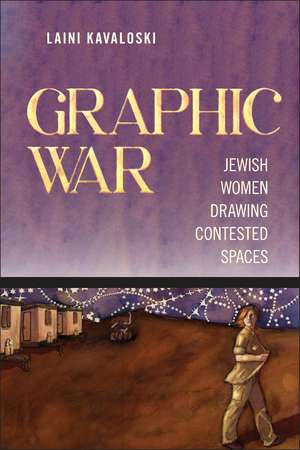
Graphic War: Jewish Women Drawing Contested Spaces
Autor Laini Kavaloskien Limba Engleză Paperback – 13 ian 2026 – vârsta ani
| Toate formatele și edițiile | Preț | Express |
|---|---|---|
| Paperback (1) | 221.74 lei Precomandă | |
| Rutgers University Press – 13 ian 2026 | 221.74 lei Precomandă | |
| Hardback (1) | 654.33 lei Precomandă | |
| Rutgers University Press – 13 ian 2026 | 654.33 lei Precomandă |
Preț: 221.74 lei
Precomandă
Puncte Express: 333
Preț estimativ în valută:
39.24€ • 46.01$ • 34.46£
39.24€ • 46.01$ • 34.46£
Carte nepublicată încă
Doresc să fiu notificat când acest titlu va fi disponibil:
Se trimite...
Preluare comenzi: 021 569.72.76
Specificații
ISBN-13: 9781978830981
ISBN-10: 197883098X
Pagini: 180
Ilustrații: 19 color images and 13 B-W images
Dimensiuni: 152 x 229 x 15 mm
Greutate: 0.25 kg
Editura: Rutgers University Press
Colecția Rutgers University Press
ISBN-10: 197883098X
Pagini: 180
Ilustrații: 19 color images and 13 B-W images
Dimensiuni: 152 x 229 x 15 mm
Greutate: 0.25 kg
Editura: Rutgers University Press
Colecția Rutgers University Press
Notă biografică
LAINI KAVALOSKI is an associate professor of English and humanities at the State University of New York in Canton.
Cuprins
Introduction: Jewish In/security and Graphic Borders 1
1 Militarized Bodies and Contested Homelands in the
Works of Miriam Libicki and Sarah Glidden 23
2 The Implicated Subject and World War II Identity in the
Twenty-First
Century 51
3 “The Drug of H”: Holocaust Addiction, Pulp Horror, and
Jewish Identity 87
4 “Work for the Future, Not Only for Memory”: Agency,
Activism, and Joy in the Works of Leela Corman and
Julia Alekseyeva 108
Conclusion: Transforming Political Structures and Futures 137
Notes 141
Works Cited 153
Index 161
1 Militarized Bodies and Contested Homelands in the
Works of Miriam Libicki and Sarah Glidden 23
2 The Implicated Subject and World War II Identity in the
Twenty-First
Century 51
3 “The Drug of H”: Holocaust Addiction, Pulp Horror, and
Jewish Identity 87
4 “Work for the Future, Not Only for Memory”: Agency,
Activism, and Joy in the Works of Leela Corman and
Julia Alekseyeva 108
Conclusion: Transforming Political Structures and Futures 137
Notes 141
Works Cited 153
Index 161
Recenzii
"Graphic War is remarkable, arguing that the comic form is exemplary in its engagement with borders, boundaries, and national and cultural identity. Kavaloski argues that comics are an ideal genre for women to contest Jewish national and cultural identity at a time when gender, nation, and belonging have been put seriously in question."
"Kavaloski's feminist-spatial practice, with her focus on nationalization and bodies, avoids many of the exceptionalist pitfalls to which the standard historicism dominant in Jewish studies is heir. The compelling model of critical intellectuality elaborated here will aid the effort to break down the boundaries of epistemic privilege behind which Jewish studies so often practices its trade."
"Anchored by representations of war and violence, Kavaloski offers a deft addition to the study of contemporary Jewish graphic narratives through an analysis of the female experience across gendered and national borders."
"Kavaloski's thoughtful readings of Jewish graphic narratives offer new insights into how war and violence affect contemporary Jewish women. This is an important contribution towards understanding the ways that politics, gender, religion, and nationality intersect and the role that visual narratives can play in providing a platform for navigating these complex identities."
“Kavaloski constructs a useful framework to read the embodied, gendered experience of war and violence in graphic narratives. She calls it 'neoformalist,' but what we get are impactful cultural readings at the intersection of feminism theory, in the wake of spatial turn, with an eye on the aesthetic that can be translated beyond the Jewish literary domain.”
"Kavaloski's feminist-spatial practice, with her focus on nationalization and bodies, avoids many of the exceptionalist pitfalls to which the standard historicism dominant in Jewish studies is heir. The compelling model of critical intellectuality elaborated here will aid the effort to break down the boundaries of epistemic privilege behind which Jewish studies so often practices its trade."
"Anchored by representations of war and violence, Kavaloski offers a deft addition to the study of contemporary Jewish graphic narratives through an analysis of the female experience across gendered and national borders."
"Kavaloski's thoughtful readings of Jewish graphic narratives offer new insights into how war and violence affect contemporary Jewish women. This is an important contribution towards understanding the ways that politics, gender, religion, and nationality intersect and the role that visual narratives can play in providing a platform for navigating these complex identities."
“Kavaloski constructs a useful framework to read the embodied, gendered experience of war and violence in graphic narratives. She calls it 'neoformalist,' but what we get are impactful cultural readings at the intersection of feminism theory, in the wake of spatial turn, with an eye on the aesthetic that can be translated beyond the Jewish literary domain.”
Descriere
Graphic War introduces graphic border poetics to the field of comics, which enables a methodological response to nationalist, empirical, and gendered ideologies. It registers a shift from the persistent Jewish identification with 20th-century oppression toward a Jewish belonging based in transnational agency and activism in the 21st Century.