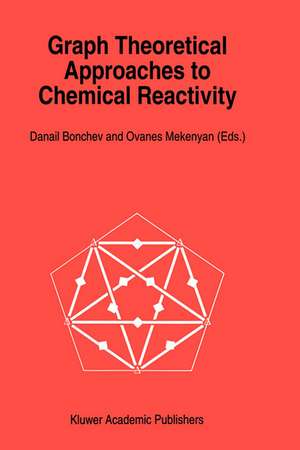
Graph Theoretical Approaches to Chemical Reactivity: Understanding Chemical Reactivity, cartea 9
Editat de Danail D. Bonchev, O.G. Mekenyanen Limba Engleză Hardback – 30 iun 1994
| Toate formatele și edițiile | Preț | Express |
|---|---|---|
| Paperback (1) | 908.00 lei 43-57 zile | |
| SPRINGER NETHERLANDS – 11 oct 2012 | 908.00 lei 43-57 zile | |
| Hardback (1) | 913.75 lei 43-57 zile | |
| SPRINGER NETHERLANDS – 30 iun 1994 | 913.75 lei 43-57 zile |
Din seria Understanding Chemical Reactivity
- 18%
 Preț: 1173.98 lei
 - 18%
 Preț: 1191.91 lei
 - 15%
 Preț: 614.11 lei
 - 24%
 Preț: 863.89 lei
 - 18%
 Preț: 706.04 lei
 - 18%
 Preț: 915.43 lei
 -
 Preț: 376.55 lei
 - 18%
 Preț: 914.35 lei
 - 18%
 Preț: 1179.90 lei
 -
 Preț: 371.57 lei
 - 15%
 Preț: 620.86 lei
 - 18%
 Preț: 1760.56 lei
 - 18%
 Preț: 866.14 lei
 - 18%
 Preț: 910.11 lei
 - 15%
 Preț: 555.00 lei
 - 15%
 Preț: 610.96 lei
 - 18%
 Preț: 1281.50 lei
 -
 Preț: 377.40 lei
 - 18%
 Preț: 1777.22 lei
 - 15%
 Preț: 572.92 lei
 - 18%
 Preț: 914.35 lei
 - 18%
 Preț: 917.87 lei
 - 18%
 Preț: 1180.06 lei
 - 18%
 Preț: 1763.88 lei
Preț: 913.75 lei
Preț vechi: 1114.33 lei
-18% Nou
Puncte Express: 1371
Preț estimativ în valută:
161.72€ • 189.65$ • 141.79£
161.72€ • 189.65$ • 141.79£
Carte tipărită la comandă
Livrare economică 26 ianuarie-09 februarie 26
Preluare comenzi: 021 569.72.76
Specificații
ISBN-13: 9780792328377
ISBN-10: 079232837X
Pagini: 283
Ilustrații: XI, 283 p.
Dimensiuni: 170 x 244 x 18 mm
Greutate: 0.59 kg
Ediția:1994
Editura: SPRINGER NETHERLANDS
Colecția Springer
Seria Understanding Chemical Reactivity
Locul publicării:Dordrecht, Netherlands
ISBN-10: 079232837X
Pagini: 283
Ilustrații: XI, 283 p.
Dimensiuni: 170 x 244 x 18 mm
Greutate: 0.59 kg
Ediția:1994
Editura: SPRINGER NETHERLANDS
Colecția Springer
Seria Understanding Chemical Reactivity
Locul publicării:Dordrecht, Netherlands
V-ar putea interesa
-
 The Lost Elements: The Periodic Table's Shadow SideMarco Fontani-14%Preț: 361.22 lei421.28 lei
 -
 Capillarity and Wetting PhenomenaPierre Gilles de Gennes-15%Preț: 568.19 lei668.45 lei
 -
 -9%Preț: 771.63 lei847.94 lei
 -
 -9%Preț: 1048.34 lei1152.02 lei
 -
 Current Trends of Surface Science and CatalysisJeong Young Park-15%Preț: 624.01 lei734.13 lei
 -
 Chemical Thermodynamics: An IntroductionErnö KeszeiPreț: 446.10 lei
 -
 Frustrated Lewis Pairs I: Uncovering and UnderstandingGerhard Erker-18%Preț: 1176.89 lei1435.23 lei
 -
 Plasma Chemistry IIIS. Veprek-15%Preț: 609.39 lei716.93 lei
Public țintă
ResearchCuprins
1. Introduction to Graph Theory.- 1. Chemical Graph Theory.- 2. Representation and Characterization of a Graph.- 3. Realization of a Graph.- 4. Operations on Graphs.- 5. References.- 2. The Interplay Between Graph Theory and Molecular Orbital Theory.- 1. Introduction.- 2. Fundamentals of Graph Theory.- 3. Isomorphism of Graph Spectral Theory and Hückel Molecular Orbital Theory.- 4. Hückel Spectrum.- 5. Topological Effect on Molecular Orbitals.- 6. The HOMO-LUMO Separation.- 7. Topological Charge Stabilization.- 8. Localization Energy.- 9. Concluding Remarks.- 10. References.- 3. Topological Control of Molecular Orbital Theory:A Comparison of µ2-Scaled HüCkel Theory and Restricted Hartree-Fock Theory for Boranes and Carboranes.- 1. Introduction.- 2. Calculational Method.- 3. The Method of Moments.- 4. Elemental Boron.- 5. BnHn2-Clusters.- 6. The ?-Parameter of B10H102-.- 7. Reaction Pathways.- 8. Conclusion.- 9. References.- 4. Polyhedral Dynamics.- 1. Introduction.- 2. The Topology of Polyhedra.- 3. Polyhedral Isomerizations.- 4. Microscopic Models: Diamond-Square-Diamond Processes and Gale Diagrams.- 5. Macroscopic Models: Topological Representations.- 6. Literature References.- 5. Reaction Graphs.- 1. Introduction.- 2. Reaction Graphs of Rearrangements Via Carbocations.- 3. Automerization of Bulvalene, Other Valence Isomers of Annulenes,and Azabullvalene.- 4. Rotation in Molecular Propellers.- 5. Reaction Graphs for Rearrangements of Metallic Complexes.- 6. Xenon Hexafluoride.- 7. Heptaphosphide Trianion.- 8. Kinetic Graphs, Synthon Graphs, and Graph Transforms.- 9. Conclusions.- 10. References.- 6. Discrete Representations of Three-Dimensional Molecular Bodies and Their Shape Changes in Chemical Reactions.- 1. Introduction and Review of Basic TopologicalConcepts of Molecular Shape Representation.- 2. Molecular Shape Representation by Nuclear Potential Contours(NUPCO’s).- 3. Topological Patterns of NUPCO Sequences.- 4. Shape Changes of NUPCO Sequences Along Reaction Paths and in Conformational Domains.- 5. Shape Changes of NUPCO’s in Conformational Changes and inMolecular Deformations; NUPCO Shape Invariance Domains of the Configuration Space.- 6. Local Shape Invariance of NUPCO’s and the Transfer of FunctionalGroups in Chemical Reactions.- 7. Summary.- 8. References.- 7. The Invariance of Molecular Topology in Chemical Reactions.- 1. Introduction.- 2. From a Lewis Diagram to the Pseudo-Graph and Graphoid.- 3. From Graph (Graphoid) to Surface.- 4. What Is the Topological Homeomorphism from the Chemical Pointof View?.- 5. The Invariance of the Euler Characteristic in Chemical Reactions.- 6. The Main Theorem.- 7. Conclusion.- 8. References and Notes.- 8. Topological Indices and Chemical Reactivity.- 1. Introduction.- 2. Basic Principles Underlying the Topological Nature of Chemical Reactivity.- 3. Molecular Topology and Topological Invariants.- 4. Applications of Topological Indices to Chemical Reactivity.- 5. Conclusions.- 6. References.- 9. Graph-Theoretical Models of Complex Reaction Mechanisms and Their Elementary Steps.- 1. Introduction.- 2. Graph-Theoretical Approach to Studies in the Elementary Stepsof Complex Reactions.- 3. Classification and Coding of Linear Reaction Mechanisms By UsingKinetic Graphs.- 4. Application of Bipartite Graphs and Stoichiometric Matrices to theDescription of Linear and Nonlinear Reaction Mechanisms.- 5. Topological Aspects of Complex Reaction Mechanisms.- 6. References.