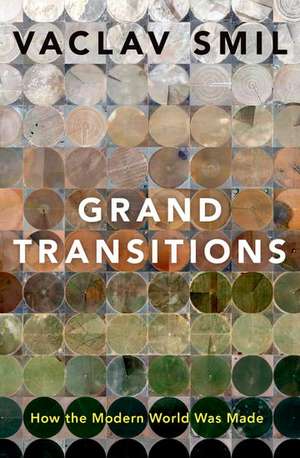
Grand Transitions: How the Modern World Was Made
Autor Vaclav Smilen Limba Engleză Hardback – 27 mai 2021
Preț: 225.81 lei
Preț vechi: 264.85 lei
-15%
Puncte Express: 339
Carte disponibilă
Livrare economică 06-17 noiembrie
Livrare express 24-30 octombrie pentru 77.77 lei
Livrare prin curier în România Termenul estimat este afișat lângă disponibilitate.
Transport gratuit de la 400.00 lei Plată online sau ramburs, în funcție de opțiunile comenzii.
Retur gratuit în 14 zile Comandă securizată și suport în română.
Specificații
ISBN-13: 9780190060664
ISBN-10: 0190060662
Pagini: 384
Dimensiuni: 231 x 163 x 33 mm
Greutate: 0.66 kg
Editura: Oxford University Press
Colecția OUP USA
Locul publicării:New York, United States
ISBN-10: 0190060662
Pagini: 384
Dimensiuni: 231 x 163 x 33 mm
Greutate: 0.66 kg
Editura: Oxford University Press
Colecția OUP USA
Locul publicării:New York, United States
V-ar putea interesa
-
 Preț: 67.84 lei
 -
 How To Travel With A SalmonUmberto Eco-32%Preț: 63.10 lei92.27 lei
 -
 White NoiseDon DelilloPreț: 107.81 lei
 -
 The Oxford Handbook of PragmaticsYan Huang-18%Preț: 373.34 lei456.80 lei
 -
 12 Rules for LifeJordan B. Peterson-23%Preț: 151.43 lei195.57 lei
 -
 An Execution in the Family: One Son's JourneyRobert MeeropolPreț: 120.25 lei
 -
 The Syntax and Pragmatics of AnaphoraYan HuangPreț: 460.64 lei
 -
 Madness and CivilizationMichel FoucaultPreț: 110.80 lei
 -
 Atomic HabitsJames ClearPreț: 156.88 lei
 -
 The E-Myth Landscape ContractorMichael E. GerberPreț: 328.45 lei
 -
 NonflictAmir KfirPreț: 82.97 lei
 -
 Value Proposition DesignAlexander OsterwalderPreț: 217.90 lei
 -
 INSPIREDMarty CaganPreț: 194.55 lei
 -
 SprintJake KnappPreț: 198.62 lei
 -
 -33%Preț: 52.91 lei79.39 lei
 -
 The One-Straw RevolutionMasanobu FukuokaPreț: 86.45 lei
 -
 Sowing Seeds in the DesertMasanobu Fukuoka-35%Preț: 92.66 lei142.34 lei
 -
 The Meaning of Human ExistenceEdward O. WilsonPreț: 82.06 lei
 -
 Winning on PurposeDarci DarnellPreț: 183.49 lei
 -
 The Doctor Will See You NowTamer Seckin MDPreț: 201.11 lei
 -
 The Silent WomanJanet MalcolmPreț: 79.27 lei
 -
 OilVaclav SmilPreț: 78.39 lei
 -
 The Ride of a LifetimeRobert Iger-20%Preț: 110.74 lei138.12 lei
 -
 Forty-One False StartsJanet MalcolmPreț: 71.14 lei
 -
 -25%Preț: 80.97 lei108.67 lei
 -
 Preț: 149.00 lei
Recenzii
Grand Transitions shows Vaclav Smil truly to be Bringing It All Back Home
Vaclav Smil is my favorite author.
His book roams impressively around the globe and across five centuries as it asks big questions and searches for big answers. . . .His five-pack of grand transitions encompasses population, agriculture and diets, energy, economy, and environment. . . . anyone who hasn't read about these subjects since graduation will be awestruck by the amount of research that has gone into these vaguely familiar stories. Smil pulls recent studies together, throws in a few of his own, offers interpretive twists, and fills his account with delicious nuggets of information. (This book actually got me in trouble at home, as I kept asking my family, "Did you know..." about some gem of an anecdote.)
No one writes about the great issues of our time with more rigor or erudition than Vaclav Smil. Grand Transitions is at once sweeping, sobering, and profoundly informative.
An expert portrait of spectacular technical and economic advances that many in the 21st century enjoy but which exclude large segments of the population and are creating problems that may or may not be solvable. Ingenious, insightful, and disturbing.
Underpinned by mesmerizing data and deep analysis, Grand Transitions provides a clear and compelling framework for thinking about the future of energy, the environment, and the economy. A feast for anyone interested in the future of energy. A must read.
Grand Transitions is the epitome of excellence in integrative systemic scientific analysis, anchored in a magisterial exploration of the main five transitions of mankind since civilizations emerged. And it provides a healthy antidote to the wishful thinking so prevalent today. Decision makers and the public should educate themselves with this authoritative evaluation, which will shape their decisions on how to ensure a harmonious, sustainable future for all.
For a generation, polymath Vaclav Smil has expounded on the big patterns in energy, food, and other means through which humans have transformed their environment. In Grand Transitions he has zoomed out even further to paint a picture of how the pieces fit together and to explain how the modern world works. In elegant prose with relentless attention to fact and reality-rare these days-he has written a masterpiece that forces you to think, disagree, wonder, and grapple with the accomplishments and challenges of today's industrial society.
In Grand Transitions, Vaclav Smil reminds us of the fundamental point that the economy cannot be untethered from nature. Technological ingenuity has loosened the links, but the outlook for economic gains--or losses--is inextricably tied to the dynamics of population change, and of food and energy production.
Investing requires quantification of impact. But Vaclav Smil convincingly challenges the increased reliance on applying mathematical modelling to single-frame narratives. He steadily illustrates why such approaches seldom provide useful enough insights, as they tend to ignore technical constraints and biospheric limits.
Smil offers a sweeping account of the deep material forces that have shaped the modern world... He tells a remarkable story of the human capacity to innovate, build, and integrate societies across vast distances.
Smil is a conjurer with numbers. In Grand Transitions, he works to show just how thoroughly this is now a planet of our making--and how rapidly the transformation is still happening.
Vaclav Smil is my favorite author.
His book roams impressively around the globe and across five centuries as it asks big questions and searches for big answers. . . .His five-pack of grand transitions encompasses population, agriculture and diets, energy, economy, and environment. . . . anyone who hasn't read about these subjects since graduation will be awestruck by the amount of research that has gone into these vaguely familiar stories. Smil pulls recent studies together, throws in a few of his own, offers interpretive twists, and fills his account with delicious nuggets of information. (This book actually got me in trouble at home, as I kept asking my family, "Did you know..." about some gem of an anecdote.)
No one writes about the great issues of our time with more rigor or erudition than Vaclav Smil. Grand Transitions is at once sweeping, sobering, and profoundly informative.
An expert portrait of spectacular technical and economic advances that many in the 21st century enjoy but which exclude large segments of the population and are creating problems that may or may not be solvable. Ingenious, insightful, and disturbing.
Underpinned by mesmerizing data and deep analysis, Grand Transitions provides a clear and compelling framework for thinking about the future of energy, the environment, and the economy. A feast for anyone interested in the future of energy. A must read.
Grand Transitions is the epitome of excellence in integrative systemic scientific analysis, anchored in a magisterial exploration of the main five transitions of mankind since civilizations emerged. And it provides a healthy antidote to the wishful thinking so prevalent today. Decision makers and the public should educate themselves with this authoritative evaluation, which will shape their decisions on how to ensure a harmonious, sustainable future for all.
For a generation, polymath Vaclav Smil has expounded on the big patterns in energy, food, and other means through which humans have transformed their environment. In Grand Transitions he has zoomed out even further to paint a picture of how the pieces fit together and to explain how the modern world works. In elegant prose with relentless attention to fact and reality-rare these days-he has written a masterpiece that forces you to think, disagree, wonder, and grapple with the accomplishments and challenges of today's industrial society.
In Grand Transitions, Vaclav Smil reminds us of the fundamental point that the economy cannot be untethered from nature. Technological ingenuity has loosened the links, but the outlook for economic gains--or losses--is inextricably tied to the dynamics of population change, and of food and energy production.
Investing requires quantification of impact. But Vaclav Smil convincingly challenges the increased reliance on applying mathematical modelling to single-frame narratives. He steadily illustrates why such approaches seldom provide useful enough insights, as they tend to ignore technical constraints and biospheric limits.
Smil offers a sweeping account of the deep material forces that have shaped the modern world... He tells a remarkable story of the human capacity to innovate, build, and integrate societies across vast distances.
Smil is a conjurer with numbers. In Grand Transitions, he works to show just how thoroughly this is now a planet of our making--and how rapidly the transformation is still happening.
Notă biografică
Vaclav Smil is Distinguished Professor Emeritus at the University of Manitoba. The author of more than 50 books, he conducts interdisciplinary research in energy, environmental and population change, food production and nutrition, technical innovation, risk assessment, and public policy. He has worked globally as a consultant and frequently delivers invited talks at conferences and workshops throughout the world.
Cuprins
- 1 EPOCHAL TRANSITIONS
- 2 POPULATIONS
- 3 AGRICULTURES AND DIETS
- 4 ENERGIES
- 5 ECONOMIES
- 6 ENVIRONMENT
- 7 OUTCOMES AND OUTLOOKS