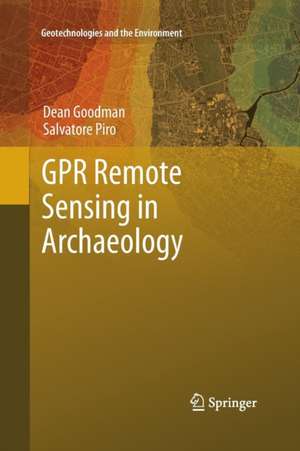
GPR Remote Sensing in Archaeology: Geotechnologies and the Environment, cartea 9
Autor Dean Goodman, Salvatore Piroen Limba Engleză Paperback – 23 aug 2016
Recomandăm GPR Remote Sensing in Archaeology ca o resursă esențială de nivel academic, fiind ideală pentru programele de licență și master în geofizică sau arheologie, dar și ca referință profesională pentru cercetători. Publicat în seria Geotechnologies and the Environment, volumul semnat de Dean Goodman și Salvatore Piro se distinge prin abordarea pragmatică a procesării datelor radar. Autorii ghidează cititorul de la înțelegerea teoretică a semnalului, facilitată de un simulator integrat, până la tehnici complexe de interpolare și generare a volumelor 3D. Considerăm că punctul forte al acestei ediții din 2013 este capacitatea de a demistifica semnăturile radar complexe prin exemple vizuale clare și numeroase studii de caz internaționale. Spre deosebire de alte manuale pur teoretice, acesta pune accent pe fluxul de lucru necesar pentru a obține imagini subacvatice coerente, esențiale în diagnosticarea siturilor arheologice fără excavare. Cititorii familiarizați cu Interpreting Ground-penetrating Radar for Archaeology de Lawrence B. Conyers vor aprecia aici accentul pus pe soluțiile avansate de imagistică și pe metodologia riguroasă de procesare a datelor provenite de la echipamente multi-canal. În timp ce volumul lui Conyers se concentrează pe interpretarea culturală și istorică, lucrarea de față, publicată de Springer, oferă fundamentul tehnic și algoritmic necesar pentru a genera datele pe care se bazează acele interpretări. Structura este logică, pornind de la radargrame individuale către analize de tip overlay, oferind instrumente indispensabile pentru investigații moderne de teledetecție.
Din seria Geotechnologies and the Environment
- 15%
 Preț: 670.14 lei
 - 18%
 Preț: 1457.17 lei
 - 18%
 Preț: 1039.93 lei
 - 18%
 Preț: 980.36 lei
 - 18%
 Preț: 988.91 lei
 - 18%
 Preț: 978.23 lei
 - 15%
 Preț: 670.71 lei
 - 18%
 Preț: 986.12 lei
 - 15%
 Preț: 661.49 lei
 - 15%
 Preț: 675.76 lei
 - 24%
 Preț: 842.99 lei
 - 24%
 Preț: 897.22 lei
 - 18%
 Preț: 915.73 lei
 - 18%
 Preț: 1004.53 lei
 - 23%
 Preț: 644.61 lei
 - 24%
 Preț: 885.87 lei
 - 18%
 Preț: 1000.03 lei
 - 18%
 Preț: 1439.89 lei
 - 18%
 Preț: 1271.73 lei
 - 18%
 Preț: 977.75 lei
 - 5%
 Preț: 1157.84 lei
 - 5%
 Preț: 1063.72 lei
 - 18%
 Preț: 1167.76 lei
 - 15%
 Preț: 614.82 lei
 - 18%
 Preț: 996.56 lei
 - 15%
 Preț: 549.88 lei
 - 18%
 Preț: 1346.41 lei
Preț: 527.92 lei
Preț vechi: 621.08 lei
-15%
Carte tipărită la comandă
Livrare economică 05-19 decembrie
Specificații
ISBN-10: 3662521784
Pagini: 248
Ilustrații: XI, 233 p.
Dimensiuni: 155 x 235 x 14 mm
Greutate: 0.35 kg
Ediția:Softcover reprint of the original 1st edition 2013
Editura: Springer
Colecția Geotechnologies and the Environment
Seria Geotechnologies and the Environment
Locul publicării:Berlin, Heidelberg, Germany
V-ar putea interesa
-
 Radar Handbook, Third EditionMerrill Skolnik-23%Preț: 1292.51 lei1678.59 lei
 -
 Dig!Ruth Hatfield-16%Preț: 92.35 lei109.98 lei
 -
 A Practical Handbook of ArchaeologyChristopher CatlingPreț: 72.98 lei
 -
 Preț: 451.79 lei
 -
 Archaeological InvestigationMartin CarverPreț: 364.02 lei
 -
 Remote Sensing and Image InterpretationThomas Lillesand-18%Preț: 1378.98 lei1681.68 lei
 -
 -23%Preț: 618.01 lei802.62 lei
 -
 GIS For DummiesJami DennisPreț: 166.20 lei
 -
 Preț: 355.20 lei
 -
 New Global Perspectives on Archaeological ProspectionJames BonsallPreț: 406.58 lei
 -
 Archaeology: What It Is, Where It Is, and How to Do ItPaul WilkinsonPreț: 132.27 lei
 -
 Preț: 395.69 lei
 -
 Sensing the PastNicola Masini-18%Preț: 1457.17 lei1777.04 lei
 -
 Image Analysis in Earth SciencesRenée Heilbronner-18%Preț: 1010.39 lei1232.18 lei
 -
 Advancing Subsurface Imaging, Energy Transition and Digital InnovationNumair Ahmed Siddiqui-18%Preț: 1448.41 lei1766.34 lei
 -
 Advances in Geoscience and Remote Sensing TechnologyJosaphat Tetuko Sri Sumantyo-18%Preț: 1445.52 lei1762.84 lei
 -
 Introduction to Space ArchaeologyHuadong Guo-18%Preț: 768.25 lei936.90 lei
De ce să citești această carte
Apreciem această lucrare pentru echilibrul rar între rigoarea geofizică și aplicabilitatea arheologică. Cititorul câștigă o înțelegere profundă a modului în care datele brute devin hărți 3D clare ale structurilor îngropate. Este o investiție strategică pentru specialiștii care doresc să stăpânească tehnologia GPR, oferind soluții concrete pentru gestionarea datelor complexe în cercetarea de teren.
Despre autor
Dean Goodman și Salvatore Piro sunt cercetători recunoscuți internațional în domeniul geofizicii aplicate. Dean Goodman este cunoscut pentru dezvoltarea de software specializat în procesarea datelor GPR, fiind un pionier în vizualizarea 3D a structurilor arheologice. Salvatore Piro activează în cadrul Consiliului Național de Cercetare din Italia (CNR), având o experiență vastă în utilizarea metodelor non-distructive pentru explorarea patrimoniului cultural. Împreună, cei doi combină expertiza în inginerie și arheometrie pentru a oferi standarde metodologice în utilizarea radarului de penetrare a solului.
Descriere scurtă
Recenzii
“This book is an excellent quick guide to the GPR method, oriented primarily towards archaeological exploration. The text is self-contained and can be used by undergraduate students in both geophysics and archaeology fields. … It includes plenty of colored, high-quality images that help the reader to conceive the presented material. It is a very useful addition to the bookshelf of students, as well as professionals of geophysics and archaeology.” (Alexandra Karamitrou, Pure and Applied Geophysics, March, 2014)
Notă biografică
Dr. Dean Goodman had a unique opportunity to work at a small archaeological geophysics lab of the University of Miami Japan Division from 1989-2008. Dean had significant support from the city of Nakajima Machi, the museum at Saitobaru in Miyazaki, and the Nara National Cultural Properties Research Institute where he also was a guest researcher for many years. Since 2001, Dean had the tremendous fortune to be ‘adopted’ by the US Forest Service Heritage Program, run at that time by Dr. Kent Schneider who helped to encourage and foster continued growth of software development at the Geophysical Archaeometry Laboratory.