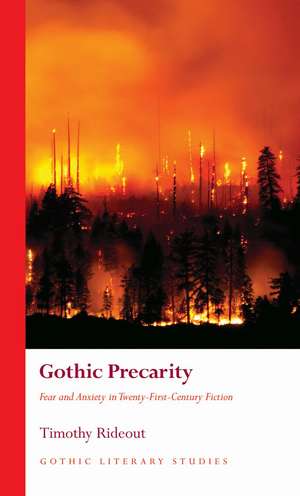
Gothic Precarity: Fear and Anxiety in Twenty-First-Century Fiction: Gothic Literary Studies
Autor Timothy Rideouten Limba Engleză Hardback – 18 noi 2025
Ne-a atras atenția modul în care Gothic Precarity reușește să redefinească genul gotic nu doar ca pe o estetică a groazei, ci ca pe un instrument critic esențial pentru înțelegerea vulnerabilităților socio-economice contemporane. Lucrarea lui Timothy Rideout aduce o perspectivă nouă prin articularea conceptului de „precaritate” — definită ca o condiție de instabilitate sistemică — în cadrul tropilor literari consacrați precum straniul (the uncanny) și monstrul. Găsim în acest volum o demonstrație riguroasă a modului în care nesiguranța zilei de mâine, fie că este provocată de colapsul economic sau de criza climatică, își găsește expresia perfectă în formele narative ale goticului.
Structura cărții este organizată tematic, facilitând o progresie de la fundamentele teoretice către analize aplicate pe contexte geografice și politice diverse. După o genealogie a conceptului, autorul explorează „goticul de război” în Bagdadul postbelic, precaritatea economică ilustrată prin vampirismul corporatist din Mexic și condiția spectrală a refugiatului. Această abordare transformă volumul într-o alternativă necesară la 21st-Century British Gothic de Emily Horton pentru cursurile de literatură comparată sau studii culturale. În timp ce studiul lui Horton se concentrează pe spațiul britanic, Timothy Rideout extinde cadrul de analiză la nivel global, oferind un avantaj competitiv prin includerea unor autori precum Yiyun Li sau Ahmed Saadawi.
Putem afirma că Gothic Precarity se distinge prin rigoarea cu care conectează discursul politic de cel literar, demonstrând că monștrii secolului XXI nu mai sunt simple proiecții psihologice, ci simboluri ale violenței sistemice și ale degradării mediului. Este o resursă academică solidă, publicată în prestigioasa serie Gothic Literary Studies, care reușește să sintetizeze anxietățile unei epoci marcate de incertitudine.
Din seria Gothic Literary Studies
- 15%
 Preț: 520.83 lei
 - 11%
 Preț: 532.47 lei
 - 8%
 Preț: 593.34 lei
 - 15%
 Preț: 623.68 lei
 - 15%
 Preț: 623.81 lei
 - 15%
 Preț: 612.41 lei
 -
 Preț: 217.95 lei
 - 15%
 Preț: 510.64 lei
 - nou
 Preț: 282.07 lei
 -
 Preț: 108.90 lei
 - 14%
 Preț: 211.09 lei
 - 18%
 Preț: 523.69 lei
 - 8%
 Preț: 600.70 lei
 - 14%
 Preț: 951.84 lei
 - 8%
 Preț: 592.00 lei
 -
 Preț: 217.67 lei
Preț: 607.51 lei
Preț vechi: 682.59 lei
-11%
Carte disponibilă
Livrare economică 11-25 noiembrie
Livrare express 28 octombrie-03 noiembrie pentru 33.33 lei
Specificații
ISBN-10: 183772282X
Pagini: 280
Dimensiuni: 138 x 216 x 23 mm
Greutate: 0.48 kg
Editura: University of Wales Press
Colecția University of Wales Press
Seria Gothic Literary Studies
De ce să citești această carte
Recomandăm această carte cercetătorilor și studenților la litere sau studii culturale care doresc să înțeleagă funcția politică a genului gotic astăzi. Cititorul câștigă un cadru teoretic clar pentru a interpreta literatura contemporană prin prisma vulnerabilității economice și ecologice. Este un volum esențial pentru oricine vrea să vadă cum monștrii din ficțiune reflectă realitățile brutale ale capitalismului și ale crizelor globale actuale.
Despre autor
Timothy Rideout este un cercetător specializat în literatura gotică și studiile culturale contemporane. Contribuția sa în cadrul seriei Gothic Literary Studies de la University of Wales Press reflectă un interes profund pentru modul în care formele narative tradiționale se adaptează la noile realități politice și sociale. Prin Gothic Precarity, autorul se stabilește ca o voce importantă în critica literară actuală, propunând o metodologie care îmbină analiza textuală fină cu sociologia precarității, oferind o perspectivă geografic diversă asupra literaturii de groază din secolul XXI.
Descriere scurtă
Whether political, economic, or existential, precarity has become the defining condition of the twenty-first century. As traditional structures of security unravel, the Gothic has resurged as the perfect literary mode to explore this collective unease. Gothic Precarity is the first book of its kind to examine the intersection of Gothic fiction and precarity. Timothy Rideout masterfully examines how contemporary writers use elements of the uncanny and the monstrous to engage with the anxieties of our time.
This book explores how modern Gothic narratives tackle displacement, instability, and systemic violence—whether through vampires as symbols of ruthless capitalism in Mexico City or a spectral migrant trapped between worlds of political oppression. Through an exploration of works set in post-war Baghdad, climate-ravaged North America, and beyond, Gothic Precarity displays how today’s Gothic fiction gives form to the fears shaping our precarious world.
Notă biografică
Cuprins
Theoretical Framework
Definitions of Precarity
The Literary Gothic and Political Discourse
Fearful Precarity
Monstrous Precarity
Uncanny Precarity
Prevarication and Precarity
Structural Outline
Chapter One: The Genealogy of Precarity
The Origins of Precarity
Chinese Gothic
Gothic precarity and existential entrapment in Yiyun Li’s The Vagrants
Fear and the Uncanny in The Vagrants
Gothic Counter-Narratives in The Vagrants
Chapter Two: War Precarity
War Gothic
Neoliberal Wars, War Precarity and the ‘Shock Doctrine’
Fear and Monstrous Precarity in Ahmed Saadawi’s Frankenstein in Baghdad
Uncanny Hesitation and Uncertainty in Frankenstein in Baghdad
Chapter Three: Economic Precarity
Economic Precarity
Vampiric Economics and Economic Vampires
Silvia Moreno-Garcia’s Certain Dark Things and Mexican Precarity
Certain Monstrous Things
Un-Certain Dark Things
Chapter Four: Migrant and Refugee Precarity
Precarity’s migrants and refugees
Neoliberal Hauntology: ‘The failure of the future’
Gothic Narratives of Migration and Seeking Refuge
The Spectral Refugee in Viet Thanh Nguyen’s ‘Black-Eyed Women’
Chapter Five: Climatic Precarity
Gothic Ecology
A Neoliberal Climate Crisis
Monstrosity in Diane Cook’s The New Wilderness
The Uncanny Wilderness
The Fearfully Uncertain Wilderness
Conclusion: ‘We [still] live in Gothic times’
Concluding Findings
Bibliography