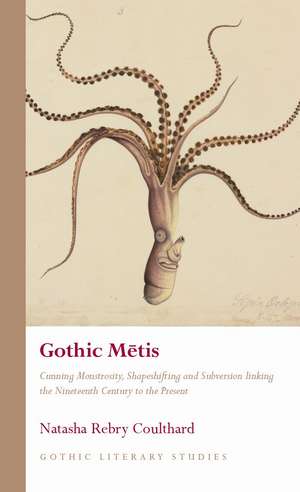
Gothic Metis: Cunning Monstrosity, Shapeshifting and Subversion Linking the Nineteenth Century to the Present: Gothic Literary Studies
Autor Natasha Rebry Coultharden Limba Engleză Hardback – 15 iun 2025
Exhuming and reanimating an ancient cunning associated with the monstrous, the hybrid, the feminine, and the nonhuman, Gothic Mētis offers a novel transdisciplinary framework for analyzing Gothic media and discourse through the lens of mētis. Mētis denotes a wily, adaptive intelligence shared by tricksters, humans, nonhumans, and objects, that is characterized by shapeshifting, twists, and duplicity. It is also an artful praxis for blurring categories, embracing multiplicity, navigating differences, and subverting authority.
Gothic Mētis weaves together myth, literature, rhetorical theory, and critical posthumanism to analyze Gothic renditions of mētis in character and narration from the nineteenth century to the present. Reading Gothic works through the lens of mētis, this book highlights the Gothic mode as a timely, artful response to the rise of the Anthropocene, rendering a post-anthropocentric world beyond Man and illuminating the rhetorical and ethical value of monstrosity, divergence, liminality, and hybridity.
Din seria Gothic Literary Studies
- 15%
 Preț: 511.79 lei
 - 11%
 Preț: 532.47 lei
 - 8%
 Preț: 593.34 lei
 - 11%
 Preț: 607.51 lei
 - 15%
 Preț: 623.81 lei
 - 15%
 Preț: 612.41 lei
 -
 Preț: 217.95 lei
 -
 Preț: 217.67 lei
 - 15%
 Preț: 510.64 lei
 - nou
 Preț: 282.07 lei
 -
 Preț: 108.90 lei
 - 15%
 Preț: 206.03 lei
 - 18%
 Preț: 523.69 lei
 - 8%
 Preț: 600.70 lei
 - 14%
 Preț: 951.84 lei
 - 8%
 Preț: 592.00 lei
Preț: 623.68 lei
Preț vechi: 733.73 lei
-15%
Puncte Express: 936
Carte disponibilă
Livrare economică 07-21 noiembrie
Livrare express 24-30 octombrie pentru 31.03 lei
Livrare prin curier în România Termenul estimat este afișat lângă disponibilitate.
Transport gratuit pentru acest produs Plată online sau ramburs, în funcție de opțiunile comenzii.
Retur gratuit în 14 zile Comandă securizată și suport în română.
Specificații
ISBN-13: 9781837722136
ISBN-10: 1837722137
Pagini: 280
Dimensiuni: 138 x 216 x 23 mm
Greutate: 0.44 kg
Editura: University of Wales Press
Colecția University of Wales Press
Seria Gothic Literary Studies
ISBN-10: 1837722137
Pagini: 280
Dimensiuni: 138 x 216 x 23 mm
Greutate: 0.44 kg
Editura: University of Wales Press
Colecția University of Wales Press
Seria Gothic Literary Studies
Notă biografică
Natasha Rebry Coulthard is an instructor in English and academic writing as part of the Faculty of Arts and Science at the University of Lethbridge in Alberta, Canada.
Cuprins
Table of Contents
Acknowledgements
Glossary of Greek Terms
Preface: Opening Lines on Liminal Times
Introduction: Gothic Metis: Cunning Monstrosity
The First Braid: Gothic’s Twisted Domain
Untangling the Gothic Mode
Gothic’s Twisted Forms
Gothic in the Long Long-Nineteenth Century
The Second Braid: Post-Anthropocentric Thought
Entanglements of Self and Other
Posthumans, Monsters and Others
Betwixt and ‘Between Betweens’: Liminality in Thinking and Being
The Third Braid: Metis in Myth and Rhetoric
Metis/Metis
The Shifting, Shimmering World
Return of the Repressed
Gothic Metis
Chapter One: Fin de Siècle Shapeshifters and Gothic Tricksters
Fin-de-siècle Flux
Shapeshifting Gothic and Gothic Shapeshifters
Arthur Machen’s Tricksters
Snake Ladies and Shedding Skins
Assembling Metis
Gothic Tricksters
Chapter Two: Gothic Tentacularity
Fin-de-siècle, Fin de Man
‘Precarious Man’: Evolution and Ecology in H. G. Wells
The Tentacular and Tentacularity
Dreadful Figures and Tentacular Tales: Cunning Models for the Chthulucene
Metis, the Twisted and the Dreadful
Gothic Speculation
Chapter Three: Jekyll’s Polytropos Ethos
The Invention of Multiple Personality
The tenuous ‘I’ of Dissociative Narrative
Flexible Multiplicity
‘Gothic Psychology’ and the Multiplex Self
The Postmodern, Posthuman Polymetis
‘Fantastic, ignoble, hardly human, or frankly non-human’ Gothic Rhetoric
Chapter Four: From Hyde the Holobiont: The Monstrous Microbial Self
Tricky Microbes
‘Homo Microbis’: The Holobiont
Unsettling Man in Popular Microbiome Discourse
Seething Zoos of Microbes: Popular Microbiome Discourse
Dorion Sagan’s ‘Beautiful Monsters’
More Microbe than Man: Posthuman Gothic Framings of the Microbial Self
Contaminated Ethics
Chapter Five: Gothic Fungus: Mycorrhizae, Metis and Monstrosity
Crypts and Creeps
A ‘study of corruption’: Arthur Machen’s ‘The Hill of Dreams’
Metic Monsters in Gaia and In the Earth
Metic Mycorrhizae: In the Earth
Subverting Anthropos: Gaia
The Polyplokos Monster and Metistic Rapport
Gothic Metis and the Ineffable More-than-Human World
Chapter Six: Gothic Metis and More-than-Human Rhetoric
Spectres and Hauntings in Lee
Genius Loci: The Spirit of Place
Metis and More-than-Human Rhetoric in Lee
Haunting More-than-Human Rhetoric
Gothic Environmentalism
Gothic is Always Already Eco
Postscript: Gothic Poros
Gothic Métissage
Talking with Ravens and Crows
Closing Lines on Liminal Times
References
Acknowledgements
Glossary of Greek Terms
Preface: Opening Lines on Liminal Times
Introduction: Gothic Metis: Cunning Monstrosity
The First Braid: Gothic’s Twisted Domain
Untangling the Gothic Mode
Gothic’s Twisted Forms
Gothic in the Long Long-Nineteenth Century
The Second Braid: Post-Anthropocentric Thought
Entanglements of Self and Other
Posthumans, Monsters and Others
Betwixt and ‘Between Betweens’: Liminality in Thinking and Being
The Third Braid: Metis in Myth and Rhetoric
Metis/Metis
The Shifting, Shimmering World
Return of the Repressed
Gothic Metis
Chapter One: Fin de Siècle Shapeshifters and Gothic Tricksters
Fin-de-siècle Flux
Shapeshifting Gothic and Gothic Shapeshifters
Arthur Machen’s Tricksters
Snake Ladies and Shedding Skins
Assembling Metis
Gothic Tricksters
Chapter Two: Gothic Tentacularity
Fin-de-siècle, Fin de Man
‘Precarious Man’: Evolution and Ecology in H. G. Wells
The Tentacular and Tentacularity
Dreadful Figures and Tentacular Tales: Cunning Models for the Chthulucene
Metis, the Twisted and the Dreadful
Gothic Speculation
Chapter Three: Jekyll’s Polytropos Ethos
The Invention of Multiple Personality
The tenuous ‘I’ of Dissociative Narrative
Flexible Multiplicity
‘Gothic Psychology’ and the Multiplex Self
The Postmodern, Posthuman Polymetis
‘Fantastic, ignoble, hardly human, or frankly non-human’ Gothic Rhetoric
Chapter Four: From Hyde the Holobiont: The Monstrous Microbial Self
Tricky Microbes
‘Homo Microbis’: The Holobiont
Unsettling Man in Popular Microbiome Discourse
Seething Zoos of Microbes: Popular Microbiome Discourse
Dorion Sagan’s ‘Beautiful Monsters’
More Microbe than Man: Posthuman Gothic Framings of the Microbial Self
Contaminated Ethics
Chapter Five: Gothic Fungus: Mycorrhizae, Metis and Monstrosity
Crypts and Creeps
A ‘study of corruption’: Arthur Machen’s ‘The Hill of Dreams’
Metic Monsters in Gaia and In the Earth
Metic Mycorrhizae: In the Earth
Subverting Anthropos: Gaia
The Polyplokos Monster and Metistic Rapport
Gothic Metis and the Ineffable More-than-Human World
Chapter Six: Gothic Metis and More-than-Human Rhetoric
Spectres and Hauntings in Lee
Genius Loci: The Spirit of Place
Metis and More-than-Human Rhetoric in Lee
Haunting More-than-Human Rhetoric
Gothic Environmentalism
Gothic is Always Already Eco
Postscript: Gothic Poros
Gothic Métissage
Talking with Ravens and Crows
Closing Lines on Liminal Times
References
Recenzii
"Offering an original, as well as highly revealing, approach to the Gothic as inherently a 'trickster' mode of cultural critique, this stunning book delivers truly revisionist readings of major Gothic works from late Victorian-era classics to recent eco-horror films, all provocatively analyzed and theorized, in their historical contexts, as never before."
"Gothic Mētis uses an interdisciplinary approach to the Gothic to cover an astounding range of theoretical, cultural and textual ground. Drawing on the mythological concept of Metis and its theoretical and cultural ramifications, the text brings together such seemingly incongruous subjects as Victorian literature, microbes, rhizomes and tentacles to weave a fascinating critical web that is at once timely and innovative. This is highly recommended reading for anyone interested in Gothic theory and criticism – especially in new materialist or posthumanist approaches to the Gothic."