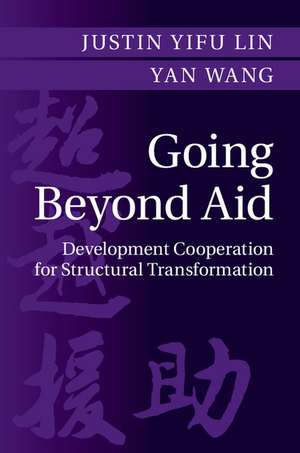
Going Beyond Aid
Autor Justin Yifu Lin, Yan Wangen Limba Engleză Paperback – 9 feb 2017
Preț: 260.00 lei
Puncte Express: 390
Carte tipărită la comandă
Livrare economică 05-19 octombrie
Livrare prin curier în România Termenul estimat este afișat lângă disponibilitate.
Transport gratuit de la 400.00 lei Plată online sau ramburs, în funcție de opțiunile comenzii.
Retur gratuit în 14 zile Comandă securizată și suport în română.
Specificații
ISBN-13: 9781316607152
ISBN-10: 1316607151
Pagini: 236
Dimensiuni: 151 x 228 x 17 mm
Greutate: 0.35 kg
Editura: Cambridge University Press
Locul publicării:Cambridge, United Kingdom
ISBN-10: 1316607151
Pagini: 236
Dimensiuni: 151 x 228 x 17 mm
Greutate: 0.35 kg
Editura: Cambridge University Press
Locul publicării:Cambridge, United Kingdom
V-ar putea interesa
-
 Demystifying the Chinese EconomyJustin Yifu LinPreț: 286.04 lei
 -
 Against the ConsensusJustin Yifu LinPreț: 281.30 lei
 -
 Spinal OsteotomyYan Wang-5%Preț: 1047.44 lei1102.57 lei
Cuprins
Preface; List of figures; List of tables; 1. Introduction and objectives; 2. Structural transformation is key to development; 3. Traditional aid is ineffective for structural transformation; 4. South-South development cooperation helps structural transformation; 5. Using China's comparative advantage to address Africa's infrastructure bottlenecks; 6. China uses its comparative advantage to help Africa in light manufacturing; 7. Effectiveness for transformation: the secret for quick wins; 8. Prospects for development finance; References; Index.
Recenzii
'This book is well-written and worth reading by scholars, policy makers, and practitioners of development cooperation as it articulates a new and important aspect of development cooperation, the Chinese involvement. The influence of Chinese development cooperation might open up new opportunities for developing countries where traditional development cooperation has not succeeded.' Youngwan Kim, International Relations of the Asia-Pacific
Descriere
This book examines South-South development aid and cooperation amongst BRICS and other developing countries from the angle of New Structural Economics.