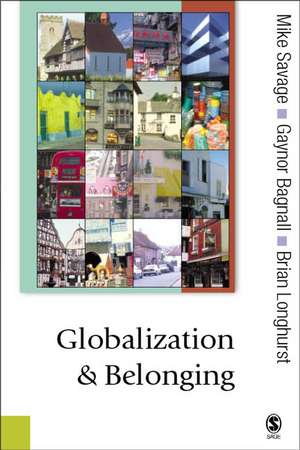
Globalization and Belonging: Published in association with Theory, Culture & Society
Autor Michael Savage, Gaynor Bagnall, Brian Longhursten Limba Engleză Paperback – noi 2004
Găsim în Globalization and Belonging o analiză riguroasă a modului în care localitatea rămâne un pilon vital pentru individ, în ciuda forțelor transnaționale. Lucrarea se deschide spre o interdisciplinaritate necesară, intersectând sociologia urbană cu geografia umană, studiile media și studiile culturale pentru a explica cum schimbările globale sunt articulate la nivel local. Autorii, printre care se numără Michael Savage și Brian Longhurst, depășesc simpla teorie, ancorând textul în date empirice colectate pe perioade lungi. Reținem din structura cărții o progresie logică, de la limitele atașamentului local până la impactul „mediascapes” și al reflexivității globale. Capitolele dedicate parentingului și educației oferă o perspectivă inedită asupra modului în care alegerile de viață contribuie la ceea ce autorii numesc „apartenență electivă” — ideea că oamenii își definesc identitatea prin locurile în care aleg să prindă rădăcini. Această abordare completează temele explorate de Michael Savage în lucrările sale mai recente, deși acesta din urmă este cunoscut publicului larg și pentru analizele sale politice tăioase din sfera publică americană, în Globalization and Belonging el menține un ton academic, axat pe stratificare socială și diferențiere culturală. Acoperă aceeași arie tematică ca Living the Global City de John Eade, dar cu o abordare mai aplicată, bazată pe interviuri și observație directă, spre deosebire de analizele mai teoretice ale altor titluri din domeniu. Credem că forța acestui volum rezidă în capacitatea de a demonstra că suburbia și identitatea urbană nu dispar sub tăvălugul globalizării, ci se reconfigurează prin valorile și stilurile de viață ale noilor rezidenți.
Din seria Published in association with Theory, Culture & Society
- 8%
 Preț: 481.51 lei
 - 18%
 Preț: 816.03 lei
 - 18%
 Preț: 750.37 lei
 - 18%
 Preț: 830.92 lei
 - 18%
 Preț: 826.81 lei
 - 18%
 Preț: 1357.92 lei
 - 18%
 Preț: 695.13 lei
 - 18%
 Preț: 778.70 lei
 - 18%
 Preț: 826.33 lei
 -
 Preț: 442.05 lei
 - 18%
 Preț: 813.20 lei
 - 18%
 Preț: 1239.19 lei
 - 18%
 Preț: 697.02 lei
 - 18%
 Preț: 1548.84 lei
 - 18%
 Preț: 826.33 lei
 - 18%
 Preț: 693.53 lei
 - 18%
 Preț: 812.53 lei
 - 18%
 Preț: 779.33 lei
 - 18%
 Preț: 1038.43 lei
 - 8%
 Preț: 482.43 lei
 - 18%
 Preț: 814.46 lei
 - 18%
 Preț: 1764.61 lei
 -
 Preț: 389.42 lei
 - 18%
 Preț: 1357.92 lei
 - 18%
 Preț: 1643.44 lei
 -
 Preț: 476.11 lei
 - 15%
 Preț: 457.55 lei
 - 18%
 Preț: 1300.54 lei
 - 8%
 Preț: 574.26 lei
 - 18%
 Preț: 1219.39 lei
 - 18%
 Preț: 813.52 lei
 - 18%
 Preț: 1548.18 lei
 - 18%
 Preț: 779.15 lei
 - 9%
 Preț: 1297.77 lei
 - 18%
 Preț: 729.29 lei
 - 18%
 Preț: 1643.28 lei
 - 18%
 Preț: 976.76 lei
 - 18%
 Preț: 1326.74 lei
 - 15%
 Preț: 547.79 lei
 - 18%
 Preț: 1456.52 lei
 - 18%
 Preț: 1560.34 lei
 - 8%
 Preț: 549.44 lei
 - 18%
 Preț: 1379.75 lei
 - 18%
 Preț: 809.71 lei
 - 18%
 Preț: 826.01 lei
 - 18%
 Preț: 804.97 lei
 - 18%
 Preț: 748.42 lei
 - 18%
 Preț: 1456.99 lei
 - 18%
 Preț: 814.61 lei
Preț: 826.01 lei
Preț vechi: 1007.33 lei
-18%
Carte tipărită la comandă
Livrare economică 23 noiembrie-07 decembrie
Specificații
ISBN-10: 0761949860
Pagini: 248
Dimensiuni: 156 x 234 x 14 mm
Greutate: 0.38 kg
Ediția:First Edition
Editura: SAGE Publications
Colecția Published in association with Theory, Culture & Society
Seria Published in association with Theory, Culture & Society
Locul publicării:London, United Kingdom
V-ar putea interesa
-
 Trickle Up PovertyMichael SavagePreț: 125.84 lei
 -
 Preț: 88.81 lei
 -
 Quantitative Data AnalysisDonald J. Treiman-19%Preț: 553.40 lei683.21 lei
 -
 Applied Latent Class AnalysisJacques A. HagenaarsPreț: 349.76 lei
 -
 Handbook of Science and Technology StudiesSheila Jasanoff-23%Preț: 641.46 lei833.06 lei
 -
 The Sociology of the BodyKate Cregan-18%Preț: 803.83 lei980.27 lei
 -
 Ethnicity and GlobalizationStephen Castles-15%Preț: 480.60 lei565.41 lei
 -
 Embodying the MonsterMargrit Shildrick-18%Preț: 734.71 lei895.98 lei
 -
 Researching 'Race' and EthnicityYasmin Gunaratnam-18%Preț: 782.81 lei954.64 lei
 -
 Testing Structural Equation ModelsJ. Scott Long-18%Preț: 819.34 lei999.19 lei
 -
 Organizations in AmericaArne L. Kalleberg-18%Preț: 805.43 lei982.23 lei
 -
 Leisure and Feminist TheoryBetsy M Wearing-18%Preț: 693.39 lei845.60 lei
 -
 The Arena of RacismMichel Wieviorka-15%Preț: 416.85 lei490.41 lei
 -
 The Consuming BodyPasi Falk-8%Preț: 582.12 lei632.73 lei
 -
 Seek Ye First the KingdomBrian LonghurstPreț: 135.19 lei
 -
 Karl Mannheim and the Contemporary Sociology of KnowledgeBrian LonghurstPreț: 383.69 lei
 -
 God, Faith, and ReasonMichael SavagePreț: 112.89 lei
 -
 Preț: 89.88 lei
 -
 The Political ZooMichael SavagePreț: 179.94 lei
De ce să citești această carte
Această carte este esențială pentru studenții și cercetătorii care doresc să înțeleagă sociologia contemporană dincolo de concepte abstracte. Cititorul câștigă o înțelegere profundă a modului în care comunitățile locale se transformă fără a-și pierde relevanța. Este un instrument valoros pentru cursuri de geografie urbană sau antropologie culturală, oferind dovezi clare despre cum identitatea personală rămâne strâns legată de locul geografic, chiar și într-o lume hiper-conectată.
Despre autor
Michael Savage este un autor prolific, cunoscut pentru capacitatea sa de a îmbina analiza socială cu narativul captivant, având în palmares numeroase titluri incluse în lista de bestselleruri New York Times. Deși o parte din opera sa recentă, precum Our Fight for America sau Scorched Earth, se concentrează pe peisajul politic și cultural american contemporan, contribuția sa în Globalization and Belonging reflectă expertiza sa academică în sociologie. Alături de Gaynor Bagnall și Brian Longhurst, Savage explorează aici mecanismele identității și ale comunității, demonstrând o înțelegere profundă a structurilor sociale care definesc viața cotidiană.
Descriere scurtă
Drawing on long-term empirical research into cultural practices, lifestyles and identities, Globalization and Belonging explores how far-reaching global changes are articulated locally.
The authors address key sociological issues of stratification as analysis alongside 'cultural' issues of identity, difference, choice and lifestyle. Their original argument:
"Shows how globalisation theory conceives of the 'local'
"Reveals that people have a sense of elective belonging based on where they choose to put down roots
"Suggests that the feel of a place is much more strongly influenced by the values and lifestyles of those migrating to it
"reinvigorates debates in urban and community studies by recovering the 'local' as an intrinsic aspect of globalisation
Theoretically rigorous, the book is brought to life with direct quotations from the authors' research, and appeals to students in urban sociology, urban geography, media studies and cultural studies.
Cuprins
The Limits of Local Attachment
Parenting, Education and Elective Belonging
Suburbia and the Aura of Place
The Ambivalence of Urban Identity
'Manchester, So Much to Answer For'
Work Cultures and Social Ties
Mediascapes in the Mediation of the Local and the Global
Cosmopolitanism, Diaspora and Global Reflexivity
Notă biografică
I studied originally as a historian (BA at York and MA at Lancaster). I became a sociologist partly by design, since I was interested in the grand theoretical questions which sociologists tend to pose, and partly by luck (the Department of Sociology at Lancaster happened to have a PhD grant available!). My doctoral work, which became my first book, was on the history of the local Labour movement in Preston, Lancashire between 1880 and 1940. Although this was a specific case study, it contains many issues of enduring interest to me: the changing role of place, space, locality; the significance of time; and social inequality and social movements. I have been unable to shake off an enduring enthusiasm for geography (my favourite subject at school) and history. My research tries to develop a sociology of stratification which is adequate to 21st century complexities and fluidities. This has involved me in thinking about the sociology of the middle classes which now makes up a large proportion of the labour force; in exploring the nature of changing gender relations; in thinking about how people's sense of attachment to place and locale is being reconfigured; and in thinking about new and under-utilised conceptual and methodological tools for understanding social inequality, social protest and social mobility. I have pursued these interests through jobs at the Universities of Lancaster, Sussex, Surrey, Keele, North Carolina at Chapel Hill, and since 1995 I have been here at Manchester (where I was head of Department between 1999-2001). My concerns have crystallized since 2004 in my role as Director of the ESRC Centre for Research on Socio-Cultural Change (CRESC), which brings together anthropologists, media researchers, geographers, historians, political economists, and sociologists from the University of Manchester and the Open University. I was elected a member of the Academy of Social Sciences (2003), elected Fellow-Designate of the British Academy (2007), and I am a member of HEFCE's Sociology sub-panel assessing the quality of research in the 2008 Research Assessment exercise. I have been visiting professor at the Universities of North Carolina at Chapel Hill (where I was a Fulbright Scholar) and at Sciences-Po in Paris. I was managing editor of The Sociological Review between 2001 and 2007.
Gaynor Bagnall is a Senior Lecturer in the Sociology of Culture. Her research and teaching focus primarily on culture, consumption, social class and identity, and in particular social and cultural capital, culture-led regeneration, social and cultural life in cities, and audiences, museums, memory and heritage. She has researched and published widely on these topics, with work ranging from an investigation into the performativity of museum audiences, to an exploration of what it means to belong 'locally' in a global world. Currently, she is working on two research projects, Writing Lives: 'Engaging Communities through Arts' is funded by HEFCE and aims to examine the use of creative writing workshops as a form of culture-led regeneration. It explores their role as a means for the expression of identities, and as a facilitator of community cohesion and belonging. 'Experiencing: The Imperial War Museum North' is an examination of visitor responses to IWMN that looks at how people articulate their experience of the museum by drawing on particular biographical resources and narrative strategies.
Professor Brian Longhurst is a sociologist who has long standing interests in cultural studies, media studies and the sociology of culture. His books include Popular Music and Society (Polity Press, 1995, 2007), The Penguin Dictionary of Media Studies (co-authored, 2007), Globalization and Belonging (co-authored, Sage, 2005), Introducing Cultural Studies (co-authored, Pearson, 1999, 2004) and Audiences: A Sociological Theory of Performance and Imagination (co-authored 1998). He has held research grants from various bodies including ESRC and EPSRC and has published widely in a range of journals and edited collections. He was formerly Head of the School of English, Sociology, Politics & Contemporary History (ESPaCH), Associate Dean for Research and Director of the Institute for Social Research, all at the University of Salford. He has been a Director of Salford¿s prize winning initiative, Community Finance Solutions and was the founding Chair of the Board of East Lancs Moneyline (ELM), a successful Community Reinvestment Trust.