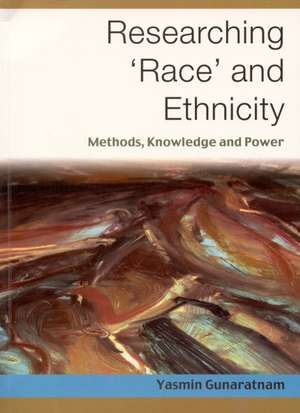
Researching 'Race' and Ethnicity
Autor Yasmin Gunaratnamen Limba Engleză Paperback – 18 aug 2003
Adresată studenților, cercetătorilor și practicienilor din științele sociale, Researching 'Race' and Ethnicity oferă un cadru riguros pentru navigarea complexităților inerente studiului diferențelor sociale. Apreciem modul în care Yasmin Gunaratnam refuză simplificările, insistând că variabilele de 'rasă' și etnicitate nu sunt doar nișe de studiu, ci elemente fundamentale care influențează orice interacțiune de cercetare și cunoașterea produsă. Textul se distinge printr-o tranziție abilă de la perspectiva cantitativă la cea calitativă, structurată în trei părți esențiale. Prima parte analizează relația dintre cunoaștere și putere, a doua explorează dilemele practice ale cercetării „interrasiale” — inclusiv efectele identității cercetătorului asupra subiectului — iar ultima parte investighează înțelesurile rasializate în spațiul psiho-social. Această progresie oferă o profunzime teoretică superioară manualelor tehnice, ancorând dezbaterea în exemple etnografice concrete. Lucrarea extinde cadrul propus de Race and Ethnicity in Research Methods de John H. Stanfield cu date noi și o atenție sporită asupra subiectivității cercetătorului. În timp ce Stanfield oferă o privire de ansamblu asupra metodelor, Gunaratnam se concentrează pe „munca dezordonată” (messy work) a interviului și pe tăcerile care apar atunci când rasa este un factor non-manifest. Această abordare completează traiectoria academică a autoarei, vizibilă și în lucrări precum Death and the Migrant sau Go home?, unde analizează impactul politicilor asupra vieții cotidiene și identității în Marea Britanie.
Preț: 782.81 lei
Preț vechi: 954.64 lei
-18%
Carte tipărită la comandă
Livrare economică 17 noiembrie-01 decembrie
Specificații
ISBN-10: 0761972870
Pagini: 232
Dimensiuni: 170 x 244 x 13 mm
Greutate: 0.4 kg
Ediția:First Edition
Editura: SAGE Publications
Locul publicării:London, United Kingdom
V-ar putea interesa
-
 Preț: 109.35 lei
 -
 Ethnicity, Law and Human Rights: The English ExperienceSebastian Poulter-21%Preț: 218.34 lei276.96 lei
 -
 Language and Identity in the Balkans: Serbo-Croatian and Its DisintegrationRobert D. Greenberg-12%Preț: 373.34 lei422.18 lei
 -
 Racialization: Studies in Theory and PracticeKarim Murji-31%Preț: 544.65 lei789.10 lei
 -
 Cultural Theory: The Key ThinkersAndrew EdgarPreț: 270.14 lei
 -
 Ethnicity and GlobalizationStephen Castles-15%Preț: 480.60 lei565.41 lei
 -
 Transcultural Counselling in Action (Second Edition)Patricia D'Ardenne-15%Preț: 569.11 lei669.54 lei
 -
 -31%Preț: 570.45 lei824.15 lei
 -
 The CircuitFrancisco JiménezPreț: 86.82 lei
 -
 Rethinking EthnicityRichard P JenkinsPreț: 481.04 lei
 -
 The SAGE Handbook of Intercultural CompetenceDarla K. Deardorff-27%Preț: 1095.68 lei1500.93 lei
 -
 Race & CrimeMichael RowePreț: 405.65 lei
De ce să citești această carte
Pentru cercetătorul care dorește să depășească „gândirea categorială” și să înțeleagă cum dinamica puterii modelează datele colectate, această carte este indispensabilă. Cititorul câștigă o metodologie critică și etică pentru a lucra eficient peste barierele de diferență, învățând să identifice și să teoretizeze dilemele de teren care rămân adesea nespuse în mediul academic.
Despre autor
Yasmin Gunaratnam este un academician cu o vastă experiență în cercetare și predare în învățământul superior și sectorul voluntar din Marea Britanie. Cu un doctorat obținut la London School of Economics, ea s-a specializat în sociologie și politici sociale. Interesele sale de cercetare vizează transferul de cunoștințe, metodologiile participative și intersecția dintre rasă, gen și migrație. Expertiza sa este reflectată în lucrări de referință care analizează experiențele minorităților în sisteme sociale complexe, fiind recunoscută pentru capacitatea de a aduce la lumină perspectivele cercetătorilor marginalizați.
Descriere scurtă
'This is a welcome book for those engaged in policy and empirical work with an active research agenda… there is a level of theoretical sophistication in the text which is often missing from texts concerned with methods in this area' - Race Relations Abstracts
`The particular value of this book to readers lies in the discussion of "race", ethnicity and research issues within a political and social context. The author states her intention to explore some of the theoretical and practical dilemmas of researching "race" and ethnicity. This is, without question, achieved. I recommend it as essential reading for those concerned with increasing their awareness of issues relating to race, ethnicity and research practice' - Nurse Researcher
'This is a thought-provoking and challenging book which demonstrated the fractured and fluid nature of difference and power in the research process. Importantly it offers a guide to the ways in which research can be effectively and productively used in challenging the status quo' - Diversity in Health and Social Care
Researching `Race' and Ethnicity provides an innovative discussion of the methodological, epistemological and ethical challenges of doing qualitative research that is informed by questions of `race', ethnicity and social difference. By identifying and challenging `categorical thinking' and many longstanding assumptions about the meanings of `race' and ethnicity, the author gets to the heart of many of the everyday dilemmas and difficulties that researchers confront in the field, but are rarely theorised or openly discussed.
Yasmin Gunaratnam's insistence that `race' and ethnicity are a significant part of all qualitative research, and are not the `specialist' concerns of those whose work is explicitly focussed upon `race', provokes a radical rethinking of current methological debates. How do racial and ethnic categories inform our approaches to research? How does the racialised indentity of the researcher and the research participants affect the research interaction and the knowledge that we produce? What are the assumptions that are made about racialised subjectivity and inter-subjectivity? How can we make sense of accounts in which `race' and ethnicity are silent or are non-manifest? How can we work ethically across difference?
In examining these and other questions, the wide-ranging discussions in the book are animated by examples drawn from the author's ethnographic research with white and minoritized research participants. Through these examples readers will be able to engage with some of the complexities of research relationships, power relations and ethical concerns about engagement, disconnection and complicity in research. The attention that the book gives to the excluded experiences of minoritized researchers will be of particular value to many readers.
Researching `Race' and Ethnicity is essential reading for students and academics in the social sciences.
Recenzii
other words does it matter what race or ethnicity the interviewer is in social research. Gunaratnam looks at this problem in terms of the social
construction of the nature of research on racialized groups in Britain. The
very fact that the race/ ethnicity of a researcher is posed as a problem for
reflection and questioning is the starting point for the author. In this way, the race/ethnicity of the researchers matters as a source of methodological concern, but there is no correct method for all contexts.
Indeed, there is a level of theoretical sophistication in the text which is
often missing from texts concerned with methods in this area. But this
does not take away from socially committed comment on the author's
fieldwork area of hospice provision. Here we find the application of some
of the methodological issues raised in the book in the author's own work.
The only criticism is the specificity of this research area for the general
ideas that are presented, a more general overview of research in the arena
(a difficult and wide ranging task) and how it may apply to the framework
presented would have been more useful. However, this is still one of the
few books, out of Britain, which takes seriously the issues of methodology and race' - Race Relations Abstacts
'This is a thought-provoking and challenging book which demonstrated the fractured and fluid nature of difference and power in the research process. Importantly it offers a guide to the ways in which research can be effectively and productively used in challenging the status quo' - Diversity in Health and Social Care
Cuprins
Researching `Race' and Ethnicity
A `Treacherous Bind'
Working with and against Racial Categories
PART TWO: DEBATES AND DILEMMAS IN `INTERRACIAL' RESEARCH
Faking `Race' or `Making Race'?
`Race-of-Interviewer-Effects' in Survey Research
Messy Work
Qualitative Interviewing across Difference
PART THREE: THE DOINGS AND UNDOINGS OF `RACE' - RESEARCHING LIVED EXPERIENCE
Looking for `Race'?
Analyzing Racialized Meanings and Identifications
`What Do You Mean?' Insecurities of Meaning and Difference
Threatening Topics and Difference
Encounters in Psycho-Social Space
Towards Multi-Sited Research
Connection, Juxtapositioning and Complicity