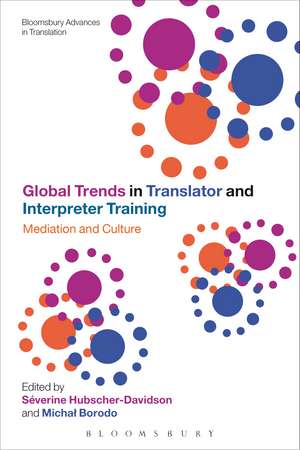
Global Trends in Translator and Interpreter Training: Mediation and Culture: Continuum Advances in Translation
Editat de Séverine Hubscher-Davidson, Dr Michal Borodoen Limba Engleză Hardback – 7 iun 2012


Preț: 1107.31 lei
Preț vechi: 1648.63 lei
-33%
Puncte Express: 1661
Carte tipărită la comandă
Livrare economică 16-30 noiembrie
Livrare prin curier în România Termenul estimat este afișat lângă disponibilitate.
Transport gratuit pentru acest produs Plată online sau ramburs, în funcție de opțiunile comenzii.
Retur gratuit în 14 zile Comandă securizată și suport în română.
Specificații
ISBN-13: 9781441193407
ISBN-10: 1441193405
Pagini: 288
Dimensiuni: 156 x 234 x 20 mm
Greutate: 0.58 kg
Ediția:New.
Editura: Bloomsbury Publishing
Colecția Continuum
Seria Continuum Advances in Translation
Locul publicării:London, United Kingdom
ISBN-10: 1441193405
Pagini: 288
Dimensiuni: 156 x 234 x 20 mm
Greutate: 0.58 kg
Ediția:New.
Editura: Bloomsbury Publishing
Colecția Continuum
Seria Continuum Advances in Translation
Locul publicării:London, United Kingdom
V-ar putea interesa
-
 Good Practice Accreditation of Prior LearningLovemore Nyatanga-47%Preț: 137.26 lei256.92 lei
 -
 -35%Preț: 349.92 lei538.89 lei
 -
 -15%Preț: 501.53 lei590.03 lei
 -
 Educating NursesPatricia BennerPreț: 329.34 lei
 -
 Developing Professional Knowledge And CompetenceMichael Eraut-8%Preț: 435.41 lei473.27 lei
 -
 Preț: 405.93 lei
 -
 -8%Preț: 436.29 lei474.23 lei
 -
 Translation and Emotion: A Psychological PerspectiveSéverine Hubscher-Davidson-18%Preț: 1249.87 lei1524.23 lei
 -
 Work Placements - A Survival Guide for StudentsChristine Fanthome-17%Preț: 210.58 lei252.66 lei
 -
 The SAGE Handbook of Workplace LearningMargaret MallochPreț: 293.65 lei
 -
 Preț: 467.65 lei
 -
 -5%Preț: 409.31 lei430.86 lei
 -
 Preț: 379.42 lei
 -
 Dial M for MentorJonathan GravellsPreț: 245.67 lei
 -
 Handbuch OrganisationspädagogikMichael Göhlich-18%Preț: 1421.62 lei1733.69 lei
 -
 Das Personal in der WeiterbildungRolf Dobischat-15%Preț: 438.17 lei515.50 lei
Cuprins
Series Editor's Preface
Contributors
Introduction, Séverine Hubscher-Davidson and Michal Borodo
Part 1: Curriculum Issues in an International Context
Chapter 1: Curriculum Ideologies in Translator and Interpreter Training, John Kearns
Chapter 2: Translation Competence: Training for the Real World, Christina Schäffner
Chapter 3: The EN 15038 Standard: Is there a Washback Effect on Translation Education? Anca Greere
Part 2: Global Trends in Technology for T&I Training
Chapter 4: Translation Technologies as Seen Through the Eyes of Educators and Students: Harmonizing Views with the Help of a Centralized Teaching and Learning Resource, Elizabeth Marshman & Lynne Bowker
Chapter 5: Assessing Competence in Using Electronic Corpora in Translator Training, Patricia Rodríguez-Inés & Amparo Hurtado Albir
Chapter 6: Subtitling and the Didactics of Translation, Laura Incalcaterra McLoughlin
Part 3: Translation, Intercultural Communication and Empowerment
Chapter 7: Teaching and Learning the Importance of Ideological Awareness for Chinese-speaking Trainee Translators, Valerie Pellatt
Chapter 8: The Role of Translation in Other Learning Contexts: Towards Acting Interculturally, Maria González Davies
Chapter 9: Towards Empowerment in Translator Education: Students' Opinions and Expectations of a Translation Training Course, Konrad Klimkowski & Katarzyna Klimkowska
Part 4: Global Perspectives on the Translation Process
Chapter 10: Training of Professional Translators in Australia: Process-oriented and Product-oriented Evaluation Approaches, Marc Orlando
Chapter 11: Addressing the Question of Ethical Dilemmas in Community Interpreter Training, Lukasz Kaczmarek
Chapter 12: Tracing Strategic Behaviour in Translation Processes: Translation Novices, 4th-semester Students and Professional Translators Compared, Susanne Göpferich
Index
Contributors
Introduction, Séverine Hubscher-Davidson and Michal Borodo
Part 1: Curriculum Issues in an International Context
Chapter 1: Curriculum Ideologies in Translator and Interpreter Training, John Kearns
Chapter 2: Translation Competence: Training for the Real World, Christina Schäffner
Chapter 3: The EN 15038 Standard: Is there a Washback Effect on Translation Education? Anca Greere
Part 2: Global Trends in Technology for T&I Training
Chapter 4: Translation Technologies as Seen Through the Eyes of Educators and Students: Harmonizing Views with the Help of a Centralized Teaching and Learning Resource, Elizabeth Marshman & Lynne Bowker
Chapter 5: Assessing Competence in Using Electronic Corpora in Translator Training, Patricia Rodríguez-Inés & Amparo Hurtado Albir
Chapter 6: Subtitling and the Didactics of Translation, Laura Incalcaterra McLoughlin
Part 3: Translation, Intercultural Communication and Empowerment
Chapter 7: Teaching and Learning the Importance of Ideological Awareness for Chinese-speaking Trainee Translators, Valerie Pellatt
Chapter 8: The Role of Translation in Other Learning Contexts: Towards Acting Interculturally, Maria González Davies
Chapter 9: Towards Empowerment in Translator Education: Students' Opinions and Expectations of a Translation Training Course, Konrad Klimkowski & Katarzyna Klimkowska
Part 4: Global Perspectives on the Translation Process
Chapter 10: Training of Professional Translators in Australia: Process-oriented and Product-oriented Evaluation Approaches, Marc Orlando
Chapter 11: Addressing the Question of Ethical Dilemmas in Community Interpreter Training, Lukasz Kaczmarek
Chapter 12: Tracing Strategic Behaviour in Translation Processes: Translation Novices, 4th-semester Students and Professional Translators Compared, Susanne Göpferich
Index
Recenzii
My joy and exuberance are insurmountable when I find accessible, original scholarship that empowers me in my practice, research, and teaching. [This book] include[s] the kind of scholarship that serves this purpose ... [It] will appeal to interpreters, service providers, researchers, educators, and any reader interested in interpreting and translation services and studies.
Stimulating reading! This innovative and thought-provoking collection of articles, by authors with their finger on the pulse of recent translator and interpreter training trends, tackles salient issues, addressing fundamental questions through well-informed studies in the field.
This volume offers a fascinating view of the rich tapestry that is contemporary translator education. The studies covered move from micro-level investigations of students' translation strategies to macro-level interrogations of the ideologies that inform translation curricula. Drawing on educational, technological and ideological approaches, amongst others, it presents a picture of an area in flux, where trans-national standardization and local exigencies come up against each other, and received wisdom is - or should be - constantly questioned.
In an increasingly globalized but also splintered world, translator training is absolutely vital. Therefore, Global Trends in Translator and Interpreter Training edited by Séverine Hubscher-Davidson and Michal Borodo is a most timely publication. It comprises chapters by a selection of international authors which offer practically-oriented proposals firmly grounded in state-of-the-art IT technologies, in rapidly changing needs and expectations of young translation adepts and in burgeoning 21st-centurytranslation theory, to embrace such issues as intercultural communication,greater empowerment of translators and their increasingly exacting ethical commitments. Any teacher or student engaged in academic translator training programmes would be well advised to read this book.
Stimulating reading! This innovative and thought-provoking collection of articles, by authors with their finger on the pulse of recent translator and interpreter training trends, tackles salient issues, addressing fundamental questions through well-informed studies in the field.
This volume offers a fascinating view of the rich tapestry that is contemporary translator education. The studies covered move from micro-level investigations of students' translation strategies to macro-level interrogations of the ideologies that inform translation curricula. Drawing on educational, technological and ideological approaches, amongst others, it presents a picture of an area in flux, where trans-national standardization and local exigencies come up against each other, and received wisdom is - or should be - constantly questioned.
In an increasingly globalized but also splintered world, translator training is absolutely vital. Therefore, Global Trends in Translator and Interpreter Training edited by Séverine Hubscher-Davidson and Michal Borodo is a most timely publication. It comprises chapters by a selection of international authors which offer practically-oriented proposals firmly grounded in state-of-the-art IT technologies, in rapidly changing needs and expectations of young translation adepts and in burgeoning 21st-centurytranslation theory, to embrace such issues as intercultural communication,greater empowerment of translators and their increasingly exacting ethical commitments. Any teacher or student engaged in academic translator training programmes would be well advised to read this book.