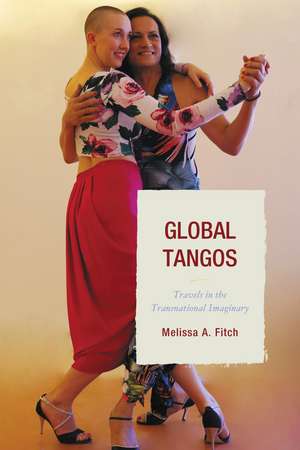
Global Tangos: Travels in the Transnational Imaginary
Autor Melissa A. Fitchen Limba Engleză Hardback – 25 feb 2015
Preț: 632.44 lei
Preț vechi: 957.92 lei
-34%
Puncte Express: 949
Carte tipărită la comandă
Livrare economică 24 noiembrie-08 decembrie
Livrare prin curier în România Termenul estimat este afișat lângă disponibilitate.
Transport gratuit pentru acest produs Plată online sau ramburs, în funcție de opțiunile comenzii.
Retur gratuit în 14 zile Comandă securizată și suport în română.
Specificații
ISBN-13: 9781611486520
ISBN-10: 1611486521
Pagini: 252
Dimensiuni: 161 x 236 x 22 mm
Greutate: 0.45 kg
Editura: Bloomsbury Publishing
Colecția Bucknell University Press
Locul publicării:New York, United States
ISBN-10: 1611486521
Pagini: 252
Dimensiuni: 161 x 236 x 22 mm
Greutate: 0.45 kg
Editura: Bloomsbury Publishing
Colecția Bucknell University Press
Locul publicării:New York, United States
V-ar putea interesa
-
 The Meaning Of TangoChristine DennistonPreț: 70.42 lei
 -
 Funny Moves: Dance Humor PoliticsMarta E. Savigliano-21%Preț: 219.25 lei277.60 lei
 -
 Preț: 307.66 lei
 -
 Feminism for the WorldLola OlufemiPreț: 105.62 lei
 -
 Beyond the Final Whistle: Soccer for a Better WorldVasilis KostakisPreț: 101.47 lei
 -
 Tango NuevoCarolyn MerrittPreț: 189.62 lei
 -
 Preț: 380.35 lei
 -
 Theatre and TourismMargaret Werry-20%Preț: 68.05 lei85.44 lei
 -
 -19%Preț: 160.40 lei197.80 lei
 -
 Preț: 137.81 lei
 -
 TangoFacundo RodulfoPreț: 107.37 lei
 -
 Foreign FruitKatie GohPreț: 120.47 lei
 -
 Lonely Planet Buenos AiresRachel Tolosa Paz-12%Preț: 107.41 lei121.56 lei
 -
 Small WorldMartin Parr-24%Preț: 232.89 lei306.57 lei
 -
 Global Groove: Art, Dance, Performance & ProtestMuseum Folkwang-17%Preț: 290.40 lei348.60 lei
 -
 -24%Preț: 188.48 lei248.80 lei
 -
 -18%Preț: 309.95 lei380.00 lei
 -
 New Geographies of Music 2Séverin GuillardPreț: 336.23 lei
 -
 TacoProf. Ignacio M. Sánchez Prado-32%Preț: 51.81 lei76.33 lei
 -
 No Straight Road Takes You ThereRebecca SolnitPreț: 93.02 lei
Cuprins
Notes on Translations
Acknowledgments
Introduction: Arrival
Chapter One: Foundational Clichés: From Valentino to Viagra
Chapter Two: Tango "Discovery" and the Neocolonial Gaze
Chapter Three: Queer Rebellions
Chapter Four: Touch, Healing and Zen
Chapter Five: Activism, Social Media, Crisis and Community
Conclusion: Departure
Appendix: Tango in Numbers
Bibliography
Sound Recordings
Index
About the Author
Acknowledgments
Introduction: Arrival
Chapter One: Foundational Clichés: From Valentino to Viagra
Chapter Two: Tango "Discovery" and the Neocolonial Gaze
Chapter Three: Queer Rebellions
Chapter Four: Touch, Healing and Zen
Chapter Five: Activism, Social Media, Crisis and Community
Conclusion: Departure
Appendix: Tango in Numbers
Bibliography
Sound Recordings
Index
About the Author
Recenzii
This collection of unusual, readable essays expands scholarly writing on dance, making dance an element of social globalization. Incorporating background on the complex emotional and cultural roles the tango plays in Argentina, Fitch uses the dance as a distinct and recognizable lens through which to explore the forces of transnationalism, access to technology, and social media. Having noted in the introduction that 'the central question is how ... social identities are codified in the presentation of dance,' the author reviews the tango's global explosion, which has moved tango culture far beyond its geographic roots. Beginning with a chapter on the basic images and clichés related to the tango in media (ranging from the films of Rudolph Valentino to I Love Lucy), Fitch explores tango tourism, the rise of queer tango performances and their contexts, the therapeutic use of the tango as meditation, and the tango as a vehicle for and an element of social protest. Summing Up: Recommended. Lower- and upper-division undergraduates; general readers.
Global Tangos overturns many of the myths that have enshrouded Argentina's national dance since it became a global dance craze more than a century ago. Reviewing an impressive array of materials drawn from mass media, social media, and her own experience on the dance floor on seemingly every continent, Melissa A. Fitch reveals how tango has been deployed to reimagine traditional gender roles, heal physical and emotional ills, and ignite social protest. This is an important contribution to our understanding of how popular dance forms cross borders and establish powerful transnational networks.
Global Tangos: Travels in the Transnational Imaginary is a welcome addition to the growing body of literature on contemporary tango. In thought-provoking snapshots of tango around the globe, Fitch connects its myriad manifestations to larger themes of cultural appropriation, neocolonialism, commodification, and identitarian politics. Her critique of the tango memoir is incisive, while she evokes the depths beneath its clichéd surface image in portraits of social activism, healing, and queer liberation via tango. Throughout, Fitch underscores the global pursuit of connection and community through the dance today.
Global Tangos overturns many of the myths that have enshrouded Argentina's national dance since it became a global dance craze more than a century ago. Reviewing an impressive array of materials drawn from mass media, social media, and her own experience on the dance floor on seemingly every continent, Melissa A. Fitch reveals how tango has been deployed to reimagine traditional gender roles, heal physical and emotional ills, and ignite social protest. This is an important contribution to our understanding of how popular dance forms cross borders and establish powerful transnational networks.
Global Tangos: Travels in the Transnational Imaginary is a welcome addition to the growing body of literature on contemporary tango. In thought-provoking snapshots of tango around the globe, Fitch connects its myriad manifestations to larger themes of cultural appropriation, neocolonialism, commodification, and identitarian politics. Her critique of the tango memoir is incisive, while she evokes the depths beneath its clichéd surface image in portraits of social activism, healing, and queer liberation via tango. Throughout, Fitch underscores the global pursuit of connection and community through the dance today.