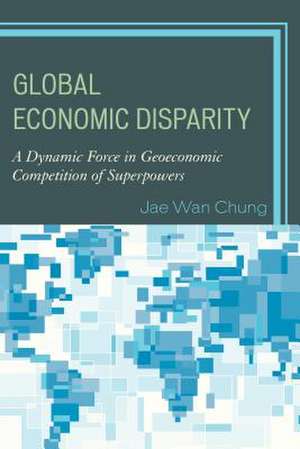
Global Economic Disparity
Autor Jae Wan Chungen Limba Engleză Hardback – 9 apr 2015
| Toate formatele și edițiile | Preț | Express |
|---|---|---|
| Paperback (1) | 270.67 lei 6-8 săpt. | |
| Bloomsbury Publishing – 6 aug 2019 | 270.67 lei 6-8 săpt. | |
| Hardback (1) | 659.32 lei 6-8 săpt. | |
| Bloomsbury Publishing – 9 apr 2015 | 659.32 lei 6-8 săpt. |
Preț: 659.32 lei
Preț vechi: 813.97 lei
-19%
Puncte Express: 989
Preț estimativ în valută:
116.57€ • 138.33$ • 101.36£
116.57€ • 138.33$ • 101.36£
Carte tipărită la comandă
Livrare economică 01-15 aprilie
Specificații
ISBN-13: 9780739193570
ISBN-10: 0739193570
Pagini: 212
Ilustrații: 14 black & white illustrations, 22 tables
Dimensiuni: 157 x 235 x 17 mm
Greutate: 0.5 kg
Editura: Bloomsbury Publishing
ISBN-10: 0739193570
Pagini: 212
Ilustrații: 14 black & white illustrations, 22 tables
Dimensiuni: 157 x 235 x 17 mm
Greutate: 0.5 kg
Editura: Bloomsbury Publishing
V-ar putea interesa
-
 100 Essay Plans for EconomicsErnie Jowsey-13%Preț: 419.00 lei484.09 lei
 -
 -23%Preț: 431.48 lei563.39 lei
 -
 In Cheap We TrustLauren WeberPreț: 119.90 lei
 -
 Preț: 235.63 lei
 -
 -35%Preț: 665.33 lei1021.72 lei
 -
 -26%Preț: 293.84 lei395.40 lei
 -
 -25%Preț: 334.52 lei446.84 lei
 -
 -32%Preț: 410.74 lei606.37 lei
 -
 -29%Preț: 334.59 lei470.98 lei
 -
 -28%Preț: 271.26 lei376.38 lei
 -
 The Development of Economic Thought: An OverviewJoseph R. Cammarosano-28%Preț: 258.27 lei358.33 lei
 -
 Adam Smith and the Death of David Hume: The Letter to Strahan and Related TextsDennis C. Rasmussen-29%Preț: 254.29 lei356.13 lei
 -
 Economy of Southern KurdistanAlmas Heshmati-31%Preț: 1413.78 lei2038.18 lei
 -
 200 Years of American Financial PanicsThomas P VartanianPreț: 158.08 lei
 -
 Exploring the Political Economy and Social Philosophy of F. A. HayekPeter J. Boettke-28%Preț: 273.02 lei377.34 lei
 -
 -34%Preț: 755.98 lei1149.68 lei
 -
 -23%Preț: 911.83 lei1184.20 lei
Descriere
This book explores geoeconomic insights into the global economy of superpowers. In ten chapters, the author explores causal relationships between global economic disparities and historical events, proceeding from the general to the specific.
Cuprins
Introduction
1. Global Economic Disparity
2. Global Economy and Superpowers
3. Open Economy Macroeconomic Principles and Policy Implications
4. Financial Crises in the United States
5. Impact of the U.S. Financial Crisis on Economies of Euro Countries and East Asia
6. Human Resources and Technology
7. Raw Materials
8. Energy
9. Environment, Global Warming and Water Resources
10. Food, Population and Poverty
Conclusions
1. Global Economic Disparity
2. Global Economy and Superpowers
3. Open Economy Macroeconomic Principles and Policy Implications
4. Financial Crises in the United States
5. Impact of the U.S. Financial Crisis on Economies of Euro Countries and East Asia
6. Human Resources and Technology
7. Raw Materials
8. Energy
9. Environment, Global Warming and Water Resources
10. Food, Population and Poverty
Conclusions
Recenzii
Professor Chung argues forcefully that major historical events arise from the interaction of superpowers facing economic disparities. His policy conclusion - that reducing global economic disparities would promote international stability - deserves to be widely considered.
Jae Wan Chung has put together an interesting analysis of recent economic history in Global Economic Disparity. Chung paints history on a large canvas, interpreted through the lens of economic theory and through the underlying forces of international trade and finance. The book provides a good read as well as plenty of food for thought.
A provocative thesis-that global economic disparity is the primary cause of major global historical events. A sure bet to generate lively class discussion. This book will be an excellent component for any undergraduate global political economy course.
Jae Wan Chung has put together an interesting analysis of recent economic history in Global Economic Disparity. Chung paints history on a large canvas, interpreted through the lens of economic theory and through the underlying forces of international trade and finance. The book provides a good read as well as plenty of food for thought.
A provocative thesis-that global economic disparity is the primary cause of major global historical events. A sure bet to generate lively class discussion. This book will be an excellent component for any undergraduate global political economy course.