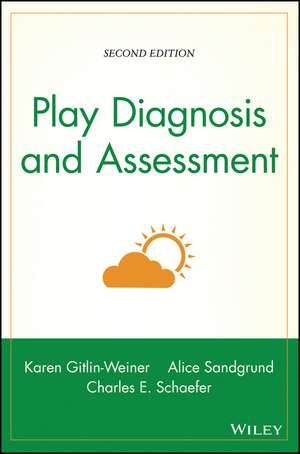
Gitlin-Wei: Play Diagnosis and Assessment
en Limba Engleză Hardback – 28 feb 2000
Remarcăm în această a doua ediție a Play Diagnosis and Assessment, Second Edition o actualizare riguroasă a ghidurilor de evaluare, impusă de necesitatea unor instrumente cu o validitate statistică superioară protocoalelor tradiționale. Într-un domeniu în care observația clinică trebuie susținută de date empirice, autorul K Gitlin–Weiner propune o trecere de la metodele descriptive la scale de evaluare perfecționate, adaptate noilor cerințe ale psihologiei clinice infantile. Notăm cu interes includerea unor proceduri specifice pentru intervenția timpurie și, mai ales, pentru terapia limitată în timp, o necesitate în contextul clinic actual. Structura volumului este una exhaustivă, fiind divizată în șase secțiuni pilon: evaluări de dezvoltare, diagnostice, interacțiunea părinte-copil, dinamica familială, interacțiunea cu grupul de colegi și tehnicile proiective. Această segmentare permite clinicianului o precizie diagnostică ridicată, transformând jocul dintr-o activitate ludică într-un instrument de screening și diagnosticare a tulburărilor mintale și comportamentale. Pe linia clinică a lucrării Handbook of Play Therapy V 2 – Advances & Innovations de KJ O′Connor, dar cu un accent mult mai pronunțat pe rigoarea instrumentelor de măsurare și pe validitatea testelor, acest titlu publicat de Wiley se distinge prin echilibrul dintre cercetarea academică și utilitatea imediată în cabinet. Suntem de părere că relevanța acestui tratat de 792 de pagini rezidă în capacitatea de a oferi soluții pentru populații diverse și grupe de vârstă variate, acoperind lacunele lăsate de metodele de interviu clasice. Față de Interviewing Children and Adolescents, Second Edition de James Morrison, care se concentrează pe dialog și utilizarea jucăriilor ca suport pentru interviu, volumul coordonat de Gitlin–Weiner prioritizează diagnosticul bazat pe scale de evaluare standardizate în mediul de joacă.
Preț: 1309.77 lei
Preț vechi: 1794.20 lei
-27%
Carte tipărită la comandă
Livrare economică 03-17 decembrie
Specificații
ISBN-10: 0471254576
Pagini: 792
Dimensiuni: 183 x 260 x 47 mm
Greutate: 1.52 kg
Ediția:2. Auflage
Locul publicării:Hoboken, United States
V-ar putea interesa
-
 -15%Preț: 156.29 lei183.69 lei
-
 -11%Preț: 162.99 lei182.78 lei
-
 -5%Preț: 553.02 lei582.13 lei
-
 Handbook of Play TherapyKevin J. O'Connor-5%Preț: 556.49 lei585.78 lei
-
 Child and Adolescent PsychiatryRobert Goodman-5%Preț: 422.63 lei444.88 lei
-
 Essentials of Dyslexia Assessment and Intervention , 2nd EditionBarbara J. WendlingPreț: 418.46 lei
-
 Play Therapy for Preschool ChildrenCharles E SchaeferPreț: 529.87 lei
-
 A Clinical Guide to Pediatric Sleep: Diagnosis and Management of Sleep ProblemsJodi A. Mindell PhD-26%Preț: 530.10 lei719.24 lei
-
 Essential Play Therapy Techniques: Time-Tested ApproachesCharles E. Schaefer-5%Preț: 322.90 lei339.89 lei
-
 Play in Family Therapy, Second EditionEliana GilPreț: 257.21 lei
-
 -5%Preț: 247.23 lei260.24 lei
-
 -5%Preț: 368.39 lei387.78 lei
-
 -5%Preț: 345.28 lei363.45 lei
-
 Play Therapy, Second Edition: Theory, Research, and PracticeDavid A. Crenshaw-5%Preț: 464.71 lei489.17 lei
-
 Psychodynamic Diagnostic Manual, Third Edition: PDM-3Vittorio Lingiardi-5%Preț: 604.40 lei636.21 lei
-
 Child-Centered Play TherapyRise VanFleet-5%Preț: 346.01 lei364.22 lei
-
 -27%Preț: 281.07 lei387.35 lei
-
 -29%Preț: 208.44 lei293.13 lei
-
 -21%Preț: 632.33 lei802.70 lei
Public țintă
Child Psychologists, School Psychologists, School Counselors, Child Therapists and other Mental Health Professional who work with children, Graduate Students in Clinical Child Psychology courses, Libraries.De ce să citești această carte
Această resursă este esențială pentru psihologii clinicieni și consilierii școlari care doresc să treacă dincolo de observația subiectivă. Cititorul câștigă acces la tehnici de evaluare validate empiric, esențiale pentru fundamentarea planurilor de tratament în terapia prin joc. Este un instrument de lucru clinic care transformă sesiunile de joacă în date de diagnostic precise, facilitând intervențiile timpurii și gestionarea cazurilor complexe în mediul clinic sau educațional.
Descriere scurtă
- Developmental Play Assessments
- Diagnostic Play Assessments
- Parent-Child Interaction Play Assessments
- Family Play Assessments
- Peer Interaction Play Assessments
- Projective Play Assessments
Notă biografică
Cuprins
A Scale for Assessing Development of Children's Play (C.Westby).
Assessing the Cognitive Ability of Infants and Toddlers ThroughPlay: The Symbolic Play Test (T. Power & J. Radcliffe).
Standardized Play Assessment of Infant and Toddler Temperament (A.Matheny).
The Play History Interview (K. Taylor, et al.).
Transdisciplinary Play-Based Assessment (T. Linder).
DIAGNOSTIC PLAY ASSESSMENTS.
Kiddie Formal Thought Disorder Rating Scale and Story Game (R.Caplan & T. Sherman).
Using Anatomically Detailed Dolls in Interviewing Preschoolers (S.White).
Linking Assessment to Intervention for Children with DevelopmentalDisabilities or At-Risk for Developmental Delay: The DevelopmentalPlay Assessment (DPA) Instrument (K. Lifter).
The Play Observation Kit (POKIT): An Observational AssessmentTechnique for Young Children (K. Mogford-Bevan).
PARENT-CHILD INTERACTION PLAY ASSESSMENTS.
Assessing Mother-Infant Interaction in Play (L. Roggman, etal.).
Parent-Child Interaction Play Assessment (D. Smith).
Assessing Parent-Child Interactions with the Marschak InteractionMethod (MIM) (S. Lindaman, et al.).
"Going to the Store": An Observational Measure of Parent-ChildInteractions for Preschoolers (J. Dumas & P. LaFreniere).
FAMILY PLAY ASSESSMENTS.
Family System Test (FAST): A Systemic Approach for FamilyEvaluation in Clinical Practice and Research (T. Gehring & J.Page).
Assessing Family Interaction by the Collaborative Drawing Technique(G. Smith).
Dynamic Play Approaches in the Observation of Family Relationships(S. Harvey).
Assessment of the Child and Family in Play Contexts (G. Stollak, etal.).
PEER INTERACTION PLAY ASSESSMENTS.
Play Assessment of Peer Interaction in Children (J. Welsh, etal.).
Observing for Individual Differences in the Social InteractionStyles of Preschool Children (M. Segal, et al.).
Assessing Nonsocial Play in Early Childhood: Conceptual andMethodological Approaches (R. Coplan).
Penn Interactive Peer Play Scale: A Parent and Teacher RatingSystem for Young Children (J. Fantuzzo & V. Hampton).
PROJECTIVE PLAY ASSESSMENTS.
The MUG and the Teddy Bears' Picnic: Story-telling Techniques forthe Assessment of Children's Emotional and Behavioral Problems (N.Mueller).
The Family Puppet Technique for Assessing Parent-Child and FamilyInteraction Patterns (P. Ross).
The Use of a Puppet Interview to Understand Children (E.Irwin).
The Puppet Sentence Completion Task (S. Knell & K. Beck).
Play Assessment of Affect: The Affect in Play Scale (S. Russ, etal.).
Indexes.