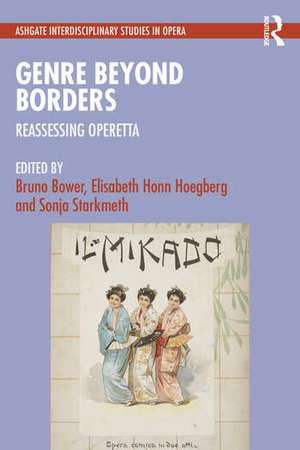
Genre Beyond Borders: Ashgate Interdisciplinary Studies in Opera
Editat de Bruno Bower, Elisabeth Honn Hoegberg, Sonja Starkmethen Limba Engleză Paperback – 27 iun 2025
| Toate formatele și edițiile | Preț | Express |
|---|---|---|
| Paperback (1) | 384.48 lei 43-57 zile | |
| Taylor & Francis Ltd (Sales) – 27 iun 2025 | 384.48 lei 43-57 zile | |
| Hardback (1) | 1016.95 lei 43-57 zile | |
| Taylor & Francis – 18 dec 2023 | 1016.95 lei 43-57 zile |
Din seria Ashgate Interdisciplinary Studies in Opera
- 8%
 Preț: 407.57 lei
 -
 Preț: 371.57 lei
 - 18%
 Preț: 1014.51 lei
 - 18%
 Preț: 1016.95 lei
 -
 Preț: 434.80 lei
 - 15%
 Preț: 428.07 lei
 - 18%
 Preț: 1018.45 lei
 -
 Preț: 428.88 lei
 -
 Preț: 376.01 lei
 -
 Preț: 421.30 lei
 -
 Preț: 432.97 lei
 -
 Preț: 380.24 lei
 -
 Preț: 389.88 lei
 - 26%
 Preț: 267.61 lei
 -
 Preț: 382.65 lei
 -
 Preț: 465.25 lei
 -
 Preț: 444.26 lei
 - 22%
 Preț: 345.96 lei
 -
 Preț: 422.40 lei
 -
 Preț: 382.12 lei
 - 15%
 Preț: 430.41 lei
 - 15%
 Preț: 432.60 lei
 - 18%
 Preț: 1015.27 lei
 - 15%
 Preț: 421.76 lei
 -
 Preț: 470.42 lei
 - 26%
 Preț: 268.39 lei
 -
 Preț: 368.79 lei
 - 18%
 Preț: 1279.13 lei
 - 18%
 Preț: 908.82 lei
Preț: 384.48 lei
Nou
Puncte Express: 577
Preț estimativ în valută:
68.04€ • 79.78$ • 59.75£
68.04€ • 79.78$ • 59.75£
Carte tipărită la comandă
Livrare economică 09-23 februarie 26
Preluare comenzi: 021 569.72.76
Specificații
ISBN-13: 9781032184265
ISBN-10: 1032184264
Pagini: 252
Dimensiuni: 156 x 234 x 14 mm
Greutate: 0.38 kg
Editura: Taylor & Francis Ltd (Sales)
Seria Ashgate Interdisciplinary Studies in Opera
ISBN-10: 1032184264
Pagini: 252
Dimensiuni: 156 x 234 x 14 mm
Greutate: 0.38 kg
Editura: Taylor & Francis Ltd (Sales)
Seria Ashgate Interdisciplinary Studies in Opera
Notă biografică
Bruno Bower is a musicologist, performer, composer, and music editor. His research covers Victorian programme notes, operetta studies, and the social history of polymaths. He currently teaches at the Guildhall School of Music and Drama and in the Centre for Languages, Culture and Communication at Imperial College London, UK.
Elisabeth Honn Hoegberg is currently Director of the School of Music, Theatre, and Dance at Oakland University, USA. Her research interests include historical theory and pedagogy and late nineteenth-century French operetta. She is currently writing a monograph on the stage works of Emmanuel Chabrier.
Sonja Starkmeth is a musicologist whose research focuses on the musical and socio-cultural aspects of operetta. After her appointment as a research fellow at Goethe-Universität Frankfurt am Main, Germany, she has recently started to work as an in-house editor for choral music at Bärenreiter publishing house.
Elisabeth Honn Hoegberg is currently Director of the School of Music, Theatre, and Dance at Oakland University, USA. Her research interests include historical theory and pedagogy and late nineteenth-century French operetta. She is currently writing a monograph on the stage works of Emmanuel Chabrier.
Sonja Starkmeth is a musicologist whose research focuses on the musical and socio-cultural aspects of operetta. After her appointment as a research fellow at Goethe-Universität Frankfurt am Main, Germany, she has recently started to work as an in-house editor for choral music at Bärenreiter publishing house.
Cuprins
Contents
Part 1: International Travel
2. Matteo Paoletti - "The operetta season considerably decreased our losses": Art and business from Italian/South American ledgers of the 1900s
3. John Graziano - The Widow and the Waltz: ‘Viennese’ Operetta in New York, (1907-1930)
4. Gyöngyi Heltai - Transnational influences in the early period of the Budapest Operetta Theatre (1922-1926)
Part 2: Politics and National Identity
5. Vojtěch Frank - Dunayevsky, Czech Edition: On Soviet Operetta in Czechoslovakia, Its Cultural Significance, and Its Artistic Character
6. Ryszard Daniel Golianek - Changing Perspectives: Poland and the Poles in German Operetta
7. Lynn M. Hooker - Hungary and Hungarianism Old and New on the Operetta Stage
Part 3: Class and Gender
8. Sonja Starkmeth - ‘Come and Buy! Buy! Buy!’ – Places of Commerce in Late Victorian Popular Musical Theatre (1890 – 1900)
9. Elisabeth Honn Hoegberg - A Star is Born: The Travesti Protagonist from Chabrier to Hahn
10. John Rigby - Der Zarewitsch (1927): Gender Ambiguity and the Repression of Sexual Identity
Part 4: Genre Transformations
11. Bruno Bower - Burlesque Quotation Practices in Gilbert and Sullivan’s Savoy Operas and the Creation of Middle-Class Identity
12. David Larkin and Chantal Nguyen - Moving things around: The Australian Ballet’s adaptation of The Merry Widow (1975)
13. Pierre Degott – ‘Treu sein, das liegt mir nicht’: Sexual Predation and Textual Correction
14. Stephanie Ruozzo - Broadway Royalty: Jerome Kern’s Princess Theatre Shows as the Heirs of Operetta
Examples
Example 3.1: Leo Fall, Das Puppenmädel, No. 4, ‘Lied des Tiborius’, mm. 62-70
Example 3.2. Jerome Kern, The Doll Girl, ‘Will it all end in smoke?’, mm. 33-40
Example 3.3: Jerome Kern, The Doll Girl, ‘If we were on our honeymoon’ mm. 1-12
Example 3.4: Jerome Kern, The Doll Girl, ‘If we were on our honeymoon’, mm. 37-44
Example 3.5: Jerome Kern, The Doll Girl, ‘If we were on our honeymoon’, mm. 53-60
Example 3.6: Jerome Kern, The Doll Girl, ‘If we were on our honeymoon’, mm. 73-88
Example 9.1a: ‘Largo al factotum,’ mm. 44-47
Example 9.1b: ‘Largo al factotum,’ mm. 189-192
Example 9.1c: ‘Rondeau du colporteur,’ mm. 5-10, bottom
Example 9.2a: ‘Largo al factotum,’ mm. 119-123
Example 9.2b: ‘Rondeau,’ mm. 115-124
Example 9.3a: ‘Non piu andrai’, mm. 1-8
Example 9.3b: ‘Etre aimé,’ mm. 21-26
Example 9.4a: Don Giovanni, Act I finale, mm. 92-94
Example 9.4b: Don Giovanni, Act I finale, mm. 107-110
Example 9.4c: ‘Etre aimé,’ mm. 11-16
Example 9.5: ‘Etre aimé,’ mm. 21-27
Example 9.6: ‘Etre aime’ mm. 96-101
Example 10.1: Der Zarewitsch, ‘Einer wird kommen,’ mm. 9–26.
Example 11.1a: Opening of She Wore a Wreath of Roses, Bayley/Knight
Example 11.1b: Act 1 finale, ‘Although our dark career’, Pirates of Penzance, Gilbert/Sullivan
Example 11.2a: Melody from The Fine Old English Gentleman, arr. Russell
Example 11.2b: Act 1 No.5, ‘Behold the Lord High Executioner’, Gilbert/Sullivan
Example 11.3a: Melody from Oh why should we bewail the dead, Russell
Example 11.3b: Act 1 No.3, ‘Oh better far to live and die’, Pirates of Penzance, Gilbert/Sullivan
Example 11.4a: ‘Agnus Dei’, Messe solennelle de Saint-Cécile, Gounod
Example 11.4b: Act 1 finale, ‘I’m telling a terrible story’, Pirates of Penzance, Gilbert/Sullivan
Example 12.1: Waltz tunes used in Ballet, No. 4
Example 12.2: Operetta No. 4 ‘O Vaterland’, mm. 9–12 (top); Ballet No. 3, mm. 40–43
Example 12.3: Operetta No. 4 ‘Da geh’ ich zu Maxim’, mm. 49–56 (top); Ballet No. 3
(transposed from E-flat), mm. 73–80 (bottom)
Example 12.4: Merry Widow ballet No. 11 (a) slow Vocalise theme; (b) accelerated finale
Example 12.5a: Operetta No. 11, mm. 52–55 (string parts only)
Example 12.5b: Ballet No. 15, mm. 26–29 (string parts only), bottom
Example 12.6: Ballet No. 19, Lippen schweigen’ melody and added descant, mm 113–144
Example 12.7: Ballet No. 1, mm. 89–96
Example 14.1: ‘Thirteen Collar,’ verse
Example 14.2: ‘Thirteen Collar,’ chorus
Example 14.3: ‘Babes in the Wood,’ mm. 3-16
Example 14.4: ‘Babes in the Wood,’ mm. 17-48
Example 14.5: ‘A Peach of Life,’ mm. 1-8
Example 14.6: ‘The Sun Shines Brighter,’ mm. 75-82
Figures
Figure 7.1: The Second Vienna Award and the return of Kolozsvár
Figure 7.2: Cover of Kálmán’s ‘Szép város Kolózsvár’
Figure 10.1: Rita Georg, Franz Lehár and Richard Tauber in 1927
Figure 10.2: Friedrich Ebert (r) and Defence Minister Gustav Noske, on the cover of
Illustrierte Zeitung, 21 August 1919.
Figure 12.1: Layout of Ballet, No. 4
Figure 12.2: Comparative layout of Act 1 in operetta and ballet (simplified)
Figure 12.3: Comparison of Danilo’s opening number (operetta and ballet versions)
Figure 12.4: Still from Merry Widow flashback scene (The Australian Ballet production, 2018)
Figure 12.5: Still from Merry Widow Act 3 finale (The Australian Ballet production, 2018)
Tables
Table 2.1: Comparison of box office revenues at Città di Milano, 1912-1913
Table 3.1: Comparison of the German and English versions of Tiborius and Yvette’s duet, ‘On
Our Honeymoon’
Table 4.1: Obtained stage rights for the Budapest Operetta Theatre (title, composer)
Table 4.2: Premiers of Budapest Operetta Theatre (title, composer)
Table 5.1: Soviet operetta premieres in Czech-speaking theatres
Table 6.1: German operettas with Polish motifs
Table 6.2. Settings of the operettas’ plots
Table 6.3. The operettas’ main characters
Table 6.4 Contexts of the text Poland has not perished yet in Polnische Hochzeit and Dąbrowski-Mazurka
Table 12.1: Dance types in The Merry Widow (operetta)
Table 12.2: Comparison of the operetta and ballet versions at the start of Act 2
Appendix: Viennese, German, and Hungarian Operettas Produced in New York, 1907-1930
- Bruno Bower, Elisabeth Honn Hoegberg, Sonja Starkmeth - Introduction
Part 1: International Travel
2. Matteo Paoletti - "The operetta season considerably decreased our losses": Art and business from Italian/South American ledgers of the 1900s
3. John Graziano - The Widow and the Waltz: ‘Viennese’ Operetta in New York, (1907-1930)
4. Gyöngyi Heltai - Transnational influences in the early period of the Budapest Operetta Theatre (1922-1926)
Part 2: Politics and National Identity
5. Vojtěch Frank - Dunayevsky, Czech Edition: On Soviet Operetta in Czechoslovakia, Its Cultural Significance, and Its Artistic Character
6. Ryszard Daniel Golianek - Changing Perspectives: Poland and the Poles in German Operetta
7. Lynn M. Hooker - Hungary and Hungarianism Old and New on the Operetta Stage
Part 3: Class and Gender
8. Sonja Starkmeth - ‘Come and Buy! Buy! Buy!’ – Places of Commerce in Late Victorian Popular Musical Theatre (1890 – 1900)
9. Elisabeth Honn Hoegberg - A Star is Born: The Travesti Protagonist from Chabrier to Hahn
10. John Rigby - Der Zarewitsch (1927): Gender Ambiguity and the Repression of Sexual Identity
Part 4: Genre Transformations
11. Bruno Bower - Burlesque Quotation Practices in Gilbert and Sullivan’s Savoy Operas and the Creation of Middle-Class Identity
12. David Larkin and Chantal Nguyen - Moving things around: The Australian Ballet’s adaptation of The Merry Widow (1975)
13. Pierre Degott – ‘Treu sein, das liegt mir nicht’: Sexual Predation and Textual Correction
14. Stephanie Ruozzo - Broadway Royalty: Jerome Kern’s Princess Theatre Shows as the Heirs of Operetta
Examples
Example 3.1: Leo Fall, Das Puppenmädel, No. 4, ‘Lied des Tiborius’, mm. 62-70
Example 3.2. Jerome Kern, The Doll Girl, ‘Will it all end in smoke?’, mm. 33-40
Example 3.3: Jerome Kern, The Doll Girl, ‘If we were on our honeymoon’ mm. 1-12
Example 3.4: Jerome Kern, The Doll Girl, ‘If we were on our honeymoon’, mm. 37-44
Example 3.5: Jerome Kern, The Doll Girl, ‘If we were on our honeymoon’, mm. 53-60
Example 3.6: Jerome Kern, The Doll Girl, ‘If we were on our honeymoon’, mm. 73-88
Example 9.1a: ‘Largo al factotum,’ mm. 44-47
Example 9.1b: ‘Largo al factotum,’ mm. 189-192
Example 9.1c: ‘Rondeau du colporteur,’ mm. 5-10, bottom
Example 9.2a: ‘Largo al factotum,’ mm. 119-123
Example 9.2b: ‘Rondeau,’ mm. 115-124
Example 9.3a: ‘Non piu andrai’, mm. 1-8
Example 9.3b: ‘Etre aimé,’ mm. 21-26
Example 9.4a: Don Giovanni, Act I finale, mm. 92-94
Example 9.4b: Don Giovanni, Act I finale, mm. 107-110
Example 9.4c: ‘Etre aimé,’ mm. 11-16
Example 9.5: ‘Etre aimé,’ mm. 21-27
Example 9.6: ‘Etre aime’ mm. 96-101
Example 10.1: Der Zarewitsch, ‘Einer wird kommen,’ mm. 9–26.
Example 11.1a: Opening of She Wore a Wreath of Roses, Bayley/Knight
Example 11.1b: Act 1 finale, ‘Although our dark career’, Pirates of Penzance, Gilbert/Sullivan
Example 11.2a: Melody from The Fine Old English Gentleman, arr. Russell
Example 11.2b: Act 1 No.5, ‘Behold the Lord High Executioner’, Gilbert/Sullivan
Example 11.3a: Melody from Oh why should we bewail the dead, Russell
Example 11.3b: Act 1 No.3, ‘Oh better far to live and die’, Pirates of Penzance, Gilbert/Sullivan
Example 11.4a: ‘Agnus Dei’, Messe solennelle de Saint-Cécile, Gounod
Example 11.4b: Act 1 finale, ‘I’m telling a terrible story’, Pirates of Penzance, Gilbert/Sullivan
Example 12.1: Waltz tunes used in Ballet, No. 4
Example 12.2: Operetta No. 4 ‘O Vaterland’, mm. 9–12 (top); Ballet No. 3, mm. 40–43
Example 12.3: Operetta No. 4 ‘Da geh’ ich zu Maxim’, mm. 49–56 (top); Ballet No. 3
(transposed from E-flat), mm. 73–80 (bottom)
Example 12.4: Merry Widow ballet No. 11 (a) slow Vocalise theme; (b) accelerated finale
Example 12.5a: Operetta No. 11, mm. 52–55 (string parts only)
Example 12.5b: Ballet No. 15, mm. 26–29 (string parts only), bottom
Example 12.6: Ballet No. 19, Lippen schweigen’ melody and added descant, mm 113–144
Example 12.7: Ballet No. 1, mm. 89–96
Example 14.1: ‘Thirteen Collar,’ verse
Example 14.2: ‘Thirteen Collar,’ chorus
Example 14.3: ‘Babes in the Wood,’ mm. 3-16
Example 14.4: ‘Babes in the Wood,’ mm. 17-48
Example 14.5: ‘A Peach of Life,’ mm. 1-8
Example 14.6: ‘The Sun Shines Brighter,’ mm. 75-82
Figures
Figure 7.1: The Second Vienna Award and the return of Kolozsvár
Figure 7.2: Cover of Kálmán’s ‘Szép város Kolózsvár’
Figure 10.1: Rita Georg, Franz Lehár and Richard Tauber in 1927
Figure 10.2: Friedrich Ebert (r) and Defence Minister Gustav Noske, on the cover of
Illustrierte Zeitung, 21 August 1919.
Figure 12.1: Layout of Ballet, No. 4
Figure 12.2: Comparative layout of Act 1 in operetta and ballet (simplified)
Figure 12.3: Comparison of Danilo’s opening number (operetta and ballet versions)
Figure 12.4: Still from Merry Widow flashback scene (The Australian Ballet production, 2018)
Figure 12.5: Still from Merry Widow Act 3 finale (The Australian Ballet production, 2018)
Tables
Table 2.1: Comparison of box office revenues at Città di Milano, 1912-1913
Table 3.1: Comparison of the German and English versions of Tiborius and Yvette’s duet, ‘On
Our Honeymoon’
Table 4.1: Obtained stage rights for the Budapest Operetta Theatre (title, composer)
Table 4.2: Premiers of Budapest Operetta Theatre (title, composer)
Table 5.1: Soviet operetta premieres in Czech-speaking theatres
Table 6.1: German operettas with Polish motifs
Table 6.2. Settings of the operettas’ plots
Table 6.3. The operettas’ main characters
Table 6.4 Contexts of the text Poland has not perished yet in Polnische Hochzeit and Dąbrowski-Mazurka
Table 12.1: Dance types in The Merry Widow (operetta)
Table 12.2: Comparison of the operetta and ballet versions at the start of Act 2
Appendix: Viennese, German, and Hungarian Operettas Produced in New York, 1907-1930