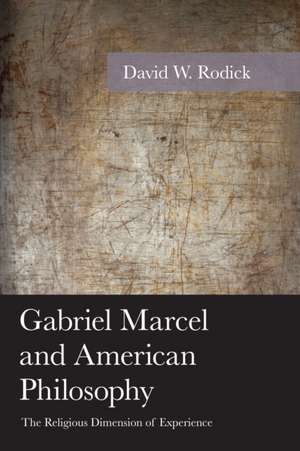
Gabriel Marcel and American Philosophy: The Religious Dimension of Experience: American Philosophy Series
Autor David W. Rodicken Limba Engleză Hardback – 12 apr 2017
Marcel's essays on Royce offer a window into the soul of Marcel's recent philosophical development. The idealism of early Marcel stemmed from an omnipresent sense of a "broken world"-an experience of rent or tear within the tissue of experience similar to what John Dewey referred to as an "inward laceration of the spirit." Furthermore, Marcel's intuition concerning the primacy of intersubjective experience can help us understand W. E. Hocking's thought. Finally, Marcel's notion of l exigence ontologique clarifies his relationship to Henry Bugbee. Marcel and Bugbee explore the contour of experience-the indigenous circuit of associations pertaining to the self as coesse. Through a reflexive act Marcel refers to as "ingatherdness," the self undergoes increasing degrees of unification by experiencing "an act of faith made explicit only in a dialectical act of participation."
David W. Rodick shows that Marcel's relationship to these American philosophers is not coincidental, but rather the philosophical expression of his Christian faith. Marcel's most important legacy is his commitment to unity of Christian philosophizing, a unity derived from both reason and revelation. Its diversity stems from the objective plurality of what is pursued as well as the subjective plurality of those who pursue it. Christian philosophizing seeks a truth that every Christian believes can never be untrue to itself.
Din seria American Philosophy Series
- nou
 Preț: 522.89 lei
 - 34%
 Preț: 540.14 lei
 - 34%
 Preț: 645.51 lei
 - 34%
 Preț: 510.27 lei
 - 34%
 Preț: 676.41 lei
 - 34%
 Preț: 517.06 lei
 - 34%
 Preț: 502.89 lei
 - 26%
 Preț: 272.18 lei
 - 22%
 Preț: 308.55 lei
 - 26%
 Preț: 272.23 lei
 - 34%
 Preț: 643.33 lei
 - 22%
 Preț: 333.16 lei
 -
 Preț: 255.90 lei
 - 26%
 Preț: 243.13 lei
 - 34%
 Preț: 522.39 lei
 - 34%
 Preț: 555.22 lei
 - 26%
 Preț: 243.70 lei
 - 34%
 Preț: 555.30 lei
 - 34%
 Preț: 669.55 lei
 - 26%
 Preț: 242.93 lei
 - 26%
 Preț: 242.65 lei
 - 31%
 Preț: 491.31 lei
 - 26%
 Preț: 249.59 lei
 - 31%
 Preț: 491.55 lei
 - 34%
 Preț: 499.99 lei
 - 31%
 Preț: 466.06 lei
 - 31%
 Preț: 490.78 lei
 - 31%
 Preț: 491.90 lei
 - 31%
 Preț: 465.61 lei
 - 34%
 Preț: 501.32 lei
 - 31%
 Preț: 491.97 lei
 - 26%
 Preț: 523.38 lei
Preț: 551.36 lei
Preț vechi: 835.13 lei
-34%
Puncte Express: 827
Preț estimativ în valută:
97.58€ • 114.04$ • 84.72£
97.58€ • 114.04$ • 84.72£
Carte tipărită la comandă
Livrare economică 20 februarie-06 martie
Preluare comenzi: 021 569.72.76
Specificații
ISBN-13: 9781498510431
ISBN-10: 1498510434
Pagini: 168
Ilustrații: 3 BW Photos
Dimensiuni: 160 x 237 x 16 mm
Greutate: 0.37 kg
Editura: Bloomsbury Publishing
Colecția Lexington Books
Seria American Philosophy Series
Locul publicării:New York, United States
ISBN-10: 1498510434
Pagini: 168
Ilustrații: 3 BW Photos
Dimensiuni: 160 x 237 x 16 mm
Greutate: 0.37 kg
Editura: Bloomsbury Publishing
Colecția Lexington Books
Seria American Philosophy Series
Locul publicării:New York, United States
V-ar putea interesa
-
 NauseaJean-Paul SartrePreț: 74.86 lei
 -
 Existentialism: A Very Short IntroductionThomas Flynn-22%Preț: 52.96 lei67.67 lei
 -
 -34%Preț: 509.05 lei774.30 lei
 -
 The Measure of Things: Humanism, Humility, and MysteryDavid E. CooperPreț: 328.66 lei
 -
 Thomas Hobbes: Writings on Common Law and Hereditary RightAlan Cromartie-23%Preț: 348.27 lei450.64 lei
 -
 Objectivity and InsightMark Sacks-14%Preț: 355.06 lei414.61 lei
 -
 Nihil UnboundR. Brassier-18%Preț: 750.93 lei915.76 lei
 -
 Irrational Man: A Study in Existential PhilosophyWilliam BarrettPreț: 92.90 lei
 -
 Existentialism and HumanismJean-Paul SartrePreț: 72.29 lei
 -
 Introduction to PhenomenologyDermont Moran-15%Preț: 286.59 lei335.94 lei
 -
 The Jargon of AuthenticityTheodor Adorno-18%Preț: 90.69 lei110.64 lei
 -
 Body Images: Embodiment as IntercorporealityGail Weiss-29%Preț: 259.34 lei367.80 lei
 -
 Essays on Heidegger and Others: Philosophical PapersRichard RortyPreț: 161.68 lei
 -
 Introduction to PhenomenologyRobert SokolowskiPreț: 186.65 lei
 -
 Genesis and Structure of Hegel's "Phenomenology of Spirit"Jean HyppolitePreț: 233.14 lei
 -
 -5%Preț: 200.04 lei210.58 lei
Cuprins
Acknowledgements
Chapter One: Gabriel Marcel and American Philosophy
Chapter Two: Radical Empiricism, Intersubjectivity, and the Importance of Praxis in the Philosophy of Gabriel Marcel
Chapter Three: Idealism Through a Past Darkly: La métaphysic de Royce
Chapter Four: Gabriel Marcel and the Issue of "Transitional Importance" in the Philosophy of Josiah Royce
Chapter Five: Gabriel Marcel and William Ernest Hocking: "Companions of Eternity"-Experience, Intersubjectivity, and Realization of the Sacred
Chapter Six: Finding One's Own Voice: The Philosophical Development of Henry G. Bugbee, Jr.
Chapter Seven: Gabriel Marcel and the Religious Dimension of Experience
Bibliography
Appendix: Letter from John E. Smith
Chapter One: Gabriel Marcel and American Philosophy
Chapter Two: Radical Empiricism, Intersubjectivity, and the Importance of Praxis in the Philosophy of Gabriel Marcel
Chapter Three: Idealism Through a Past Darkly: La métaphysic de Royce
Chapter Four: Gabriel Marcel and the Issue of "Transitional Importance" in the Philosophy of Josiah Royce
Chapter Five: Gabriel Marcel and William Ernest Hocking: "Companions of Eternity"-Experience, Intersubjectivity, and Realization of the Sacred
Chapter Six: Finding One's Own Voice: The Philosophical Development of Henry G. Bugbee, Jr.
Chapter Seven: Gabriel Marcel and the Religious Dimension of Experience
Bibliography
Appendix: Letter from John E. Smith
Recenzii
David Rodick's fascinating study tracks the French philosopher Gabriel Marcel's conversations with the Americans Henry Bugbee, W. E. Hocking, Josiah Royce, and William James. It's a pleasure to get in step as Marcel pursues the religious and spiritual veins of everyday experiences of others, art, and nature, accompanied by these Americans. We trace their subtle explorations of what Marcel calls the mystery of being.
An important thinker in twentieth century thought, Gabriel Marcel's affinity for, and debt to, American philosophy is well known, especially the work of Josiah Royce, William James, William Ernest Hocking and Henry Bugby. Yet David Rodick's book is the first extensive study of Marcel's interaction with these distinguished American thinkers. It provides a fascinating introduction to the central themes of radical empiricism, intersubjectivity and transcendence, and also illuminates the continuing relevance of Marcel's ideas for our times. The book is a first rate addition to the literature on Marcel.
The influence of idealism on Marcel's early philosophy is often noted, but Rodick tells a more complex story. His essays explore historical and philosophical intersections between the thought of Gabriel Marcel and the work of American philosophers Josiah Royce, William Ernest Hocking and Henry Bugbee. Rodick demonstrates their interactions with Marcel, illuminates central insights of all these philosophers, and achieves particular depth in his analyses of intersubjectivity, praxis, and religious experience. I recommend this book to anyone interested in American philosophy, idealism, Marcel, and/or existential, exploratory thinking.
An important thinker in twentieth century thought, Gabriel Marcel's affinity for, and debt to, American philosophy is well known, especially the work of Josiah Royce, William James, William Ernest Hocking and Henry Bugby. Yet David Rodick's book is the first extensive study of Marcel's interaction with these distinguished American thinkers. It provides a fascinating introduction to the central themes of radical empiricism, intersubjectivity and transcendence, and also illuminates the continuing relevance of Marcel's ideas for our times. The book is a first rate addition to the literature on Marcel.
The influence of idealism on Marcel's early philosophy is often noted, but Rodick tells a more complex story. His essays explore historical and philosophical intersections between the thought of Gabriel Marcel and the work of American philosophers Josiah Royce, William Ernest Hocking and Henry Bugbee. Rodick demonstrates their interactions with Marcel, illuminates central insights of all these philosophers, and achieves particular depth in his analyses of intersubjectivity, praxis, and religious experience. I recommend this book to anyone interested in American philosophy, idealism, Marcel, and/or existential, exploratory thinking.