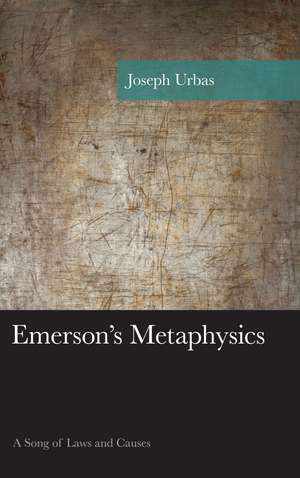
Emerson's Metaphysics: A Song of Laws and Causes: American Philosophy Series
Autor Joseph Urbasen Limba Engleză Paperback – 12 apr 2019
This book will be of interest to philosophers, literary scholars, and students of English, philosophy, and intellectual and religious history who are interested in Emerson and the American Transcendentalist movement.
Din seria American Philosophy Series
- 34%
 Preț: 568.40 lei
 - 36%
 Preț: 679.30 lei
 - 34%
 Preț: 536.82 lei
 - 32%
 Preț: 712.18 lei
 - 33%
 Preț: 580.05 lei
 - 33%
 Preț: 544.04 lei
 - 35%
 Preț: 529.19 lei
 - 22%
 Preț: 324.21 lei
 - 36%
 Preț: 676.64 lei
 -
 Preț: 269.24 lei
 - 26%
 Preț: 286.36 lei
 - 33%
 Preț: 549.82 lei
 - 32%
 Preț: 584.38 lei
 - 28%
 Preț: 350.21 lei
 - 32%
 Preț: 584.23 lei
 - 33%
 Preț: 721.94 lei
 - 27%
 Preț: 255.62 lei
 - 27%
 Preț: 256.01 lei
 - 27%
 Preț: 256.41 lei
 - 33%
 Preț: 516.57 lei
 - 27%
 Preț: 261.63 lei
 - 33%
 Preț: 517.35 lei
 - 36%
 Preț: 526.84 lei
 - 27%
 Preț: 255.93 lei
 - 32%
 Preț: 490.50 lei
 - 33%
 Preț: 516.17 lei
 - 33%
 Preț: 517.72 lei
 - 31%
 Preț: 503.33 lei
 - 35%
 Preț: 527.27 lei
 - 33%
 Preț: 517.79 lei
 - 24%
 Preț: 550.86 lei
 - 32%
 Preț: 663.85 lei
 - 33%
 Preț: 528.75 lei
 - 33%
 Preț: 547.75 lei
 - nou
 Preț: 549.38 lei
Preț: 286.85 lei
Preț vechi: 389.35 lei
-26%
Puncte Express: 430
Carte tipărită la comandă
Livrare economică 01-15 decembrie
Livrare prin curier în România Termenul estimat este afișat lângă disponibilitate.
Transport gratuit de la 400.00 lei Plată online sau ramburs, în funcție de opțiunile comenzii.
Retur gratuit în 14 zile Comandă securizată și suport în română.
Specificații
ISBN-13: 9781498524520
ISBN-10: 1498524524
Pagini: 272
Ilustrații: 1 b/w photos;
Dimensiuni: 148 x 226 x 20 mm
Greutate: 0.43 kg
Editura: Bloomsbury Publishing
Colecția Lexington Books
Seria American Philosophy Series
Locul publicării:New York, United States
ISBN-10: 1498524524
Pagini: 272
Ilustrații: 1 b/w photos;
Dimensiuni: 148 x 226 x 20 mm
Greutate: 0.43 kg
Editura: Bloomsbury Publishing
Colecția Lexington Books
Seria American Philosophy Series
Locul publicării:New York, United States
Cuprins
Introduction
Chapter One: The Historical Background of Emerson's Metaphysics: The Ontological Turn, 1820-1850
Chapter Two: The Making of a Metaphysician
Chapter Three: Fashions in Emerson's Intellectual Milieu: Enthusiasms over the Cause
Chapter Four: Controversies within New England Christianity: Arguments over the Cause
Chapter Five: Emerson among the Causationists
Chapter Six: Causationism and Method in the Late Emerson
Conclusion
Annex - Causa Causarum: A Representative Sampling of References in the Emerson Corpus
Chapter One: The Historical Background of Emerson's Metaphysics: The Ontological Turn, 1820-1850
Chapter Two: The Making of a Metaphysician
Chapter Three: Fashions in Emerson's Intellectual Milieu: Enthusiasms over the Cause
Chapter Four: Controversies within New England Christianity: Arguments over the Cause
Chapter Five: Emerson among the Causationists
Chapter Six: Causationism and Method in the Late Emerson
Conclusion
Annex - Causa Causarum: A Representative Sampling of References in the Emerson Corpus
Recenzii
In this captivating book, Joseph Urbas proposes a reconstruction of the metaphysics of the American poet, essayist, and self-defined philosopher Ralph Waldo Emerson.... The author provides an abundance of textual evidence to support his thesis.
Urbas does a fine job contextualizing Emerson's metaphysics in the thought of transatlantic contemporaries as well as friends and family. Well written and thoroughly researched, Emerson's Metaphysics is an outstanding contribution to our understanding of Emerson's philosophy.
In a perceptive and stimulating reappraisal, Joseph Urbas elucidates the concept of 'causation' as the 'dynamic, creative first principle' of Emerson's philosophy. Restoring him to his place as a philosopher in an age searching for a new grounding of fundamental principles, Urbas shows Emerson as a surprisingly systematic thinker, whose 'first philosophy' sought to merge ontology with moral law.
Professor Urbas offers both a thoughtful and passionate defense of Emerson as a metaphysical thinker, and a wide-ranging exploration of a broad swathe of contemporary philosophical texts that situates him in a vital transatlantic perspective. This book will likely picture "a new Emerson" for many readers.
Urbas defends a new thesis about how Emerson's metaphysics ought to be understood, both historically and in light of metaphysics as an on-going discipline. Emerson is a "causationist" in a special and difficult sense. This insight will lead to a reconsideration of other metaphysicians who were influenced by Emerson, such as Peirce and Dewey and Royce. The causationist interpretation will also open up new comparative work between Emerson and South Asian philosophies, including the traditional schools of Buddhism, which is timely for our age.
With Emerson's Metaphysics we leave behind the "rehabilitation era" in Emerson studies. We can debate whether Emerson's current standing as a philosopher benefited or not from a generation of scholarship focused on just the parts we liked: his skepticism, his individualism, his egalitarianism. But what can no longer be claimed-thanks to this book-is that any of these things mattered to Emerson more than his metaphysics. Peering deeply into the writings both of Emerson and of an astounding array of his contemporaries, Joseph Urbas proves that epistemology, ethics, and politics all followed-in Emerson's view-from metaphysics. Causation, specifically, was Emerson's "first philosophy," as amply shown in this carefully researched and argued book.
Deeply informed both by modern scholarship and by forgotten primary texts, and drawing on all of Emerson's writings, this lively, comprehensive study clearly reconstructs Emerson's metaphysics of causation, persuasively demonstrating its centrality to Emerson and his contemporaries. No one who studies Emerson, Transcendentalism, or nineteenth-century New England literary culture can afford to miss it.
Much of the best recent writing about Emerson emphasizes his skepticism, the instabilities of his philosophical positions, and his epistemology of moods. Yet it was Emerson himself who wrote that although "all moods may safely be tried" there is "an order which makes skepticism impossible." Such metaphysical moments occur regularly in Emerson's writings, and they are the opening for Joseph Urbas's fine new book, in which he argues that an active living "Cause" is Emerson's fundamental metaphysical principle. Urbas considers the entire range of Emerson's writing, including his poetry, and places Emerson's thought in the context of such influential predecessors as Samuel Taylor Coleridge and Victor Cousin, and his American contemporaries Mary Moody Emerson, William Ellery Channing, Margaret Fuller, and Bronson Alcott. Urbas's challenging account, replete with careful and original readings and observations, is a valuable new contribution to the study of Emerson's thought.
Urbas's fine book restores to the reading of Emerson its historical context, which serves as a corrective of the narrow, epistemological readings popular in the last half century. Emerson's revival now needs the goading that this book provides to remember there is far more to his philosophy than was discussed in the last generation.
Urbas's fine book provides new historical research, bringing to bear on the interpretation of Emerson important sources that have been neglected by philosophers and overlooked even in the genuinely historical studies of his thought. Understanding Emerson as a writer, poet, lecturer, cultural icon, or human being depends upon understanding his reading of Hegel, Kant, Schelling, and Hume to Coleridge, Victor Cousin and other outright metaphysicians. Urbas handle this difficult material and integrates it into the interpretation of Emerson to everyone's benefit. That is a very great service.
Urbas does a fine job contextualizing Emerson's metaphysics in the thought of transatlantic contemporaries as well as friends and family. Well written and thoroughly researched, Emerson's Metaphysics is an outstanding contribution to our understanding of Emerson's philosophy.
In a perceptive and stimulating reappraisal, Joseph Urbas elucidates the concept of 'causation' as the 'dynamic, creative first principle' of Emerson's philosophy. Restoring him to his place as a philosopher in an age searching for a new grounding of fundamental principles, Urbas shows Emerson as a surprisingly systematic thinker, whose 'first philosophy' sought to merge ontology with moral law.
Professor Urbas offers both a thoughtful and passionate defense of Emerson as a metaphysical thinker, and a wide-ranging exploration of a broad swathe of contemporary philosophical texts that situates him in a vital transatlantic perspective. This book will likely picture "a new Emerson" for many readers.
Urbas defends a new thesis about how Emerson's metaphysics ought to be understood, both historically and in light of metaphysics as an on-going discipline. Emerson is a "causationist" in a special and difficult sense. This insight will lead to a reconsideration of other metaphysicians who were influenced by Emerson, such as Peirce and Dewey and Royce. The causationist interpretation will also open up new comparative work between Emerson and South Asian philosophies, including the traditional schools of Buddhism, which is timely for our age.
With Emerson's Metaphysics we leave behind the "rehabilitation era" in Emerson studies. We can debate whether Emerson's current standing as a philosopher benefited or not from a generation of scholarship focused on just the parts we liked: his skepticism, his individualism, his egalitarianism. But what can no longer be claimed-thanks to this book-is that any of these things mattered to Emerson more than his metaphysics. Peering deeply into the writings both of Emerson and of an astounding array of his contemporaries, Joseph Urbas proves that epistemology, ethics, and politics all followed-in Emerson's view-from metaphysics. Causation, specifically, was Emerson's "first philosophy," as amply shown in this carefully researched and argued book.
Deeply informed both by modern scholarship and by forgotten primary texts, and drawing on all of Emerson's writings, this lively, comprehensive study clearly reconstructs Emerson's metaphysics of causation, persuasively demonstrating its centrality to Emerson and his contemporaries. No one who studies Emerson, Transcendentalism, or nineteenth-century New England literary culture can afford to miss it.
Much of the best recent writing about Emerson emphasizes his skepticism, the instabilities of his philosophical positions, and his epistemology of moods. Yet it was Emerson himself who wrote that although "all moods may safely be tried" there is "an order which makes skepticism impossible." Such metaphysical moments occur regularly in Emerson's writings, and they are the opening for Joseph Urbas's fine new book, in which he argues that an active living "Cause" is Emerson's fundamental metaphysical principle. Urbas considers the entire range of Emerson's writing, including his poetry, and places Emerson's thought in the context of such influential predecessors as Samuel Taylor Coleridge and Victor Cousin, and his American contemporaries Mary Moody Emerson, William Ellery Channing, Margaret Fuller, and Bronson Alcott. Urbas's challenging account, replete with careful and original readings and observations, is a valuable new contribution to the study of Emerson's thought.
Urbas's fine book restores to the reading of Emerson its historical context, which serves as a corrective of the narrow, epistemological readings popular in the last half century. Emerson's revival now needs the goading that this book provides to remember there is far more to his philosophy than was discussed in the last generation.
Urbas's fine book provides new historical research, bringing to bear on the interpretation of Emerson important sources that have been neglected by philosophers and overlooked even in the genuinely historical studies of his thought. Understanding Emerson as a writer, poet, lecturer, cultural icon, or human being depends upon understanding his reading of Hegel, Kant, Schelling, and Hume to Coleridge, Victor Cousin and other outright metaphysicians. Urbas handle this difficult material and integrates it into the interpretation of Emerson to everyone's benefit. That is a very great service.