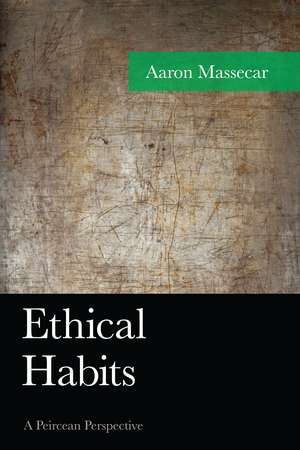
Ethical Habits: A Peircean Perspective: American Philosophy Series
Autor Aaron Massecaren Limba Engleză Hardback – 21 apr 2016
Din seria American Philosophy Series
- nou
 Preț: 527.15 lei
 - 35%
 Preț: 544.54 lei
 - 36%
 Preț: 650.79 lei
 - 33%
 Preț: 681.95 lei
 - 33%
 Preț: 555.87 lei
 - 34%
 Preț: 521.28 lei
 - 36%
 Preț: 506.99 lei
 - 27%
 Preț: 274.44 lei
 - 23%
 Preț: 311.04 lei
 - 36%
 Preț: 648.60 lei
 -
 Preț: 257.99 lei
 - 27%
 Preț: 274.47 lei
 - 33%
 Preț: 526.63 lei
 - 33%
 Preț: 559.76 lei
 - 28%
 Preț: 245.70 lei
 - 29%
 Preț: 335.85 lei
 - 33%
 Preț: 559.84 lei
 - 34%
 Preț: 675.04 lei
 - 28%
 Preț: 244.64 lei
 - 28%
 Preț: 245.12 lei
 - 34%
 Preț: 495.32 lei
 - 28%
 Preț: 251.06 lei
 - 33%
 Preț: 495.57 lei
 - 36%
 Preț: 504.57 lei
 - 28%
 Preț: 244.93 lei
 - 33%
 Preț: 469.84 lei
 - 34%
 Preț: 494.78 lei
 - 33%
 Preț: 495.91 lei
 - 33%
 Preț: 469.40 lei
 - 36%
 Preț: 505.42 lei
 - 33%
 Preț: 495.99 lei
 - 25%
 Preț: 527.65 lei
 - 32%
 Preț: 633.59 lei
 - 33%
 Preț: 528.75 lei
Preț: 514.43 lei
Preț vechi: 790.56 lei
-35%
Puncte Express: 772
Carte tipărită la comandă
Livrare economică 08-22 iunie
Specificații
ISBN-13: 9781498508544
ISBN-10: 1498508545
Pagini: 176
Ilustrații: 5 BW Illustrations
Dimensiuni: 150 x 232 x 18 mm
Greutate: 0.42 kg
Editura: Bloomsbury Publishing
Colecția Lexington Books
Seria American Philosophy Series
Locul publicării:New York, United States
ISBN-10: 1498508545
Pagini: 176
Ilustrații: 5 BW Illustrations
Dimensiuni: 150 x 232 x 18 mm
Greutate: 0.42 kg
Editura: Bloomsbury Publishing
Colecția Lexington Books
Seria American Philosophy Series
Locul publicării:New York, United States
Cuprins
Introduction1. The Trouble with Theory and Practice2. Preparing a Place for a Peircean Ethics3. Intelligent Habits4. The Metaphysics of Habits5. Thinking of Habits6. Self-Controlled HabitsConclusionBibliography
Recenzii
In Ethical Habits: A Peircean Perspective, Aaron Massecar has taken on the worthwhile adventure of seeing how Peirce's normative (theoretical) ethics might be put to work. He explores a wide range of Peircean texts to make his case for critical self-control in the development of human habits. The result is a persuasive story that reveals the nuances in Peirce's thought and shows a creative dimension in establishing our moral habits and in pursuing human virtues. The Aristotelian-influenced Peirce of Massecar's work is quite unlike the mechanical, deliberative Peirce others have promoted. Massecar's work provides a nice opening for those who want to explore all of Peirce's normative sciences for their everyday usefulness. And as an historical approach to the ethics of the pragmatists, this book makes a nice companion to Gregory Pappas's John Dewey's Ethics.
No creative appropriation of a commonplace concept more dramatically reveals the fecundity of Peirce's philosophical genius or the scope of his theoretical imagination than his treatment of habit. Aaron Massecar's probing, critical engagement with Peirce's appropriation of this concept weaves together seemingly disparate concerns and fields (e.g., cosmology, psychology, and ethics) and exhibits unnoticed connections. His systematic, detailed, and nuanced study of Peirce on habit is a contribution to both Peirce scholarship and, of even greater significance, contemporary philosophy more generally.
Setting out from a novel appraisal of C. S. Peirce's controversial separation between theory and practice-an apparent dualism that has perplexed many a reader of the founder of pragmatism over the years-Aaron Massecar sketches a dynamic conception of ethics rooted in the activity of habit formation and revision. This serves as a useful corrective to interpretations that overstate the role of theory and reason in Peircean ethics, and opens up the field for a re-evaluation of the role of practice, tradition, and sentiment in normative inquiry. The significance of these results reaches well beyond mere exegesis, implying vital connections between Peirce's conception of normative science and virtue ethics as well as revealing new possibilities for applying his thought in humanistic and social research.
No creative appropriation of a commonplace concept more dramatically reveals the fecundity of Peirce's philosophical genius or the scope of his theoretical imagination than his treatment of habit. Aaron Massecar's probing, critical engagement with Peirce's appropriation of this concept weaves together seemingly disparate concerns and fields (e.g., cosmology, psychology, and ethics) and exhibits unnoticed connections. His systematic, detailed, and nuanced study of Peirce on habit is a contribution to both Peirce scholarship and, of even greater significance, contemporary philosophy more generally.
Setting out from a novel appraisal of C. S. Peirce's controversial separation between theory and practice-an apparent dualism that has perplexed many a reader of the founder of pragmatism over the years-Aaron Massecar sketches a dynamic conception of ethics rooted in the activity of habit formation and revision. This serves as a useful corrective to interpretations that overstate the role of theory and reason in Peircean ethics, and opens up the field for a re-evaluation of the role of practice, tradition, and sentiment in normative inquiry. The significance of these results reaches well beyond mere exegesis, implying vital connections between Peirce's conception of normative science and virtue ethics as well as revealing new possibilities for applying his thought in humanistic and social research.