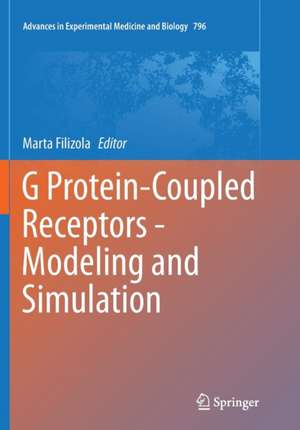
G Protein-Coupled Receptors - Modeling and Simulation: Advances in Experimental Medicine and Biology, cartea 796
Editat de Marta Filizolaen Limba Engleză Paperback – 23 aug 2016
Evoluția farmacologiei moleculare a fost marcată în ultimul deceniu de trecerea de la metodele empirice de screening la designul rațional de medicamente, o transformare facilitată de progresele masive în biologia structurală. Recomandăm lucrarea G Protein-Coupled Receptors - Modeling and Simulation, editată de Marta Filizola, ca pe un instrument esențial pentru înțelegerea modului în care datele de cristalografie sunt acum integrate în simulările de dinamică moleculară. Această ediție din seria Advances in Experimental Medicine and Biology reflectă realitatea curentă a domeniului: GPCR-urile nu mai sunt privite ca entități statice, ci ca sisteme dinamice a căror funcție este influențată critic de mediul lipidic și de colesterol.
Suntem de părere că rigoarea acestei lucrări rezidă în structura sa logică, divizată în patru piloni fundamentali. Prima secțiune analizează impactul „boom-ului” cristalografic asupra modelării prin omologie, în timp ce a doua parte explorează mecanismele moleculare dincolo de dinamica standard, incluzând interacțiunile cu membrana celulară. Ultimele secțiuni fac tranziția spre aplicații practice, de la modelarea matematică la utilizarea resurselor bioinformatice specifice. Comparabil cu Modelling of GPCRs de Andrea Strasser în rigurozitate, volumul de față este actualizat pentru contextul post-2007, punând un accent mult mai mare pe simulările avansate și pe noile structuri de înaltă rezoluție disponibile.
În contextul cercetărilor editorului Marta Filizola, acest volum consolidează direcția sa academică axată pe aplicarea metodelor teoretice și computaționale pentru elucidarea proceselor biologice complexe. Spre deosebire de manualele introductive, acest titlu oferă o perspectivă tehnică asupra modului în care modelarea matematică și simularea pot depăși limitările lipsei de informații structurale complete, oferind soluții concrete pentru descoperirea de liganzi cu proprietăți terapeutice optimizate.
Din seria Advances in Experimental Medicine and Biology
- 30%
 Preț: 715.95 lei
 - 5%
 Preț: 1382.79 lei
 - 5%
 Preț: 1070.60 lei
 - 5%
 Preț: 688.64 lei
 - 5%
 Preț: 689.53 lei
 - 5%
 Preț: 1243.69 lei
 - 5%
 Preț: 1125.05 lei
 - 5%
 Preț: 1243.97 lei
 - 5%
 Preț: 1119.42 lei
 - 5%
 Preț: 1058.97 lei
 - 18%
 Preț: 1079.97 lei
 - 5%
 Preț: 1379.77 lei
 - 5%
 Preț: 1118.41 lei
 - 18%
 Preț: 920.45 lei
 - 18%
 Preț: 1187.64 lei
 - 5%
 Preț: 1183.68 lei
 - 5%
 Preț: 1242.06 lei
 - 5%
 Preț: 1059.31 lei
 - 18%
 Preț: 1088.78 lei
 - 5%
 Preț: 1125.25 lei
 - 5%
 Preț: 1363.28 lei
 - 5%
 Preț: 1254.87 lei
 - 18%
 Preț: 1362.49 lei
 - 18%
 Preț: 1357.94 lei
 - 18%
 Preț: 1194.92 lei
 - 5%
 Preț: 1555.64 lei
 - 5%
 Preț: 1260.90 lei
 - 18%
 Preț: 1087.57 lei
 - 5%
 Preț: 1054.94 lei
 - 24%
 Preț: 923.80 lei
 - 15%
 Preț: 625.77 lei
 - 5%
 Preț: 1054.94 lei
 - 18%
 Preț: 909.08 lei
 - 18%
 Preț: 915.13 lei
 - 5%
 Preț: 1113.82 lei
 - 5%
 Preț: 696.54 lei
 - 18%
 Preț: 1341.26 lei
 - 5%
 Preț: 1049.67 lei
 - 18%
 Preț: 2436.13 lei
 - 18%
 Preț: 1335.19 lei
 - 5%
 Preț: 696.45 lei
 - 5%
 Preț: 1060.22 lei
 - 5%
 Preț: 696.54 lei
 - 18%
 Preț: 962.90 lei
 - 5%
 Preț: 1263.12 lei
 - 5%
 Preț: 701.25 lei
 - 18%
 Preț: 1185.81 lei
Preț: 907.85 lei
Preț vechi: 1107.13 lei
-18%
Carte tipărită la comandă
Livrare economică 08-22 iunie
Specificații
ISBN-10: 9402402586
Pagini: 236
Ilustrații: VIII, 228 p. 59 illus., 45 illus. in color.
Dimensiuni: 178 x 254 x 12 mm
Greutate: 0.42 kg
Ediția:Softcover reprint of the original 1st ed. 2014
Editura: SPRINGER NETHERLANDS
Colecția Springer
Seria Advances in Experimental Medicine and Biology
Locul publicării:Dordrecht, Netherlands
V-ar putea interesa
-
 Peptide Science -- Present and FutureYasutsugu Shimonishi-18%Preț: 1785.08 lei2176.93 lei
 -
 -18%Preț: 1186.40 lei1446.83 lei
 -
 Chemistry of Plant HormonesNobutaka Takahashi-18%Preț: 2548.77 lei3108.26 lei
 -
 Amino Acids and PeptidesJ H Jones-27%Preț: 2058.41 lei2819.73 lei
 -
 -5%Preț: 749.12 lei788.54 lei
 -
 -30%Preț: 1576.37 lei2260.29 lei
 -
 -15%Preț: 626.93 lei737.56 lei
 -
 Taurine 9Janusz Marcinkiewicz-18%Preț: 1779.65 lei2170.31 lei
 -
 Biomolecular InterfacesAriel Fernández StiglianoPreț: 388.54 lei
 -
 Physical Biology of Proteins and PeptidesLuis Olivares-Quiroz-18%Preț: 910.42 lei1110.27 lei
 -
 Regulation of Ca2+-ATPases,V-ATPases and F-ATPasesSajal Chakraborti-18%Preț: 1189.33 lei1450.40 lei
 -
 The Discreet Charm of Protein Binding SitesJoseph YarivPreț: 368.05 lei
 -
 Host Defense Peptides and Their Potential as Therapeutic AgentsRichard M. Epand-18%Preț: 915.29 lei1116.22 lei
 -
 Protein-based Engineered NanostructuresAitziber L. Cortajarena-18%Preț: 924.09 lei1126.94 lei
 -
 Evolution of the Protein Synthesis Machinery and Its RegulationGreco Hernández-18%Preț: 1760.90 lei2147.45 lei
 -
 -15%Preț: 615.05 lei723.59 lei
 -
 Directed Enzyme Evolution: Advances and ApplicationsMiguel Alcalde-18%Preț: 968.34 lei1180.91 lei
 -
 Proteomics in Domestic Animals: from Farm to Systems BiologyAndre Martinho de Almeida-18%Preț: 1079.97 lei1317.05 lei
 -
 Protein Modifications in Pathogenic Dysregulation of SignalingJun-ichiro Inoue-24%Preț: 874.74 lei1150.97 lei
 -
 The Redox State and Circadian RhythmsThérèse Vanden Driessche-18%Preț: 902.84 lei1101.02 lei
 -
 -18%Preț: 1168.97 lei1425.57 lei
 -
 -18%Preț: 911.64 lei1111.76 lei
 -
 Urea TransportersBaoxue Yang-18%Preț: 912.69 lei1113.03 lei
 -
 Quantum Adaptivity in Biology: From Genetics to CognitionMasanari Asano-15%Preț: 619.71 lei729.07 lei
 -
 From Protein Structure to Function with BioinformaticsDaniel J. Rigden-24%Preț: 1707.71 lei2246.98 lei
De ce să citești această carte
Această lucrare este indispensabilă cercetătorilor din biochimie și farmacologie care doresc să utilizeze metode computaționale moderne în studiul receptorilor GPCR. Cititorul câștigă o înțelegere profundă a integrării simulărilor de dinamică moleculară cu datele de cristalografie, un avantaj competitiv în designul rațional de medicamente. Este un ghid tehnic actualizat ce transformă datele structurale brute în modele funcționale predictive.
Cuprins
Textul de pe ultima copertă
This book, which provides, for the first time, state-of-the-art views on modeling and simulation of GPCRs, is divided into 4 parts. In the first part, the impact of currently available GPCR crystal structures on structural modeling is discussed extensively as are critical insights from simulations in the second part of the book. The third part reports recent progress in rational ligand discovery and mathematical modeling, whereas the fourth part provides an overview of bioinformatics tools and resources that are available for GPCRs.