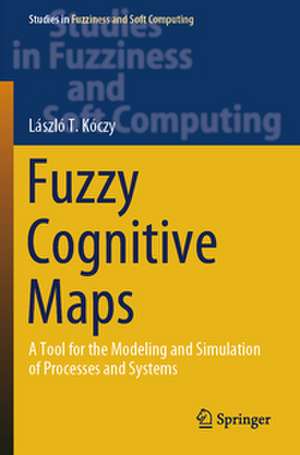
Fuzzy Cognitive Maps: Studies in Fuzziness and Soft Computing, cartea 427
Autor László T. Kóczyen Limba Engleză Paperback – 17 dec 2024
The book is built up didactically, the novel results in the field being presented in the way of starting with two real-life case studies, one in the area of waste management, while the other one in modelling bank management systems. In both cases, the book starts with explaining the applied problem and then presenting how the model construction is done and what problems emerge when attempts are made for applying directly earlier results on FCM modelling. In the first case study, the problem of the oversimplification leads to inadequacy of the model, and then it is shown how new,much finer models can be built up based on expert domain knowledge. Then, the new problem of losing transparency and interpretability emerges, and as a solution, a new algorithm family is proposed that reduces FCMs to fewer components, while preserving the essential characteristics of the original model.
The second case study raises the problems of stability and sensitivity of FCMs, especially, considering that expert knowledge is often uncertain and subjective. The new results summarised in the book target the questions of how to ascertain whether an FCM is converging to one or several fixed point attractors, whether there is a bifurcation when parameters are changing, etc.
Both problems deal with the ultimate question whether the system modelled is stable and sustainable.
Din seria Studies in Fuzziness and Soft Computing
- 20%
 Preț: 1039.08 lei
 - 20%
 Preț: 674.21 lei
 - 20%
 Preț: 672.50 lei
 - 20%
 Preț: 1002.81 lei
 - 20%
 Preț: 1014.25 lei
 - 20%
 Preț: 1004.51 lei
 - 20%
 Preț: 1118.28 lei
 - 18%
 Preț: 1011.71 lei
 - 20%
 Preț: 1038.66 lei
 - 20%
 Preț: 1033.79 lei
 - 18%
 Preț: 983.83 lei
 - 20%
 Preț: 319.49 lei
 - 20%
 Preț: 335.46 lei
 - 18%
 Preț: 984.26 lei
 -
 Preț: 402.25 lei
 - 20%
 Preț: 666.88 lei
 - 20%
 Preț: 1017.95 lei
 - 18%
 Preț: 988.46 lei
 - 20%
 Preț: 1028.07 lei
 - 20%
 Preț: 1031.83 lei
 - 15%
 Preț: 665.77 lei
 - 20%
 Preț: 671.27 lei
 - 20%
 Preț: 959.13 lei
 - 15%
 Preț: 659.90 lei
 - 20%
 Preț: 1039.78 lei
 - 20%
 Preț: 1024.11 lei
 -
 Preț: 401.51 lei
 - 18%
 Preț: 1261.42 lei
 - 20%
 Preț: 674.29 lei
 - 18%
 Preț: 985.51 lei
Preț: 998.45 lei
Preț vechi: 1248.05 lei
-20%
Puncte Express: 1498
Carte tipărită la comandă
Livrare economică 23-28 noiembrie
Livrare prin curier în România Termenul estimat este afișat lângă disponibilitate.
Transport gratuit pentru acest produs Plată online sau ramburs, în funcție de opțiunile comenzii.
Retur gratuit în 14 zile Comandă securizată și suport în română.
Specificații
ISBN-13: 9783031379611
ISBN-10: 3031379616
Pagini: 152
Dimensiuni: 155 x 235 x 9 mm
Greutate: 0.24 kg
Editura: Springer
Colecția Studies in Fuzziness and Soft Computing
Seria Studies in Fuzziness and Soft Computing
ISBN-10: 3031379616
Pagini: 152
Dimensiuni: 155 x 235 x 9 mm
Greutate: 0.24 kg
Editura: Springer
Colecția Studies in Fuzziness and Soft Computing
Seria Studies in Fuzziness and Soft Computing
V-ar putea interesa
-
 -23%Preț: 395.18 lei516.41 lei
 -
 Thinking, Fast and SlowDaniel Kahneman-27%Preț: 90.73 lei123.57 leiRecomandat
 -
 Making Sense of ChaosJ. Doyne FarmerPreț: 93.72 lei
 -
 On the EdgeNate SilverPreț: 107.37 lei
 -
 Preț: 118.71 lei
 -
 The Infinite AlphabetCésar A. HidalgoPreț: 191.23 lei
 -
 SpeedVaclav SmilPreț: 137.30 lei
 -
 You Already KnowLaura HuangPreț: 122.17 lei
 -
 NonlinearJohn MaedaPreț: 148.56 lei
 -
 -20%Preț: 457.81 lei572.26 lei
 -
 -20%Preț: 134.29 lei167.85 lei
 -
 Agentic AI For DummiesPam Baker-20%Preț: 145.95 lei182.44 lei
 -
 The Great Mental Models: Systems and MathematicsRhiannon BeaubienPreț: 142.93 lei
 -
 10 to 25David YeagerPreț: 94.32 lei
 -
 Models for Research and UnderstandingStanislaw Raczynski-20%Preț: 405.31 lei506.64 lei
 -
 Chaotic Maps, Fractals, and Rapid FluctuationsLiangliang LiPreț: 216.95 lei
 -
 Components Operationally: Reversibility and System EngineeringClaudio Antares Mezzina-20%Preț: 389.32 lei486.66 lei
 -
 Modeling Complex Processes Through Nature-Analogous MethodsChristina Klüver-15%Preț: 511.58 lei601.85 lei
 -
 -18%Preț: 962.90 lei1174.27 lei
Cuprins
Introduction to Fuzzy Cognitive Maps.- Systemic Relationships Between Regional Sustainability and Waste Management.- Identification of the Main Factors (Concepts) of Waste Management for Building the Initial FCM Model.- Rethinking the Set of Concepts - Applying Expert Analysis by the Workshop Method.- Model Reduction Methods.- Text Mining Based on the Literature of Waste Management as the Source of a Reconstructed Time Series.- Behavioral Analysis of Fuzzy Cognitive Maps.- Fuzzy Cognitive Maps: Mathematical Challenges.- Dynamics of Classical Fuzzy Cognitive Maps.- Dynamics of Fuzzy Cognitive Maps with Uncertain Weights.
Textul de pe ultima copertă
This book is considered as a monograph but also as a potential textbook for graduate students, focusing on the application of FCMs for modelling and analysing the behaviour of multicomponent systems. In the last two decades, no monograph or textbook has been published on the topic Fuzzy Cognitive Maps (FCM), so this new book is definitely filling a gap in the literature of computational intelligence.
The book is built up didactically, the novel results in the field being presented in the way of starting with two real-life case studies, one in the area of waste management, while the other one in modelling bank management systems. In both cases, the book starts with explaining the applied problem and then presenting how the model construction is done and what problems emerge when attempts are made for applying directly earlier results on FCM modelling. In the first case study, the problem of the oversimplification leads to inadequacy of the model, and then it is shown how new, much finer models can be built up based on expert domain knowledge. Then, the new problem of losing transparency and interpretability emerges, and as a solution, a new algorithm family is proposed that reduces FCMs to fewer components, while preserving the essential characteristics of the original model. The second case study raises the problems of stability and sensitivity of FCMs, especially, considering that expert knowledge is often uncertain and subjective. The new results summarised in the book target the questions of how to ascertain whether an FCM is converging to one or several fixed point attractors, whether there is a bifurcation when parameters are changing, etc.
Both problems deal with the ultimate question whether the system modelled is stable and sustainable.
The book is built up didactically, the novel results in the field being presented in the way of starting with two real-life case studies, one in the area of waste management, while the other one in modelling bank management systems. In both cases, the book starts with explaining the applied problem and then presenting how the model construction is done and what problems emerge when attempts are made for applying directly earlier results on FCM modelling. In the first case study, the problem of the oversimplification leads to inadequacy of the model, and then it is shown how new, much finer models can be built up based on expert domain knowledge. Then, the new problem of losing transparency and interpretability emerges, and as a solution, a new algorithm family is proposed that reduces FCMs to fewer components, while preserving the essential characteristics of the original model. The second case study raises the problems of stability and sensitivity of FCMs, especially, considering that expert knowledge is often uncertain and subjective. The new results summarised in the book target the questions of how to ascertain whether an FCM is converging to one or several fixed point attractors, whether there is a bifurcation when parameters are changing, etc.
Both problems deal with the ultimate question whether the system modelled is stable and sustainable.
Caracteristici
Covers a breadth of topics of cognitive maps ranging from a systematic analysis, design, and applications Offers a systematic and coherent exposure of the material Underlines interesting innovative research insights and positions the studies in the framework of timely applications