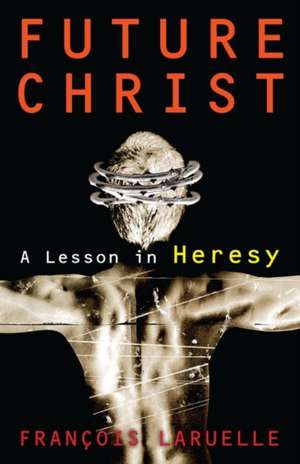
Future Christ
Autor Francois Laruelle Traducere de Anthony Paul Smithen Limba Engleză Paperback – 25 iul 2019
Preț: 128.52 lei
Preț vechi: 152.68 lei
-16%
Puncte Express: 193
Carte disponibilă
Livrare economică 07-21 noiembrie
Livrare prin curier în România Termenul estimat este afișat lângă disponibilitate.
Transport gratuit de la 400.00 lei Plată online sau ramburs, în funcție de opțiunile comenzii.
Retur gratuit în 14 zile Comandă securizată și suport în română.
Specificații
ISBN-13: 9781350060951
ISBN-10: 135006095X
Pagini: 184
Dimensiuni: 138 x 214 x 12 mm
Greutate: 0.22 kg
Editura: Bloomsbury Publishing
Locul publicării:London, United Kingdom
ISBN-10: 135006095X
Pagini: 184
Dimensiuni: 138 x 214 x 12 mm
Greutate: 0.22 kg
Editura: Bloomsbury Publishing
Locul publicării:London, United Kingdom
V-ar putea interesa
-
 Divine Teaching and the Way of the World: A Defense of Revealed ReligionSamuel Fleischacker-20%Preț: 354.31 lei444.30 lei
 -
 Kant's Elliptical PathKarl Ameriks-21%Preț: 356.79 lei450.34 lei
 -
 Religion Without GodRonald DworkinPreț: 264.71 lei
 -
 Laruelle and Non-PhilosophyJohn Mullarkey-17%Preț: 230.94 lei277.64 lei
 -
 Imagining the KingdomJames K. A. SmithPreț: 149.47 lei
 -
 The Highest Poverty: Monastic Rules and Form-of-LifeGiorgio AgambenPreț: 133.54 lei
 -
 Religion: Key Concepts in PhilosophyDr Brendan Sweetman-15%Preț: 232.80 lei272.54 lei
 -
 The Reality of God and the Problem of EvilFr Brian Davies-17%Preț: 321.67 lei388.94 lei
 -
 Theology in the Age of Global AIDS & HIVC. TrentazPreț: 383.15 lei
 -
 Principles of Non-PhilosophyProfessor Francois Laruelle-46%Preț: 276.92 lei517.00 lei
 -
 Understanding Jacques EllulJeffrey P. GreenmanPreț: 131.63 lei
 -
 Souls ExistRichard SchainPreț: 81.96 lei
 -
 The Evolving God: Charles Darwin on the Naturalness of ReligionProfessor J. David PleinsPreț: 205.33 lei
 -
 God's Final Victory: A Comparative Philosophical Case for UniversalismProfessor John Kronen-25%Preț: 278.18 lei369.61 lei
 -
 CS Lewis vs the New AtheistsPeter S. WilliamsPreț: 140.63 lei
 -
 A Manual for Creating AtheistsPeter BoghossianPreț: 168.46 lei
Caracteristici
Francois Laruelle is widely considered to be one of the most important and exciting voices in contemporary French philosophy - his profile and influence have increased significantly in recent years, yet his work has not yet been published in translation.
Cuprins
The Philosopher and the Heretic: Translator's Introduction \ The Triptych: Author's Foreword \ Glossary Raisonné: Rules for Writing Non-Philosophy (Vocabulary and Syntax) \ 1. Future Christianity \ 2. Introducing Philosophy to Heresy \ 3. The Past Foreclosed to Memory \ 4. Persecution and Revelation \ 5. The Last Prophet or Man-Messiah \ 6. Towards Non-Christian Science \ Bibliography \ Index
Recenzii
Smith has done an excellent job of making the text accessible ... For all thinking persons willing to dive deep into the core of religion or religious practices, this book is a must read.
Notă biografică
François Laruelle is a French philosopher formerly Professor of Contemporary Philosophy at the Université de Paris X (Nanterre) and the Collège International de Philosophie, France. He is the creator of the concept of 'non-philosophy' and author of over twenty works of philosophy.
Descriere
Descriere de la o altă ediție sau format:
Explores the lessons of heresy to construct a new understanding of 'belief'. This book draws on material from the traditions of Christianity, Judaism and Gnosticism, but he does so by suspending their authority. It introduces philosophy to the lessons of heresy and makes use of them in a non-philosophical dualysis of messianism and apocalypticism.
Explores the lessons of heresy to construct a new understanding of 'belief'. This book draws on material from the traditions of Christianity, Judaism and Gnosticism, but he does so by suspending their authority. It introduces philosophy to the lessons of heresy and makes use of them in a non-philosophical dualysis of messianism and apocalypticism.